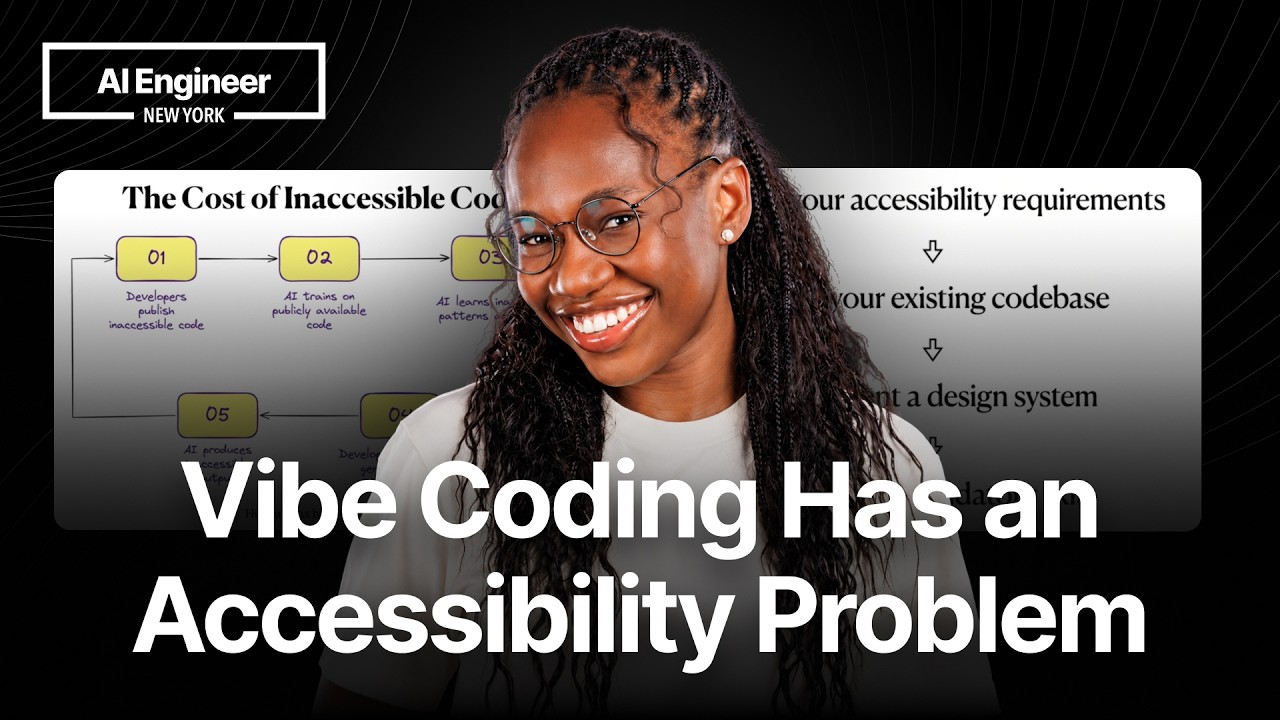
Jemima Abu’s talk, “The Cost of Accessibility in AI,” emphasizes the critical importance of building accessible AI-driven products. Accessibility means creating products usable by everyone, including people with disabilities. Jemima highlights that inaccessible products are essentially useless because they exclude a significant portion of users. Despite the rise of AI-generated code and prompt engineering, developers must prioritize human usability. She cites a study showing that 96% of top websites have accessibility issues, often because developers view accessibility as time-consuming. However, Jemima argues that with AI writing much of the code, making products accessible can actually be faster and cheaper.
Jemima shares an experiment where AI agents were tasked with implementing a design from Figma twice: once without accessibility guidelines and once with a dedicated accessibility skill. The results showed that the AI agent using accessibility skills completed the task faster and at 58% lower cost. This suggests that integrating accessibility from the start can reduce development time and expenses. She cautions that this was a single experiment and not definitive proof but uses it to illustrate how AI agents perform better with proper guidance and skills.
A major issue Jemima points out is that without explicit accessibility instructions, AI agents inherit human biases, often replicating inaccessible design patterns. Developers frequently adopt an “it works for me” mindset, neglecting accessibility testing for screen readers or other assistive technologies. Additionally, AI tends to generate verbose, redundant code when left unguided, recreating components from scratch instead of using semantic HTML elements. This leads to longer development times and more complex codebases. Jemima stresses that accessibility must be baked into the development process from the beginning, much like blueberries baked into a muffin rather than added afterward.
Jemima also discusses the broader consequences of ignoring accessibility. Businesses risk losing customers who cannot use their products, face legal repercussions under laws like the Americans with Disabilities Act, and incur higher costs due to refactoring and fixing issues late in development. Accessibility is a shared responsibility across all teams, from business and design to quality assurance. By prioritizing accessibility early, companies can avoid wasted effort, improve user experience, and reduce legal risks.
To ensure AI agents build accessible products, Jemima recommends defining clear accessibility requirements based on the platform, auditing existing codebases to fix pre-existing issues, and implementing reusable component systems. She advocates for enforcing mandatory accessibility skills for AI agents, such as using modern web standards and semantic HTML, minimizing ARIA use, ensuring keyboard operability, and labeling elements for screen readers. While AI tools help, manual testing remains essential. Ultimately, Jemima urges developers to build accessible solutions to maximize usefulness and inclusivity, making technology truly serve everyone.
Useful Links