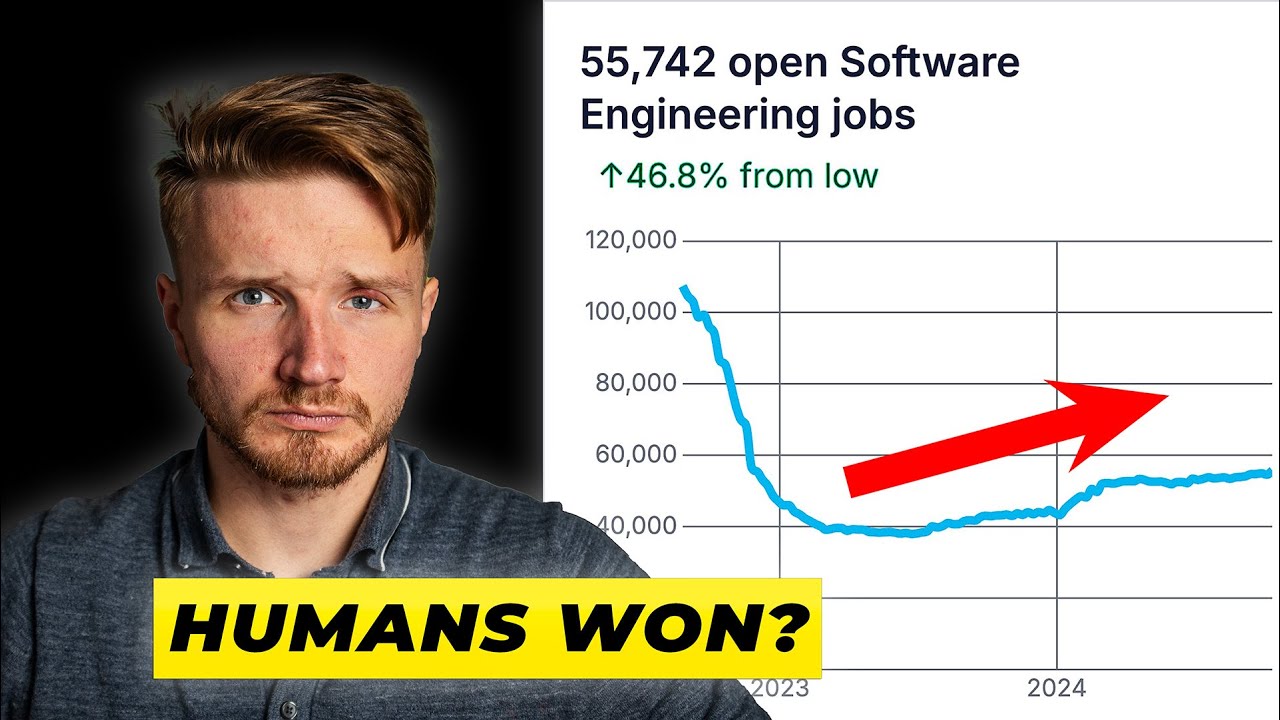
The video addresses the widespread belief that artificial intelligence, particularly large language models (LLMs) like ChatGPT, will soon replace programmers and make coding skills obsolete. The speaker notes that this narrative has been persistent since the release of advanced AI tools, with some claiming that software engineering jobs are doomed. However, after a few years of these technologies being available, actual job market data does not support the idea that AI is replacing programmers. While the number of open tech jobs dropped significantly from its peak, this decline was not primarily due to AI, and job openings have been steadily increasing as AI continues to improve.
One of the main reasons AI is not replacing programmers is that its usefulness is often overestimated, especially by beginners. While AI tools can handle simple coding tasks and are incredibly helpful for speeding up development, they are not capable of replacing the complex, creative, and novel problem-solving required in real-world software engineering. LLMs do not “think” like humans; instead, they generate responses based on patterns in their training data. When faced with new, unique problems that haven’t been encountered before, AI tools struggle because they lack true understanding and reasoning abilities.
The speaker also points out that, in practice, AI is often not as effective as it is hyped to be. Many AI-powered features, such as customer support chatbots, frequently fail to provide satisfactory solutions to users’ specific problems. In software development, AI can quickly generate basic applications, but it breaks down when dealing with large, unique codebases or complex requirements. Experienced engineers find that for most real-world tasks, especially those involving innovation or highly specific needs, human expertise is still essential.
Historically, new technologies have always sparked fears of job loss, but humanity has consistently adapted by creating new roles and shifting to higher-level tasks. The introduction of AI is no different. While some low-level programming tasks may be automated, this leads to the emergence of new jobs, such as AI engineers who specialize in integrating and maintaining AI systems. As productivity per worker increases, the total output of the tech industry grows, resulting in more opportunities rather than fewer.
In conclusion, the video argues that fears of AI replacing programmers are overblown and not supported by current evidence. AI is a powerful tool that can enhance productivity but cannot replace the creativity, problem-solving, and adaptability of human engineers. The speaker encourages aspiring developers to continue learning to code and to adapt by acquiring skills in AI integration, as these will be increasingly valuable in the evolving tech landscape. The key takeaway is that programmers should embrace AI as a tool rather than fear it as a replacement.