Rushabh Doshi, founder of Machinecraft, shares the story of how his 100-person factory in India built a unique AI system to preserve and manage the company’s knowledge without a dedicated data science team or large ML budget. The company’s critical knowledge—customer details, past quotes, and custom machine tweaks—had traditionally lived in the minds of three generations of family leadership. This reliance on human memory was risky, as employee turnover meant valuable information was constantly at risk of being lost. To solve this, Rushabh envisioned creating a digital brain that could remember and manage this knowledge autonomously, rather than relying on static documents or traditional chatbots.
Machinecraft manufactures thermoforming machines used across diverse industries, each with distinct customer needs. This complexity meant their AI brain had to understand multiple “universes” of customers and products. Instead of training a custom AI model, they fed years of internal documents, emails, quotes, and drawings into off-the-shelf language models, which extracted facts and stored them as vectors and relationships in a graph database. This approach created a highly organized memory system rather than a single smarter AI model, enabling the company to build a digital twin of their knowledge base.
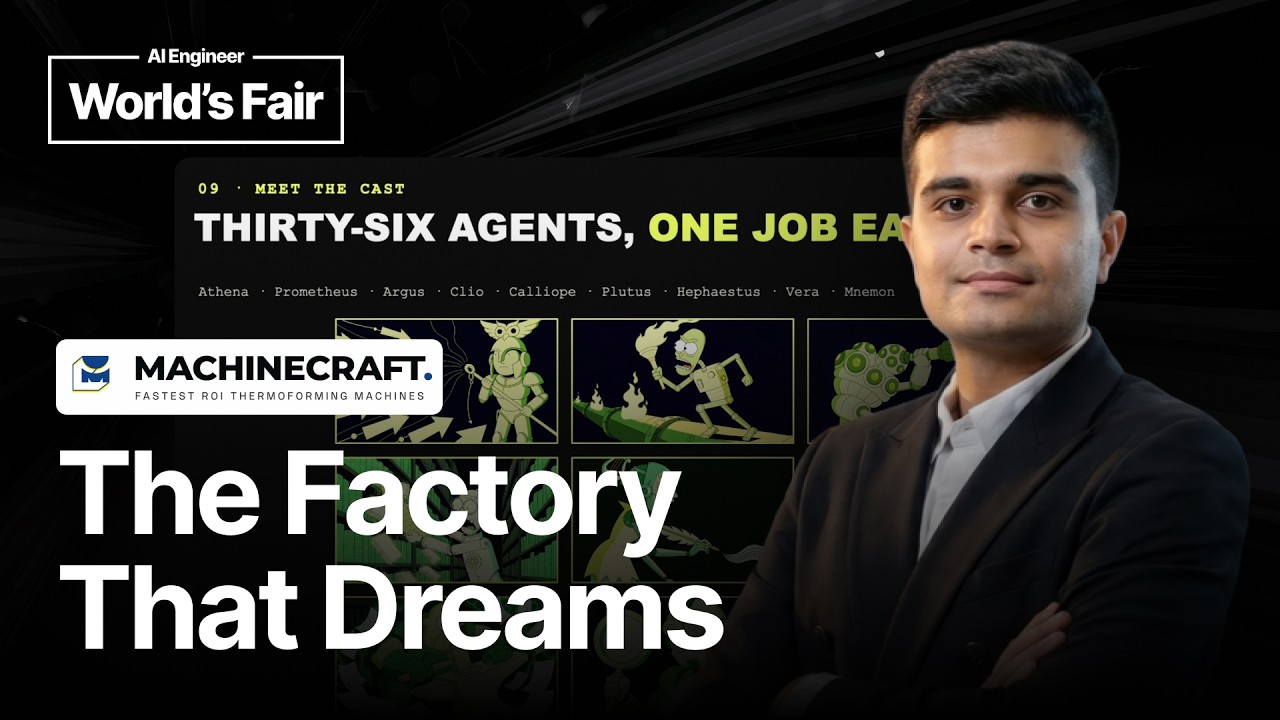
The AI system, named Eira, is composed of 36 specialized agents, each responsible for a specific task such as sales, pricing, fact-checking, or machine specifications. These agents collaborate like a boardroom, debating and arriving at consensus answers without ego or fatigue. Eira handles nine core daily business functions, including outbound emails, account briefs, quotations, lead revival, and inbound reply management. All interactions happen through a single interface where Eira drafts communications and humans approve them, ensuring control and accuracy.
A key innovation is Eira’s engineered memory system, which operates in layers: working memory for recent interactions, pinned facts, episodic memories of conversations, and a salience gate that filters what is worth remembering. The system also features a nightly “dream cycle” where it reviews the day’s data, consolidates useful information, corrects contradictions, and forgets irrelevant details, effectively making the AI smarter overnight. Each agent follows a “conscience” based on the company’s ethical principles, emphasizing truthfulness, cross-checking, and collaboration, ensuring the AI remains reliable and aligned with the company’s values.
Financially, the project was highly cost-effective, built for around $30,000 compared to a $230,000 agency quote, and runs on modest monthly cloud costs. Machinecraft has open-sourced the architecture as Brain OS, an empty nervous system that other companies can customize with their own data to build their own AI brains. Rushabh encourages other businesses to create their own systems to preserve institutional knowledge, emphasizing that while AI tools exist, only the company itself can truly build and maintain its digital brain.