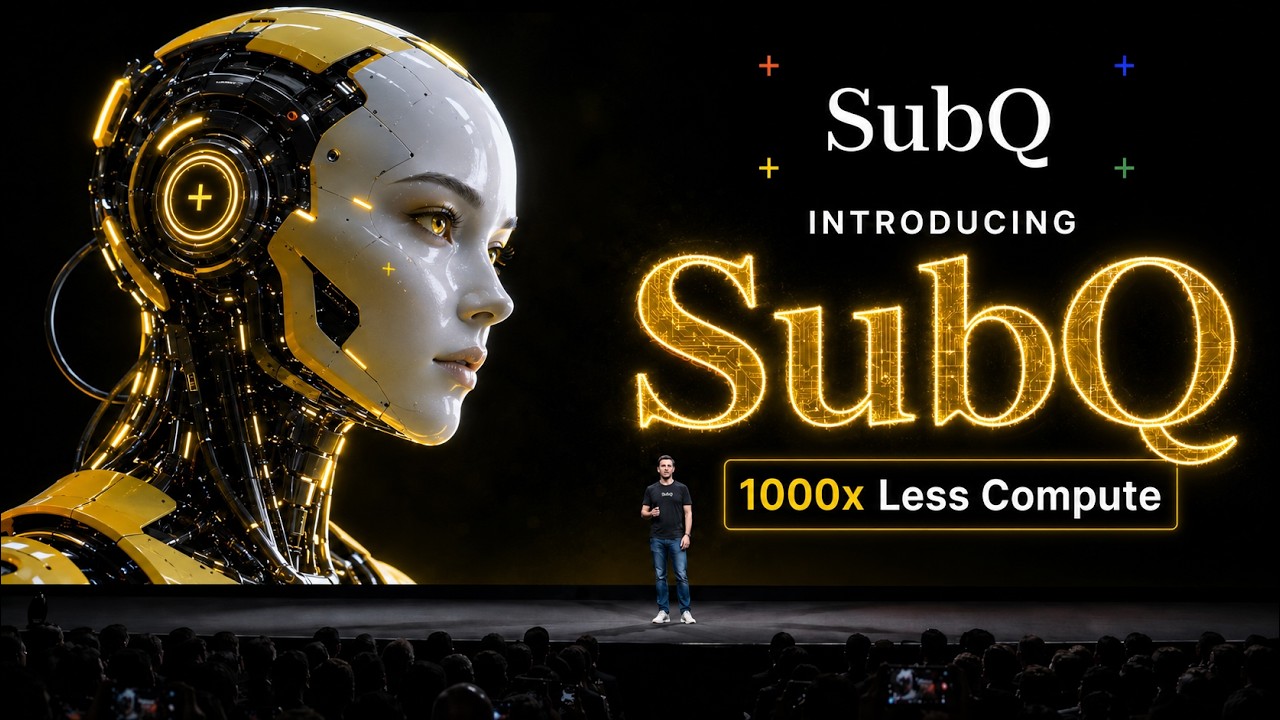
The video discusses a major breakthrough in large language model (LLM) architecture called SubQ, which introduces the world’s first fully sub-quadratic sparse attention mechanism. This innovation enables SubQ to handle an unprecedented 12 million token context window, making it 52 times faster than flash attention and less than 5% of the cost of comparable models like Opus. Traditional transformer-based LLMs suffer from quadratic scaling in attention computation, meaning that as the input length doubles, the computational cost roughly quadruples. SubQ addresses this inefficiency by focusing only on the most relevant word-to-word relationships, reducing compute requirements by nearly 1,000 times at large context sizes.
SubQ’s core technology, sub-quadratic sparse attention (SSA), differs from previous sparse attention methods by selecting relevant tokens based on content rather than position. This allows the model to attend to important information even if it is millions of tokens away, without sacrificing accuracy. Unlike other approaches that approximate attention or compress memory, SSA performs exact attention calculations on a small subset of tokens, maintaining high-quality results. The model has demonstrated strong performance on complex retrieval tasks, scoring near-perfect on multi-step reasoning tests and reliably extracting specific facts from extremely long documents.
Despite its focus on long context capabilities, SubQ also holds its own on standard benchmarks such as graduate-level science exams and competitive programming challenges, performing close to top-tier models like GPT-4.5. The model was developed by adapting an existing frontier open-weight model, replacing its dense attention with SSA, and then training extensively on naturally long documents and code repositories. This training on long-context data was made feasible by the efficiency gains of SSA, enabling over 100 times more long-context training runs than previously possible.
The practical implications of SubQ are significant, particularly for enterprise use cases that require reasoning over entire codebases, large collections of contracts, or comprehensive financial filings in one go. This capability could eliminate the need for complex retrieval pipelines and fragmented document processing, making tasks like legal contract analysis, financial due diligence, and software engineering more efficient and accurate. Cost-wise, SubQ reportedly performs long-context evaluations at a fraction of the cost of existing models, potentially democratizing access to large-scale AI reasoning.
However, the breakthrough is met with cautious optimism. While the company’s internal benchmarks and third-party verification by Appen support the claims, the model weights are not publicly available, and independent replication of the efficiency gains is pending. Sparse attention methods also tend to excel primarily on very long inputs, with less evidence of benefits on typical short prompts used in everyday applications. The coming months will be critical as design partners and independent researchers test SubQ in real-world scenarios to validate its performance and cost advantages. If successful, SubQ could represent a fundamental shift in how LLMs scale and operate.