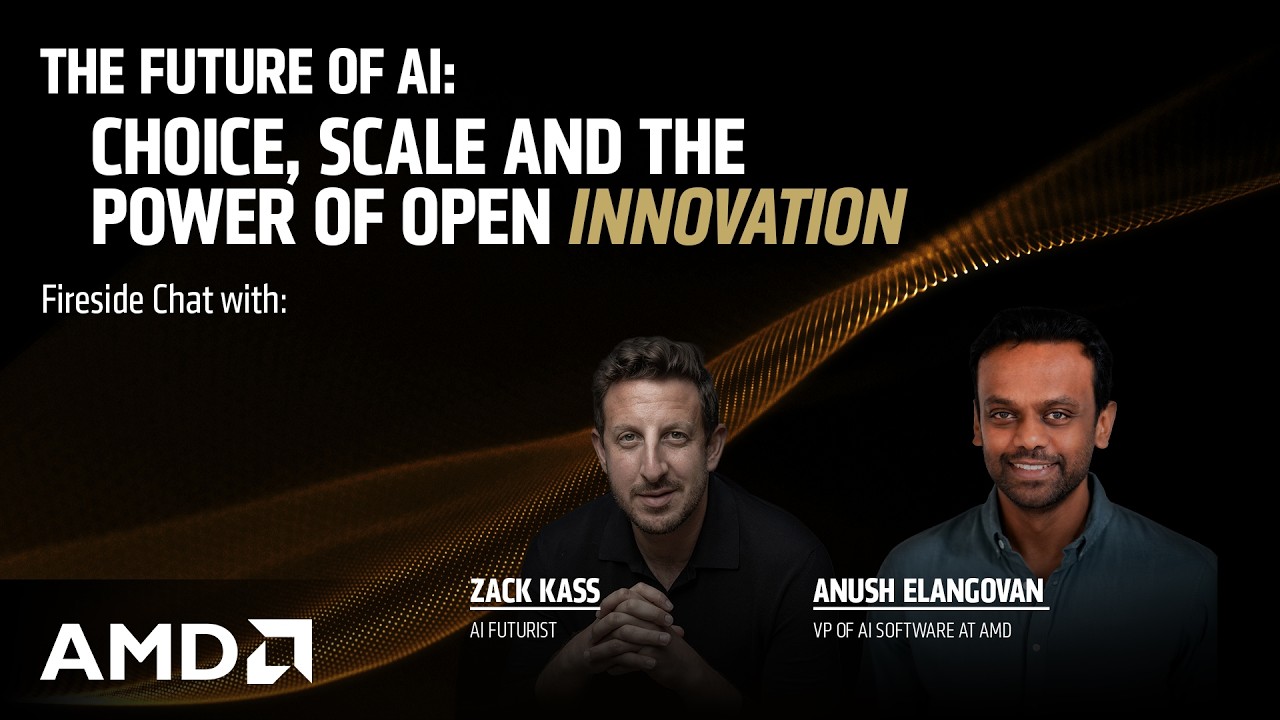
In this insightful fireside chat, Zack Kass, a global AI advisor and former head of Go to Market at OpenAI, interviews Anush Elangovan, VP at AMD, about the future of AI software and AMD’s role in advancing open-source AI technologies. Anush highlights AMD’s transition from primarily hardware manufacturing to embracing a software-first philosophy, emphasizing open-source methodologies that enable better integration and performance of AI models on AMD hardware. He discusses recent achievements like porting ROCm to Mac systems and the impressive capabilities of AMD’s Ryzen Max Strix Halo for running local AI models, underscoring the company’s commitment to empowering developers with accessible and efficient AI tools.
Anush elaborates on the evolving landscape of AI hardware and software, noting the emergence of specialized silicon for low-power AI inference and the increasing importance of software as “tokens and time.” He stresses the significance of co-designing hardware and software to achieve seamless, high-performance AI systems. Rather than betting on specific breakthroughs, Anush advocates for adaptability and speed in responding to technological changes, viewing AI agents capable of reasoning and understanding as the next frontier that will transform how developers interact with AI.
Addressing concerns about building forward-compatible AI solutions, Anush advises embracing the ephemeral nature of software in the AI era. He encourages engineering leaders to focus on outcomes and design autonomous, agile teams akin to “seal teams” that can rapidly execute missions. On the topic of vendor lock-in and model selection, he champions AMD’s open-source philosophy as a means to foster collective intelligence and innovation. He likens the current AI ecosystem to the early days of electricity, emphasizing that the focus should be on how AI is applied rather than the underlying model or infrastructure.
Anush also discusses AMD’s multi-generational investment in CPUs, GPUs, NPUs, and FPGAs, highlighting the importance of seamless integration across these accelerators to optimize AI workloads. He predicts that in the near future, both CPUs and GPUs will be fully utilized for AI inference, with intelligent routing between devices based on task requirements. He shares his personal journey into software and hardware engineering, underscoring a bottoms-up, first-principles approach that continues to influence AMD’s development of ROCm, AMD’s open compute platform for AI.
Looking ahead, Anush envisions ROCm becoming as seamless and transparent as a web browser, supported by AI agents that automate complex tasks like installation and upgrades. He acknowledges the challenges and perceptions around ROCm’s maturity but invites developers to reassess it based on current capabilities. On questions from the community, he expresses optimism about making frontier-class AI models accessible locally and cost-effectively, the future role of NPUs, and AMD’s competitive stance against innovations like Intel AMX. The conversation closes with a mutual appreciation and a commitment to revisit these evolving topics in the future.