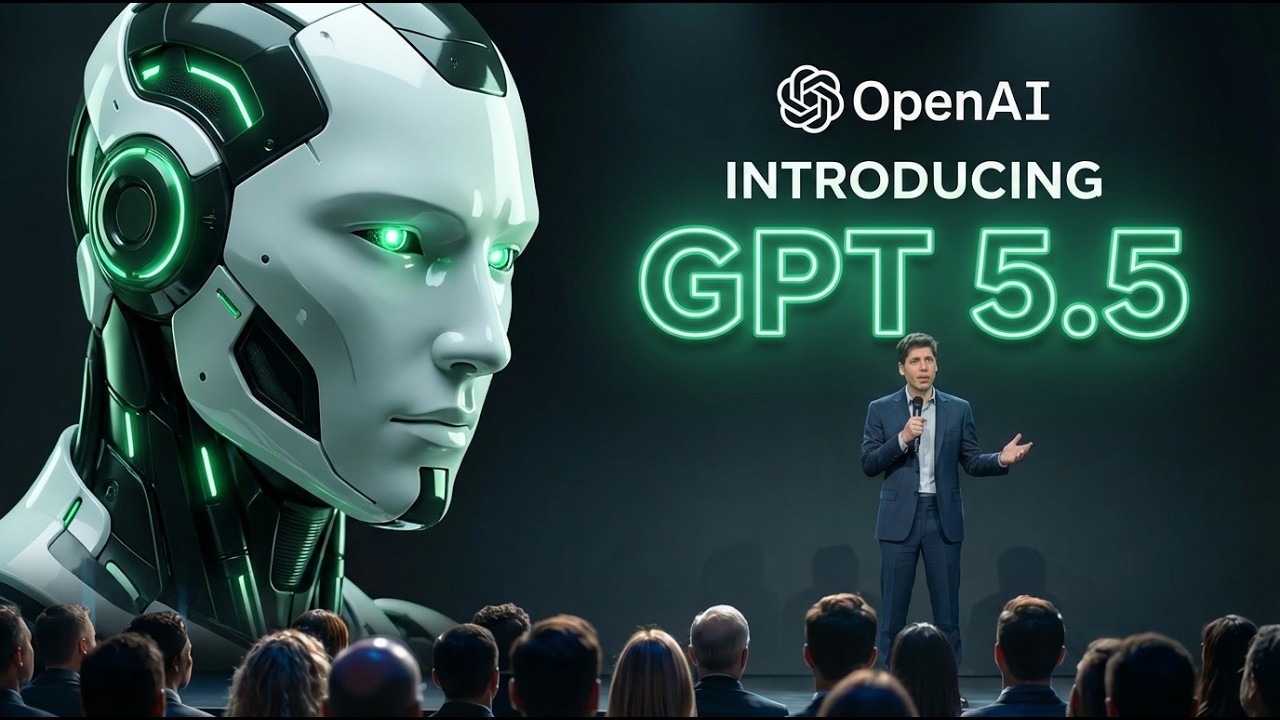
The video discusses recent leaks and insights about OpenAI’s upcoming GPT 5.5 Pro model, also referred to as GPT Spud or GPT6 by some. The presenter shares clips of Greg Brockman, OpenAI’s co-founder, who highlights that the new model will be significantly more capable than current versions. Brockman emphasizes that GPT 5.5 will solve harder problems, understand instructions and context better, and offer a qualitative leap in usability, making AI interactions smoother and more intuitive. The model is expected to raise both the performance ceiling and the baseline utility for users, enabling more complex and long-term problem-solving.
The development of GPT 5.5 has reportedly taken around two years, indicating a completely new base model rather than a minor update or distillation. This extended research and training period suggests a substantial step forward in AI capabilities. The presenter notes that this model is part of a continuous improvement engine at OpenAI, with each release building on the last. Early feedback from people who have previewed GPT 5.5 describes it as an “incredible model” on par with Anthropic’s Mythos, a leading competitor, suggesting that OpenAI may regain or strengthen its position in the AI race.
Benchmark comparisons reveal that while GPT 5.4 and Anthropic’s Opus 4.7 are currently close in performance, GPT 5.5 is expected to surpass Opus by about 10-15% across various tasks. This improvement could put OpenAI back in the lead, especially in enterprise and coding applications where Anthropic currently excels. The model is rumored to have native multimodal capabilities, allowing it to process different types of inputs more seamlessly, although the presenter remains cautious about this claim based on past OpenAI developments. GPT 5.5 is also described as an autonomous digital worker, capable of deep reasoning and enterprise workflow automation, moving beyond the more limited coding-focused GPT 5.4.
Leaked outputs from early testing show impressive advancements in coding, application generation, and even game development, with GPT 5.5 producing more coherent and detailed results than previous models. Examples include one-shot generation of complete applications and a Minecraft clone, demonstrating the model’s enhanced reasoning and coding skills. These improvements could challenge Anthropic’s dominance in coding-related AI tasks. Additionally, OpenAI is expected to release an upgraded image generation model, Images V2, which reportedly outperforms competitors like Nano Banana Pro in certain edge cases, offering better style, detail, and fidelity.
Overall, the video paints a picture of GPT 5.5 Pro as a major evolution in AI technology, combining faster, more nuanced understanding with broader multimodal and autonomous capabilities. The model aims to serve as a powerful digital assistant for complex enterprise tasks, coding, and creative applications. While some claims remain speculative, early user feedback and leaked benchmarks suggest that OpenAI is poised to make a significant leap forward with this release. The presenter concludes by highlighting the rapid pace of AI progress and the exciting potential of these new tools for both developers and end-users.