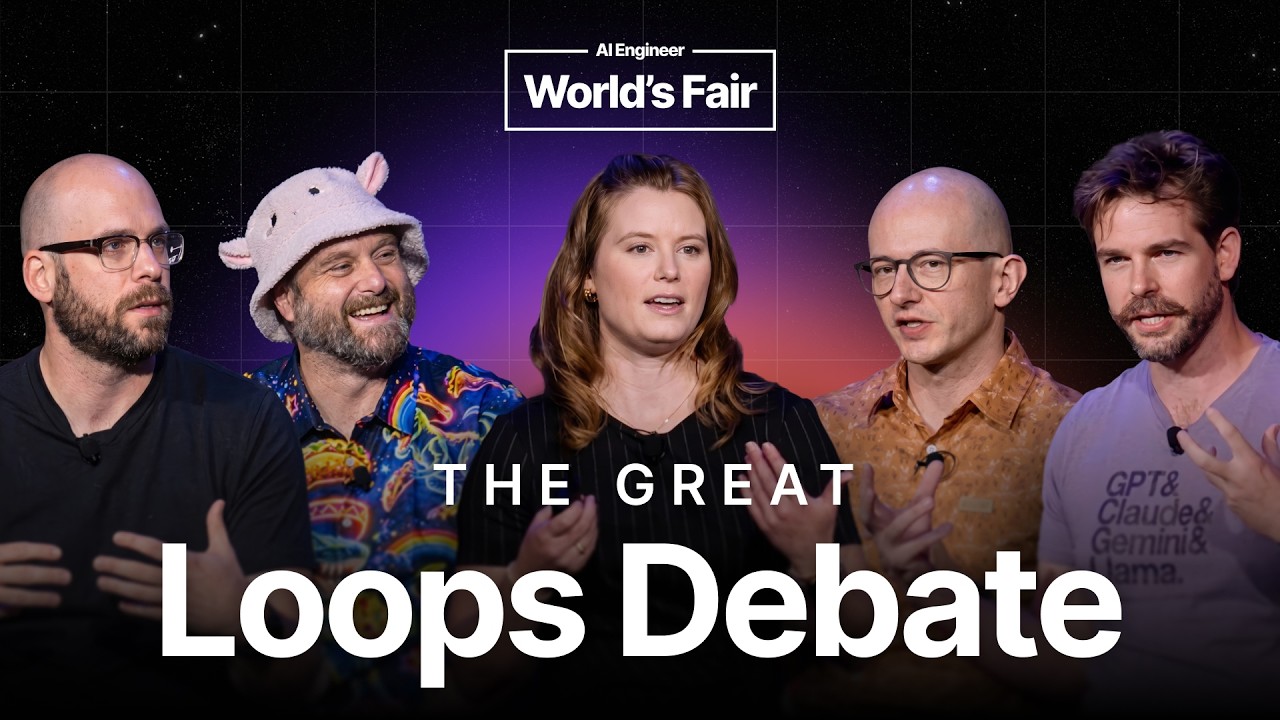
The Great Loops Debate, hosted by Ali Howard, brought together experts Ian Livingston, Jeff Huntley, Dex Horthy, and Greg Kostruba to discuss the current state and future of loops in software engineering. The debate centered on whether the hype around loops matches their practical effectiveness and if loops represent a significant inflection point toward fully autonomous software factories. Ian and Jeff argued that loops are already a core and effective part of engineering, enabling automation and productivity gains, while Dex and Greg contended that the hype outpaces reality, emphasizing the need for more discipline and caution in loop adoption.
Jeff Huntley highlighted the inevitability of loops, citing his experience with the Ralph loop and the growing acceptance of loops as a programmable substrate that can automate repetitive engineering tasks. He acknowledged that loops are not a silver bullet but stressed their practical benefits, such as reducing manual coding and accelerating tasks like product management research. Dex Horthy countered by comparing loops to Kubernetes, noting that while loops have potential, the hype often overlooks the complexity and discipline required to make them truly effective. He emphasized that loops cannot yet replace human judgment, especially in verifying the correctness and quality of code.
Ian Livingston framed software engineering itself as a series of loops—try, learn, apply—and argued that loops are a natural evolution in expediting this process by offloading human judgment to AI models. He suggested that as human interaction with software decreases, software becomes more verifiable and loop-driven. Greg Kostruba expressed skepticism about the current state of loops, pointing out issues with code quality, economic viability, and the limitations of AI-generated code. He acknowledged that loops have their place but warned against overreliance on them without sufficient verification and human oversight.
The debate also explored technical challenges such as context window limitations, verification of loop outputs, and access control in shared memory stores used by multiple agents. Jeff and Dex discussed strategies like pre-commit hooks and managing context windows to keep loops effective, while Ian highlighted the need for new attribution and liability models as agents increasingly generate code. The panel agreed that while loops can accelerate certain verifiable tasks, fully autonomous software factories remain a future goal requiring advances in model intelligence, verification methods, and engineering discipline.
In closing, the participants reflected on the balance between hype and practical adoption. Greg urged caution and experimentation to find what works without succumbing to hype, while Ian emphasized the competitive necessity of embracing loops to stay relevant. Dex advocated for pragmatic, incremental improvements rather than chasing unrealistic speedups, and Jeff encouraged engineering rigor to keep loops on track. The debate concluded with an audience vote, underscoring the ongoing discussion about the role of loops in the evolving landscape of software development.