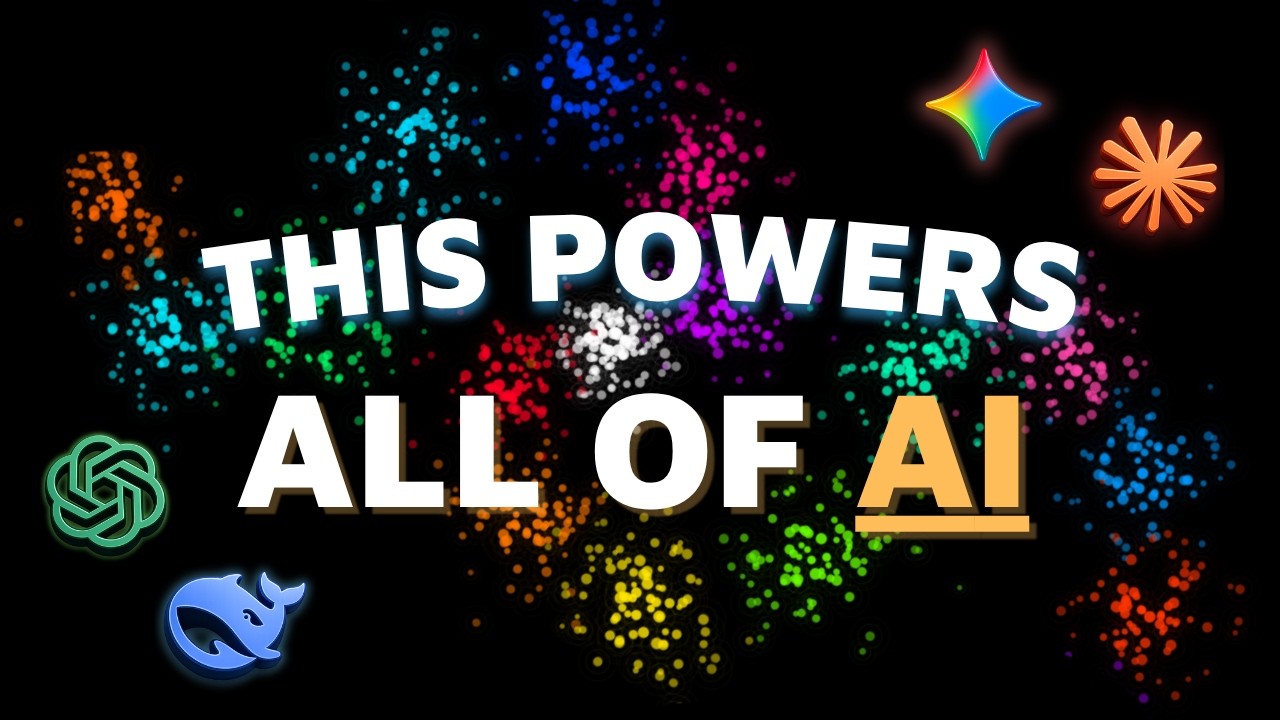
The video reveals a fundamental concept underlying every impressive language model: a hidden, multi-dimensional map of meaning. This map is not manually created but emerges naturally as the model processes vast amounts of human-written text. Each word is assigned a precise location in this high-dimensional space, where words with similar meanings cluster together. This spatial organization is crucial—without it, language models like GPT, Gemini, Claude, and Grok would cease to function effectively.
Traditional methods of representing words, such as assigning unique ID numbers or using one-hot encoding, fail to capture the nuanced relationships between words. Unique IDs treat words as isolated labels, making unrelated words appear equally distant, while one-hot encoding creates a meaningless geometric space where all words are equidistant. In contrast, the embedding map treats words as points in space, where the distance and direction between points encode semantic relationships, allowing the model to understand context and similarity.
The video illustrates how this embedding space organizes words along multiple dimensions, each representing different aspects of meaning like temperature, emotion, or geography. Remarkably, the model discovers complex relationships such as the analogy between capitals and countries purely from text patterns, without explicit instruction or external knowledge. This geometric structure is invariant under rotation, meaning the relative relationships hold regardless of how the space is oriented, emphasizing that the actual directions are less important than the distances and parallels.
Furthermore, the video highlights that embedding spaces from different languages independently develop strikingly similar structures. For example, English and French models place related words like “dog” and its neighbors in comparable geometric neighborhoods, suggesting that these maps reflect underlying concepts rather than language-specific features. This points to a universal geometry of meaning that transcends linguistic boundaries, shaped by the shared contexts in which concepts appear across languages.
Finally, the video explains that this map is not the product of deliberate design but emerges through the model’s training objective: predicting the next word in a sentence billions of times. Each prediction subtly adjusts word positions, gradually forming a coherent semantic landscape. This process mirrors how humans learn language—inferring meaning from context rather than explicit definitions. Ultimately, while the model was built to predict words, it inadvertently uncovered a profound structure underlying thought and language itself.