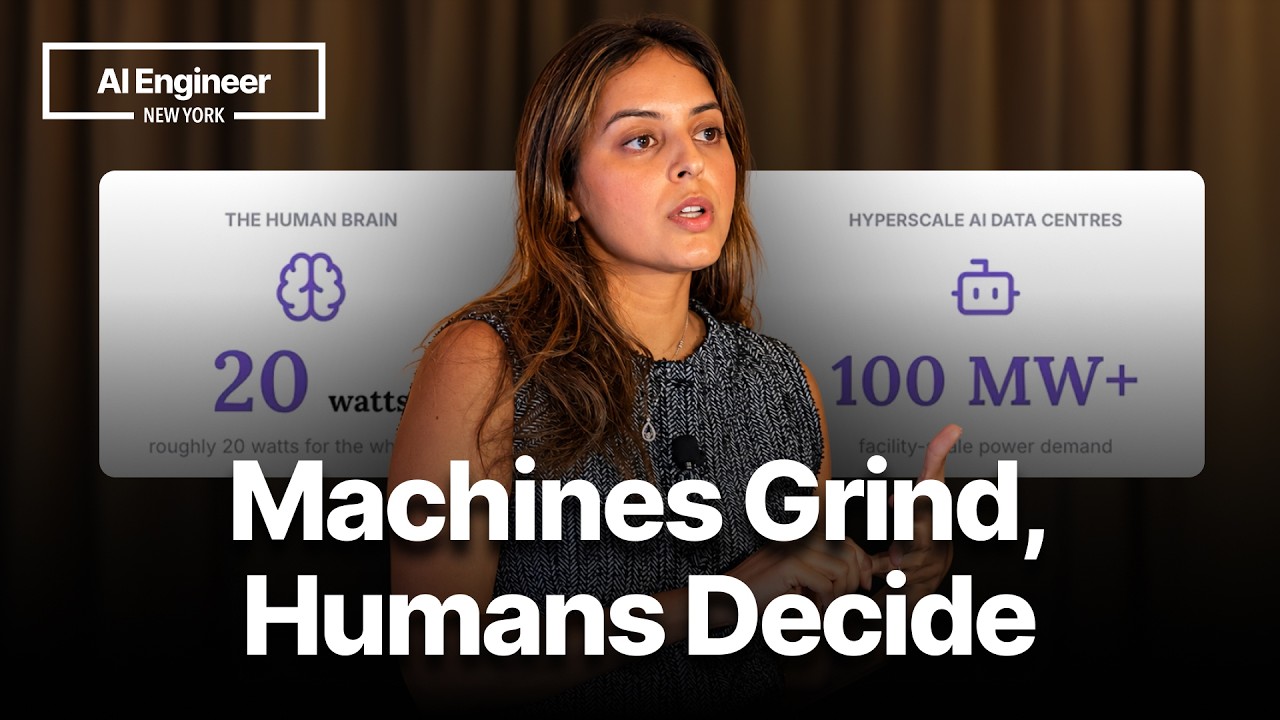
Anekha Sokhal, founder of Moshi, emphasizes that the true edge for investors lies in the knowledge and intuition developed through experience, which AI should augment rather than replace by handling data-intensive tasks. Moshi serves as a 24/7 quant analyst that processes vast market data to provide reliable, traceable insights, enabling investors to focus on decision-making while preserving human judgment and accountability.
Anekha Sokhal, founder and CEO of Moshi, discusses the challenges financial investors face in managing overwhelming amounts of data and how AI can be leveraged to assist rather than replace human decision-making. She highlights the paradox of having access to vast data but limited attention, emphasizing that more data does not necessarily translate to better information. With the exponential growth of data, investors struggle to synthesize relevant insights, and the true edge lies in the knowledge and intuition that resides in their heads, built over years of experience.
Sokhal draws on her unique background as both a derivative trader and a machine learning expert to explain the limitations of current AI systems compared to the human brain. The brain operates with remarkable efficiency and complexity, far surpassing the power consumption and capabilities of existing AI models. She questions the common approach of trying to replace human judgment with AI, proposing instead that AI should augment human decision-making by handling the data-intensive tasks that humans find tedious.
The core of an investor’s edge is the ability to anticipate market movements, identify blind spots, and have conviction in decisions. However, since everyone has access to similar data and models, the real differentiator is the tacit knowledge embedded in an investor’s mind. This knowledge is at risk of being lost when experienced investors leave or retire. Sokhal stresses the importance of understanding the investor’s workflow, which involves continuous market monitoring, contextualizing events, and synthesizing information before making decisions.
Moshi, the product Sokhal introduces, is designed as a 24/7 quant analyst that processes vast amounts of market data and investor-specific information to support traders. It uses multiple deterministic agents to monitor and analyze data continuously, providing trustworthy, traceable insights that help investors focus on decision-making rather than data gathering. Moshi aims to replicate the institutional-grade analysis typically available only to large firms, making it accessible to individual traders and smaller teams.
Ultimately, Sokhal argues that AI should not replace the human brain but feed it with relevant, reliable information to enhance judgment. She points out the risks of relying solely on AI agents for decisions in finance, where accountability and trust are crucial. Moshi embodies this philosophy by combining machine efficiency in data processing with human expertise in decision-making, offering a new paradigm for financial analysis that preserves the invaluable edge residing in the human mind.