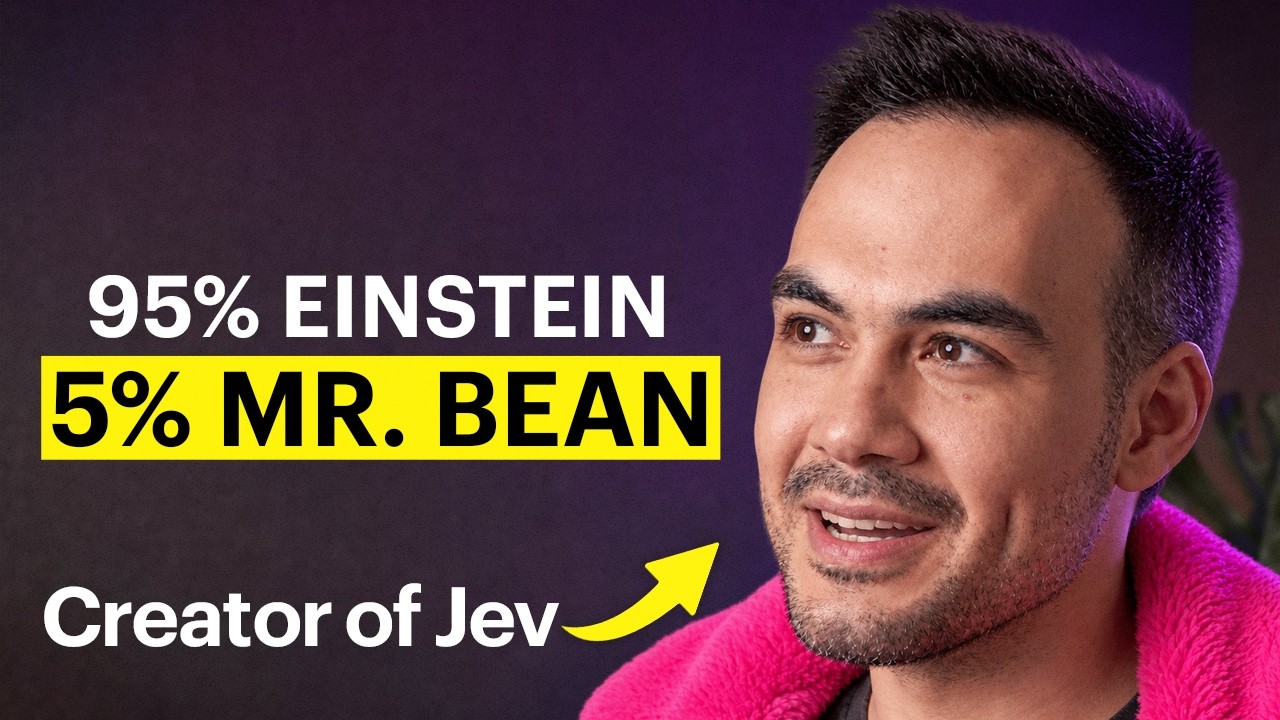
The video features an in-depth conversation with Jo, CEO of Typesafe, the company behind Jev, a groundbreaking AI model that has rapidly gained attention and adoption in the AI community. Jev represents a new paradigm in AI, focusing on “machine native intelligence” rather than traditional large language models (LLMs) like ChatGPT. Unlike LLMs that excel at generating text (system two thinking), Jev specializes in system one tasks—quick, intuitive decisions that are crucial for embedding intelligence directly into software workflows. This approach enables more reliable, composable, and programmable AI that can be integrated seamlessly into enterprise applications, offering faster, cheaper, and more controllable automation.
Jo explains that Jev is fundamentally different from existing AI models because it outputs probabilities and classifications rather than text, allowing developers to build precise, legible decision-making systems. This contrasts with LLMs, which often require complex natural language prompts and can be prone to errors, over-refusals, and stylistic repetitiveness due to their training with Reinforcement Learning from Human Feedback (RLHF). Jev’s training involves a novel method called RLCD, designed specifically to optimize for machine native intelligence, addressing the shortcomings of RLHF and RLVR (Reinforcement Learning from Verifiable Rewards) by focusing on reliability, calibration, and automation potential.
The discussion highlights the limitations of current AI approaches, particularly the overpromise and underdeliver problem caused by RLHF, which makes models appear smarter than they are in practical automation tasks. Jev’s approach bypasses the slow, resource-intensive pre-training phase common in LLMs, instead leveraging a combination of open-weight models and innovative training techniques to achieve high intelligence density and robustness. Jo emphasizes that Jev is not a narrow or simplistic classifier but a general-purpose, programmable intelligence layer that can handle any task LLMs can, but with greater efficiency and composability.
Addressing the wave of copycat models emerging shortly after Jev’s launch, Jo acknowledges that while many have replicated the interface or superficial aspects, few have matched the robustness and reliability of Jev’s intelligence. He critiques the AI community’s focus on benchmarks, arguing that they often mislead users and do not reflect real-world automation capabilities. Instead, Jo advocates for practical, product-driven development that prioritizes solving real problems over chasing academic metrics. Typesafe’s strategy involves maintaining control through an API to ensure quality and rapid iteration, with open-source considerations still under discussion.
Finally, Jo shares his broader perspective on AI’s future, rejecting the notion of rapid recursive self-improvement (RSI) and warning against inflated expectations fueled by current hype. He believes AI has a vast untapped potential to revolutionize software by embedding reliable intelligence at every level, akin to how logic gates transformed computing. Jev aims to catalyze this evolution by making AI ubiquitous, affordable, and trustworthy for automation, ultimately driving a new era of “intelligence per dollar” that will unlock unprecedented productivity and innovation across industries.
Useful Links