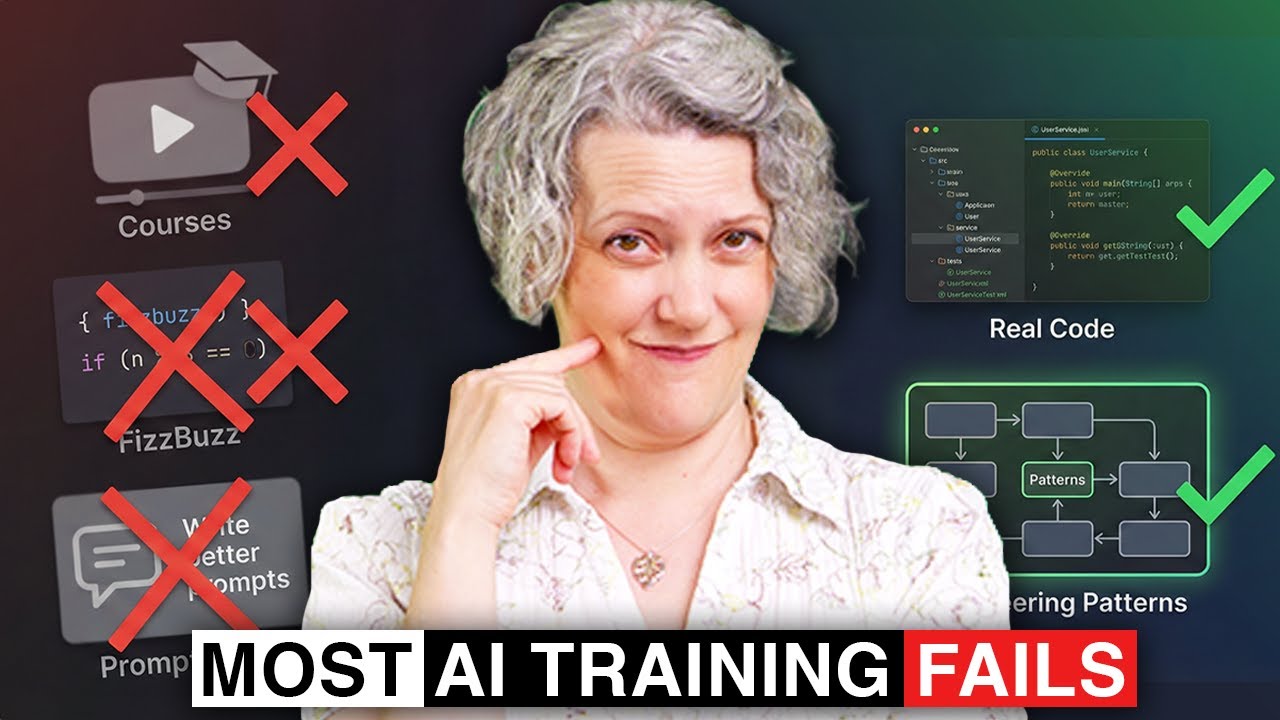
The video discusses the transformative impact of agentic AI on software development, comparing its significance to the shift from assembly to high-level languages. The presenter, Emily B., emphasizes that developers can no longer ignore AI tools, as they are rapidly becoming integral to the field. However, she notes a gap in effective training: while many courses teach how to integrate AI features or use specific tools, there is little guidance on developing generalizable skills for working with agentic AI in everyday software engineering.
Emily draws parallels to previous paradigm shifts, such as the adoption of object-oriented programming, where lack of proper training led to poor code quality. She argues that, similarly, developers need expert-led training to fully leverage agentic AI, but finding true experts is challenging due to the technology’s novelty. Agentic AI differs from earlier AI tools by being capable of autonomously handling entire tasks, running tests, researching, and updating code across repositories, fundamentally changing developers’ workflows.
Traditional teaching methods, like coding exercises (code katas) and small project examples, fall short when training for agentic AI. These exercises are either too simple for AI tools or suffer from data leakage, as large language models can reproduce solutions from their training data rather than genuinely solving new problems. This makes it difficult to teach developers how to use agentic AI effectively in real-world, novel scenarios.
Emily explores the idea of using design patterns—specifically, patterns for prompt engineering and augmented coding—as a more effective way to teach these skills. She critiques older resources, like Addy Osmani’s book, for being quickly outdated as AI capabilities advance. Instead, she recommends newer, experience-based augmented coding patterns compiled by researchers like Laura Kallstrom and Iet Erdog, which address current limitations and best practices for working with agentic AI.
In conclusion, Emily advises developers to focus on core software engineering principles—optimizing for learning and managing complexity—while adopting a test-driven development mindset. She suggests that prompt engineering, or more broadly, augmented coding, is an essential skill for working with agentic AI. Developers should seek coaching and learn from experts in real production environments, experiment with the latest augmented coding patterns, and stay updated as the field evolves rapidly.