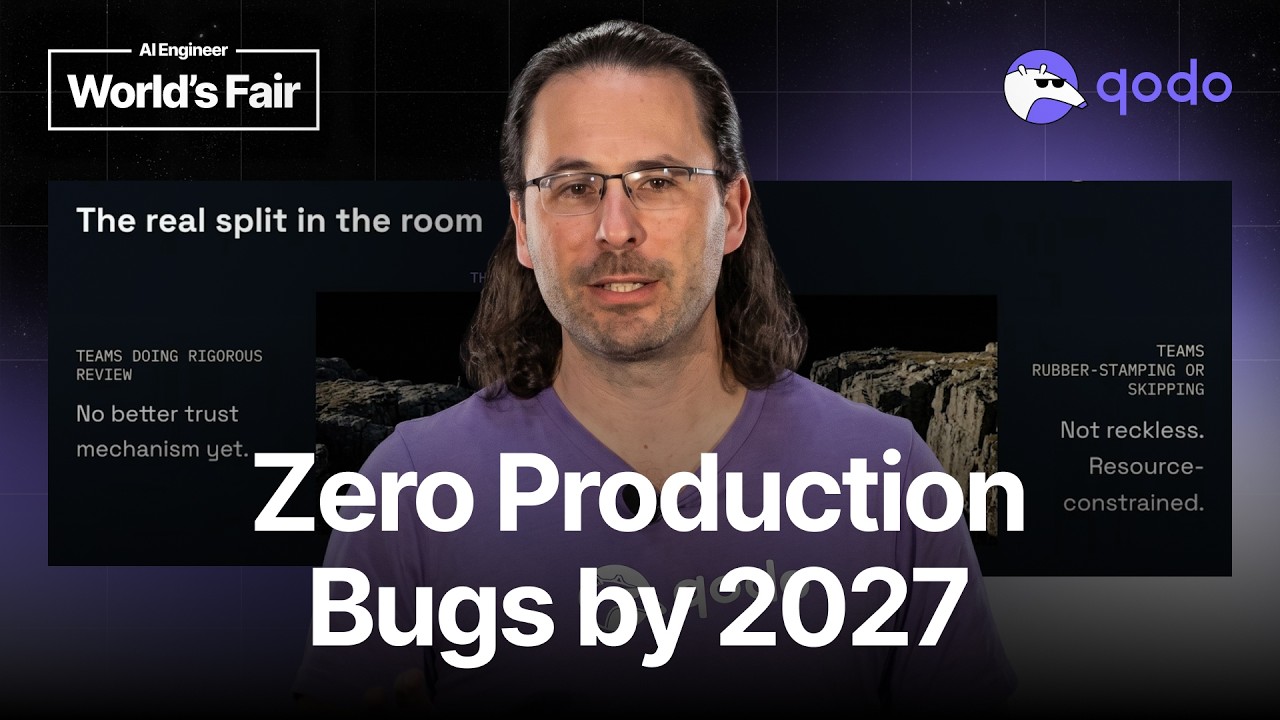
In his talk, Itamar Friedman, CEO and co-founder of Qodo, addresses the evolving landscape of code review in the age of AI-generated code. He begins by emphasizing the dual purpose of code reviews: ensuring code quality, safety, and adherence to architectural standards, and fostering alignment and learning among developers. Friedman highlights the current challenges teams face, questioning whether human code review will remain mandatory by the end of 2026 or if automation can fully replace it. He notes a divide in industry approaches—some teams prioritize speed and are willing to fix bugs post-deployment, while others insist on thorough human review to maintain trust and quality.
Friedman argues that the main barrier to fully automated code review is not the capability of AI models themselves, which have improved significantly, but the lack of proper context. Effective code review requires deep contextual understanding, including team-specific rules, standards, and the unique tribal knowledge embedded within an organization. This context is often scattered across documentation, communication platforms, and developers’ minds, making it difficult for AI tools to consistently deliver trustworthy results. He stresses the need for a governance layer that consolidates this context to enable reliable AI-driven code review.
To build this governance, Friedman proposes creating a “context engine” that codifies human knowledge, best practices, and architectural insights in a way that is accessible both to humans and AI agents. This involves collecting and structuring rules and standards, as well as capturing historical data about bugs, outages, and architectural dependencies. By doing so, organizations can provide transparent, auditable feedback during code reviews, fostering trust in automated systems. He illustrates this with examples of tools that link code review comments to specific rules and enable AI agents to collaborate and learn from past fixes.
Friedman envisions a future where code review evolves from examining individual pull requests to managing the entire software development lifecycle through a comprehensive software graph. This graph would visualize dependencies, contracts, and potential conflicts across multiple PRs, enabling smarter decision-making about approvals and blocks. Achieving this requires continuous learning from peer history, production incidents, and developer discussions, gradually automating approval processes while maintaining human oversight. The ultimate goal is to reach a state where critical bugs and outages are eliminated, and AI tools embody not just intelligence but “artificial wisdom.”
In conclusion, Friedman calls for organizations to take ownership of their code governance by codifying their unique standards and tribal knowledge into systems that support both human and AI collaboration. He stresses that the transition to trustworthy automated code review is a gradual process that demands real-time context, governance infrastructure, and analytics. Qodo’s mission is to help teams reach this future by 2027, aiming for zero critical bugs in production and a new paradigm where AI tools assist developers with deep, contextual judgment, transforming software development into a more efficient and reliable process.
Useful Links