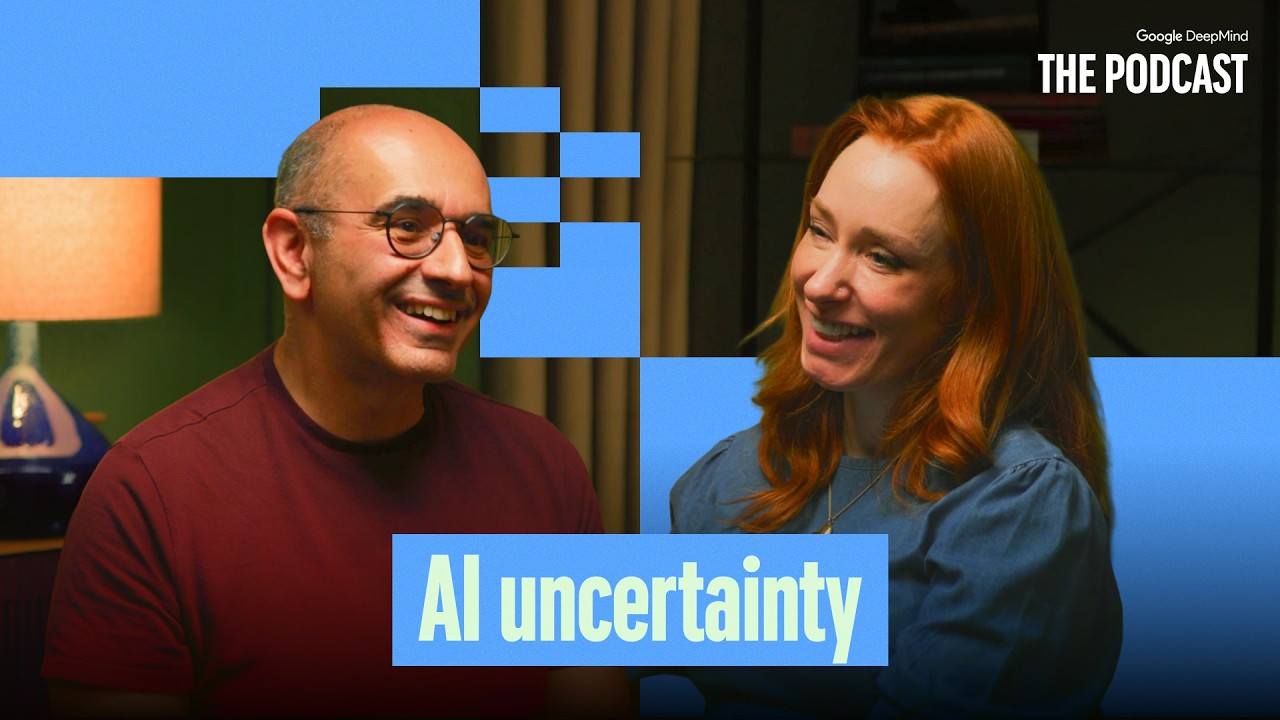
The podcast features Zubin Garamani, a professor at Cambridge and co-lead of frontier AI at Google DeepMind, discussing the importance of incorporating uncertainty into artificial intelligence systems. Unlike current AI models that often provide confident but sometimes incorrect answers, Garamani emphasizes that true intelligence requires machines to understand and represent their own uncertainty. This capability is crucial for decision-making in real-world scenarios where information is incomplete or ambiguous, such as self-driving cars encountering unfamiliar situations. By mathematically modeling uncertainty through probabilities, AI can better navigate the complexities and unpredictability of the environment.
Garamani explains that there are different types of uncertainty: inherent randomness in the world and uncertainty arising from unfamiliar or novel situations. He draws parallels with human cognition, noting that humans constantly update their beliefs based on new evidence using probabilistic reasoning, even if they are not consciously aware of it. This Bayesian approach to learning and decision-making allows humans to adapt and make rational choices despite incomplete information. AI systems, he argues, should similarly incorporate Bayesian principles to improve their reliability and trustworthiness, especially in high-stakes applications like medicine and autonomous vehicles.
The discussion highlights the limitations of current AI models, particularly large language models, which lack explicit representations of confidence and often produce overconfident but incorrect outputs, known as hallucinations. Garamani points out that while these models are probabilistic in nature, they do not explicitly calculate or communicate their uncertainty, which undermines trust and safety. He advocates for research into methods that can extract and represent uncertainty from AI models more transparently, such as analyzing the entropy of probability distributions over possible outputs, to create systems that are both accurate and appropriately humble about their knowledge.
Garamani also contrasts the current dominant AI paradigm, which relies heavily on scaling data and compute, with his view that architectural innovations are necessary to achieve more robust and intelligent systems. He cites examples like weather forecasting and protein folding, where probabilistic models and ensembles effectively represent uncertainty and improve predictions. He stresses the importance of continual learning, energy efficiency, and data efficiency as key challenges that Bayesian-inspired approaches could help address. Despite the computational challenges, he believes advances in hardware and approximation techniques make revisiting these ideas feasible and promising.
Ultimately, Garamani envisions AI systems that embody human-like qualities of humility, honesty, and self-awareness about their limitations. He argues that such systems would not only be more reliable collaborators but also better aligned with human needs and societal goals. By embracing uncertainty rather than ignoring it, AI can move beyond brittle accuracy-focused models to become tools that genuinely augment human decision-making with wisdom and caution. This shift, he concludes, is essential for building trustworthy AI that can safely and effectively tackle complex real-world problems.