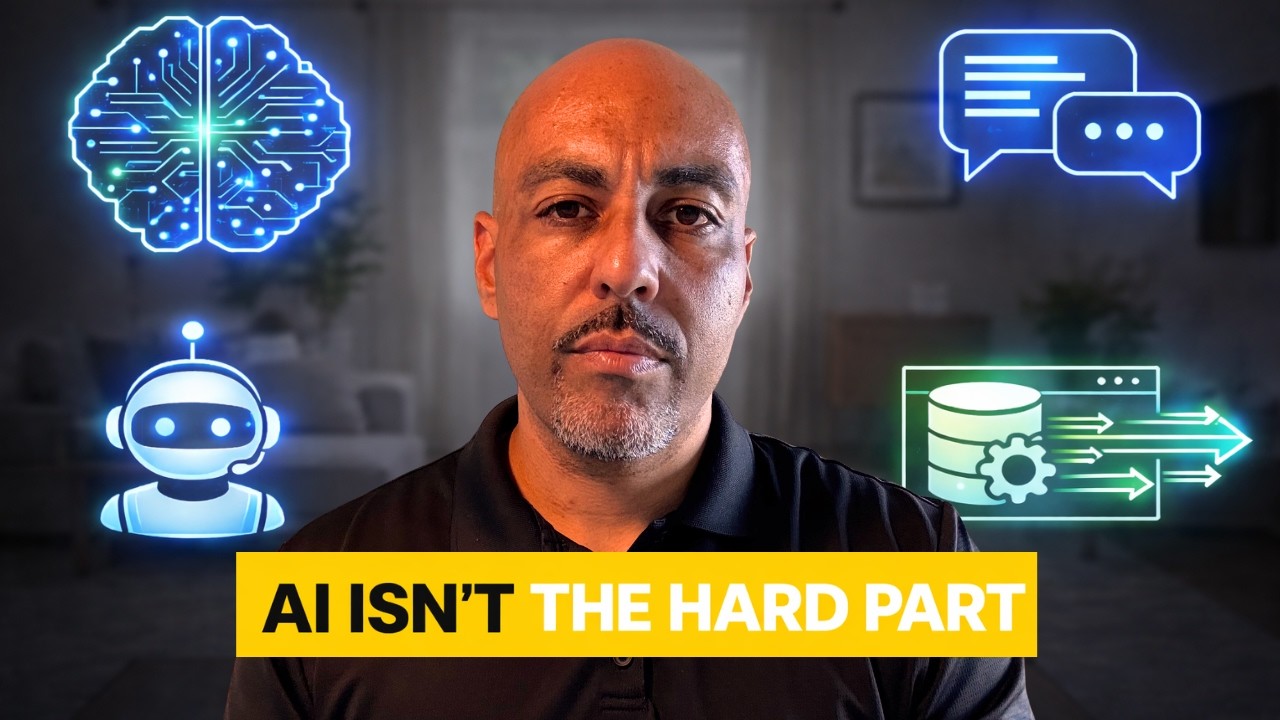
The video emphasizes that the most challenging and crucial aspect of building AI products is not the AI itself—such as agents, retrieval-augmented generation (RAG) pipelines, or prompt engineering—but rather the data. The speaker, drawing from experience running an intensive AI developer cohort, observes that the real difficulty lies in collecting, cleaning, and structuring data. The value and defensibility of an AI product are directly proportional to the effort required to obtain and maintain its data. If the data is easy to access and already well-packaged, competitors can easily replicate the product, making it less valuable.
During the cohort, developers spent most of their time not on wiring up models or agents, but on sourcing and preparing data for their projects. While technical skills like connecting models and organizing data in vector databases are important, they are secondary to having meaningful, relevant data to feed into the system. The speaker notes that many AI projects stall because they lack a robust data pipeline, resulting in little more than glorified prompt engineering or simple wrappers around existing AI tools. Without unique or well-curated data, these projects fail to deliver real value.
The video highlights web scraping as a practical method for gathering data, especially when information is scattered across the web or not available through clean APIs. Tools like Firecrawl and Crawl for AI are recommended for extracting structured data from websites, making it easier to integrate into AI systems. The speaker also mentions the YouTube Transcript API as a valuable resource for collecting transcripts from videos, which can then be used to build focused, data-driven applications such as chat interfaces grounded in specific creators’ content.
Personal or internal data—such as emails, notes, documents, and company knowledge—can make AI systems significantly more useful and tailored. By leveraging unique datasets, developers can create AI agents that understand their specific context, tone, and content, far surpassing the capabilities of generic models like ChatGPT. The speaker shares personal experience building an AI agent that operates within their business, utilizing years of accumulated content to provide highly relevant outputs.
In conclusion, the speaker advises aspiring AI developers to prioritize data collection and management over obsessing about model selection. A recommended starting project is to pick a niche topic, scrape data from several quality sources, structure it, and build a simple Q&A or summarization tool. This hands-on approach provides more practical learning than debating model superiority online. For those interested in deeper learning, the speaker offers a hands-on cohort program focused on building real AI systems with robust data pipelines and production workflows.