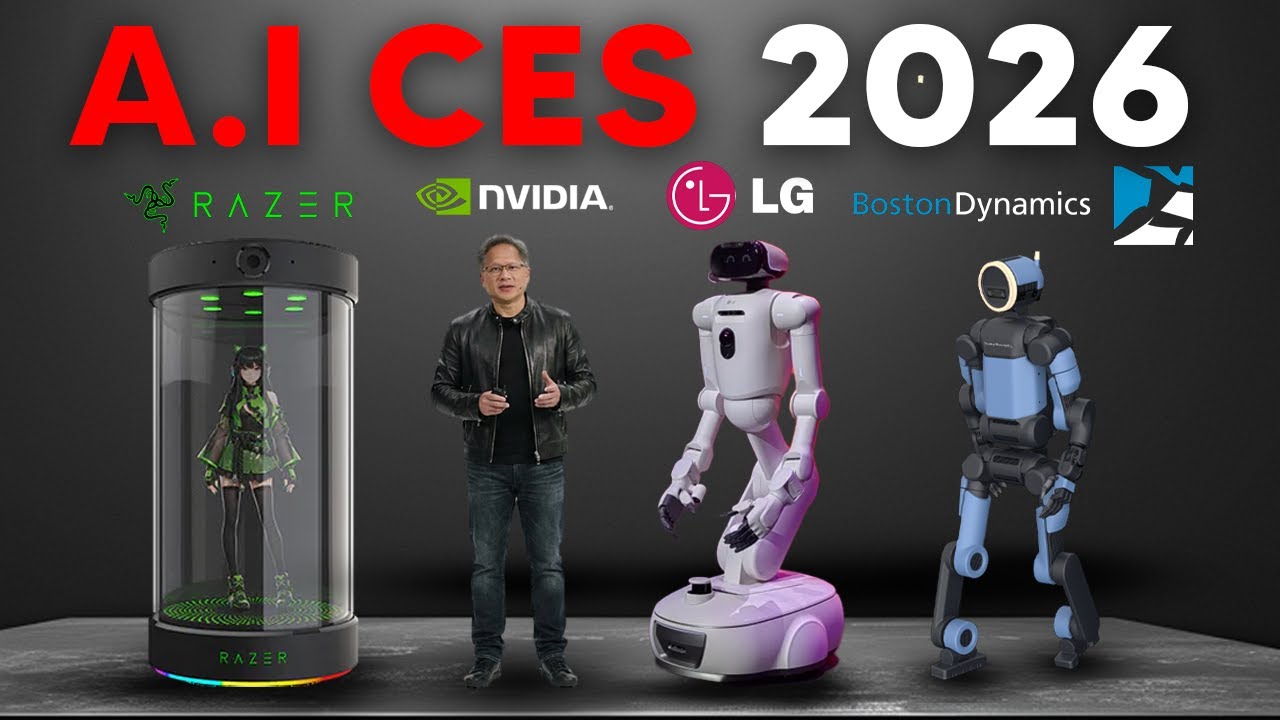
CES 2026 showcased a wave of groundbreaking AI and robotics innovations, with Boston Dynamics leading the charge by unveiling the commercial version of its Atlas humanoid robot. Unlike previous prototypes, this Atlas is designed for real-world factory work, boasting superhuman movement with 360-degree rotating joints, 156 degrees of freedom, and tactile sensing hands. Its self-swappable battery allows for continuous operation, and it’s robust enough for harsh environments, being both dust- and waterproof. The most significant upgrade is its integration with Google DeepMind’s Gemini AI, enabling managers to give it natural language instructions and allowing the robot to autonomously solve problems and adapt to dynamic situations.
LG introduced its own take on home robotics with the humanoid “Cloid” (pronounced Chloe D or Cloudy), aimed at achieving a “zero labor home.” Cloid is designed to be friendly and practical for domestic environments, featuring two arms with seven degrees of freedom and five-fingered hands for delicate tasks. Its wheelbase ensures stability, and its digital face displays emotions while housing cameras and sensors for navigation. LG’s “affectionate intelligence” allows Cloid to learn routines and proactively assist, such as suggesting indoor workouts if it’s raining. It integrates seamlessly with other LG smart appliances, but remains a prototype, with Nvidia providing the AI processing power.
In AI healthcare, Omnia revealed a futuristic 360-degree body scanning health mirror concept, combining a high-tech mirror and sensor-packed floor mat to deliver comprehensive health screenings in about a minute. Using bioimpedance, it provides detailed metrics like vascular age, ECG, and cellular hydration, with an empathetic AI companion offering personalized health advice and early detection of potential issues. While the mirror is still a concept, Withings announced the Body Scan 2, a “longevity station” scale available for purchase, which measures over 60 health biomarkers and provides predictive health scores using advanced AI.
Motorola’s Project Maxwell was another highlight, introducing a minimalist, screenless wearable AI device designed as a pendant or pin. It features a camera, microphone array, and relies on voice and gesture interaction, serving as an extension of your phone and PC. Powered by Motorola’s new Kira AI platform, Maxwell uses multimodal perception to understand context and can perform tasks like launching navigation, summarizing meetings, or translating text. Unlike previous failed AI pins, Maxwell is positioned as a phone companion to reduce screen time, with processing offloaded to paired devices or the cloud.
Other notable announcements included Razer’s Project Ava, a desktop AI assistant with a 3D animated avatar for gaming and productivity coaching, and Project Motoko, AI-powered headphones with built-in cameras and microphones for context-aware assistance. Samsung’s AI TV transformed the television into a vision AI companion, offering conversational recommendations, real-time translation, and advanced audio features. The Neura Pen, a smart pen that digitizes handwriting and integrates AI assistance, also drew attention. On the infrastructure side, NVIDIA introduced the Rubin platform for efficient AI data centers and Alpameo, a ChatGPT-style AI model and simulator for self-driving cars, emphasizing the growing importance of physical AI in real-world applications.