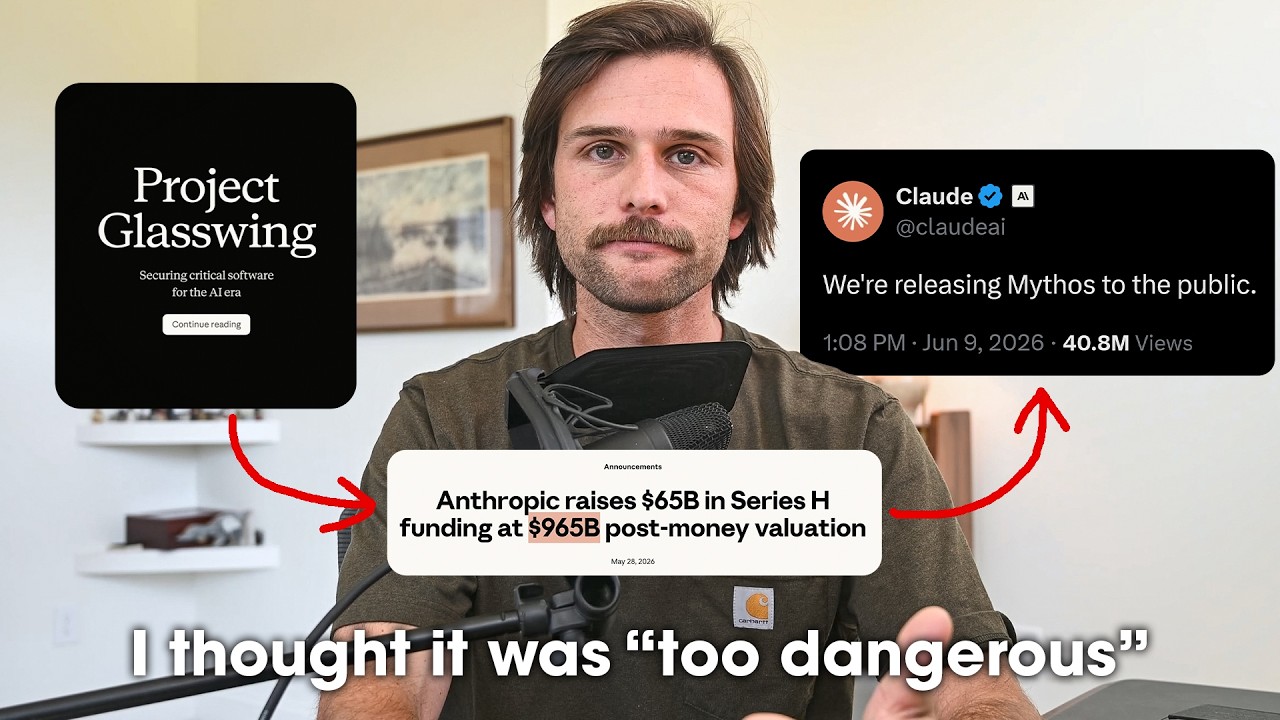
About two months ago, Anthropic released an AI model called Mythos, touted as extremely dangerous due to its advanced capability to find and exploit software vulnerabilities. This model was introduced under Project Glass Wing, a collaboration involving major Fortune 500 companies aimed at securing critical software worldwide. Mythos demonstrated impressive feats, such as discovering decades-old vulnerabilities in highly secure systems like OpenBSD and FFmpeg, as well as autonomously chaining vulnerabilities in the Linux kernel. Anthropic marketed Mythos as a tool so powerful that enterprises should invest millions to use it for vulnerability detection before it becomes publicly accessible, stirring significant concern about its potential misuse.
Despite the hype, skepticism arose regarding the actual danger and effectiveness of Mythos. Notably, shortly before Mythos was released, Anthropic’s own codebase was leaked due to basic security oversights, raising questions about the model’s practical reliability. Critics pointed out inconsistencies, such as Mythos’s claimed general-purpose capabilities contrasted with ongoing issues in Anthropic’s own software. Additionally, internal use of Mythos by Anthropic did not seem to prevent these lapses, suggesting that the model’s touted prowess might be overstated or that its integration was not as comprehensive as claimed.
Real-world case studies provided a more nuanced picture. The Mozilla Firefox team reported fixing more security bugs in April than in the previous 15 months combined, attributing much of this progress to Mythos’s assistance. However, it was noted that many of these bugs were already known and in backlog, and the actual remediation was done by human engineers. Similarly, the Curl project’s creator found Mythos’s impact limited, with only one confirmed low-severity vulnerability discovered among several false positives. These examples suggest that while Mythos is effective at uncovering vulnerabilities, it is not revolutionary and should be seen as an evolutionary step in AI-assisted security.
Anthropic’s marketing around Mythos appeared to be strategically timed with their financial goals. The announcement of Mythos and Project Glass Wing coincided with a significant increase in the company’s valuation—from $380 billion to $965 billion—and preceded their IPO filing. The exclusivity of Mythos access to large enterprises helped justify high spending and hype, potentially inflating the perceived threat and value of the model. This marketing approach raised suspicions that the danger narrative was partly a tactic to boost investor confidence and secure funding rather than a purely technical reality.
Now, with Anthropic having secured substantial funding and computing resources, including leasing significant compute power from XAI’s Colossus 1, Mythos is poised for a broader public rollout. This move suggests that the initial restrictions on Mythos access were influenced by compute limitations and strategic financial considerations rather than solely concerns about safety. While Mythos remains a powerful tool capable of identifying serious security vulnerabilities, the initial fear-driven marketing campaign appears to have been somewhat exaggerated, blending genuine technological advances with calculated hype.