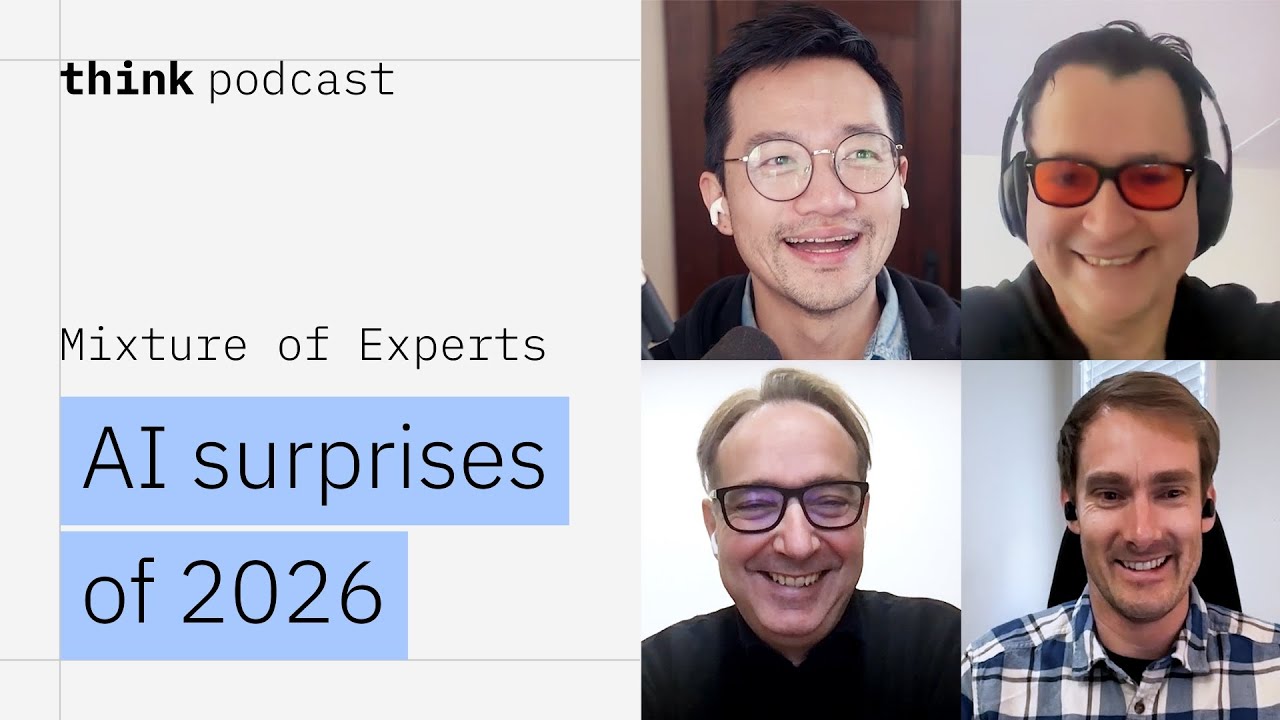
The episode discusses how enterprise AI is rapidly evolving, highlighting the introduction of ads in ChatGPT, the rise of agentic coding tools like Claude Code, and a shift in executive attitudes toward AI as a driver of innovation rather than just efficiency. It also examines the balance between standardization and openness in AI development, emphasizing ongoing concerns about user trust, transparency, and the impact of these changes on business models and the AI community.
The episode of “Mixture of Experts” explores the rapidly evolving landscape of enterprise AI, focusing on recent controversies, technological breakthroughs, and strategic shifts in how organizations are adopting artificial intelligence. The discussion opens with the news that OpenAI will soon introduce advertisements into the ChatGPT experience, a move that has sparked debate about the future of AI business models. The panelists agree that while disappointing, the introduction of ads is inevitable given the high costs of running large-scale AI services. They reflect on the historical parallels with search engines and streaming services, noting that ad-supported models often become the norm when users resist paying high subscription fees.
A significant portion of the conversation centers on the implications of integrating ads into conversational AI. The panelists express concerns about user trust, privacy, and the potential for AI-generated content to be influenced by advertisers. They highlight the importance of maintaining a clear separation between ad content and AI responses, drawing comparisons to the evolution of influencer marketing and the need for transparency. While some panelists see the subsidization of free access as a positive outcome, there is a shared wariness about the long-term effects on user experience and the integrity of AI assistants.
The episode then shifts to the recent surge in interest around Claude Code, an AI coding agent developed by Anthropic. The panelists discuss how Claude Code has made agentic AI coding more accessible and trustworthy, likening its breakthrough to the early days of ChatGPT. They note that the tool’s simplicity, effective use of context, and minimal reliance on external tools have contributed to its popularity. The conversation emphasizes the transition from assisted AI to truly agentic systems, where users can delegate complex tasks and trust the AI to deliver reliable results with minimal supervision.
Attention turns to the IBM Institute for Business Value’s new “Enterprise 2030” report, which reveals a shift in executive attitudes toward AI. The report indicates that most executives now see AI as a driver of innovation rather than just a tool for efficiency. The panelists discuss how organizations are moving beyond pilot projects to embed AI at the core of their business models, focusing on product and service innovation. They also highlight the need for new skills and operating models, noting that the roles of knowledge workers are rapidly evolving as AI takes over more execution tasks, leaving humans to focus on creativity and problem-solving.
Finally, the panel examines the launch of Hugging Face’s “Open Responses” project, which aims to standardize the agentic loop in AI inference engines. While this promises to simplify client-side development and foster innovation, the panelists caution that moving more logic to the server side could reduce transparency and hinder open-source innovation. They discuss the tension between protecting proprietary advancements and supporting the open AI community, concluding that while standardization is beneficial, it must be balanced with the need for openness and collaboration. The episode closes with reflections on the self-interested motives behind these industry shifts and the ongoing challenges of aligning technological progress with user trust and community values.