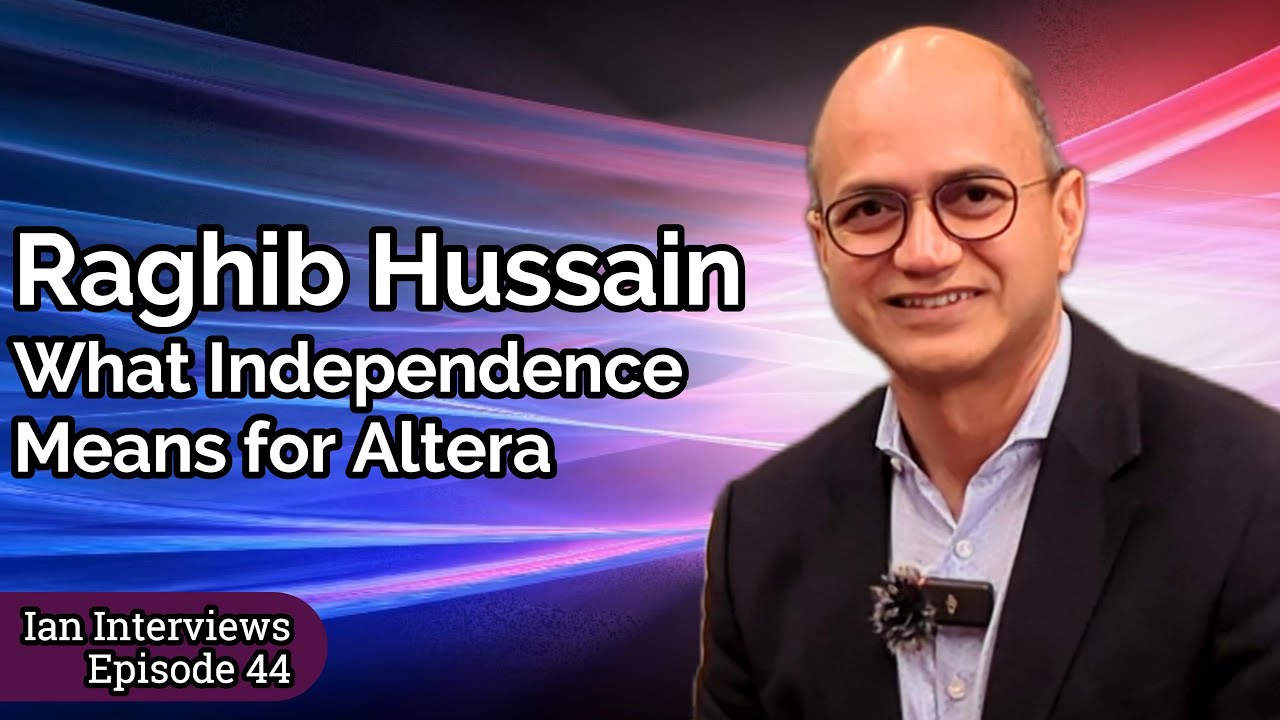
The video features an interview with Raghib Hussain, the new CEO of Altera, discussing the company’s transition as Intel divests its ownership, with Silver Lake acquiring a 51% stake while Intel retains 49%. Hussain emphasizes the critical role FPGAs (Field Programmable Gate Arrays) have played in the computing industry for decades, serving as reconfigurable compute platforms essential for chip design, security updates, and feature enhancements over long product lifecycles. With Altera becoming an independent entity, Hussain highlights the newfound freedom to control its destiny, focus on targeted markets, and revitalize its product and customer strategies, especially in the evolving AI landscape.
Coming from outside Altera, Hussain brings a fresh perspective rooted in customer-centric innovation, drawing from his experience at Cavium and Marvell. He praises Altera’s core FPGA technology, noting it remains the highest performing fabric in the industry based on independent benchmarks. Additionally, he acknowledges the company’s strong EDA tools and software, which are competitive and critical for enabling customers to fully utilize the FPGA fabric. Despite concerns about talent retention after years under Intel, Hussain is encouraged by the committed and high-quality engineering team, ready to thrive with the independence and focus now possible.
Hussain discusses the cultural shift underway at Altera, aiming to foster transparency, open communication, and a startup-like agility despite the company’s size of around 2,600 employees, with 2,000 engineers. He stresses the importance of extreme ownership and alignment across teams to solve real customer problems efficiently. The company’s revenue is noted to be around $1.5 billion, underscoring its significant scale. Hussain’s leadership style includes daily sprint meetings to enhance communication and decision-making speed, breaking down bureaucratic barriers typical of large corporations.
A key theme is the renewed focus on customer education and tailored solutions. Hussain explains that as part of a large company, Altera’s sales and support efforts were diluted, but now they can deliver targeted training, dev kits, and solutions that better meet the needs of diverse customers, from large enterprises to smaller teams with limited FPGA expertise. He also highlights the growing importance of edge AI applications, where FPGAs excel due to their reconfigurability, low latency, and cost-effectiveness compared to ASICs, especially as AI interfaces with the physical world through sensors and real-time data processing.
Looking ahead, Hussain outlines plans to improve existing products, enhance engineering support, optimize supply chains, and accelerate product development cycles to 12-15 months or faster, a significant improvement over previous multi-year cycles. He rejects the notion of old versus new Altera, instead positioning the company as one with strong IP and brand heritage but driven by a new mindset focused on quality, customer value, and rapid execution. The interview concludes with an invitation to watch Altera’s upcoming Innovators Day for further insights into the company’s future direction.