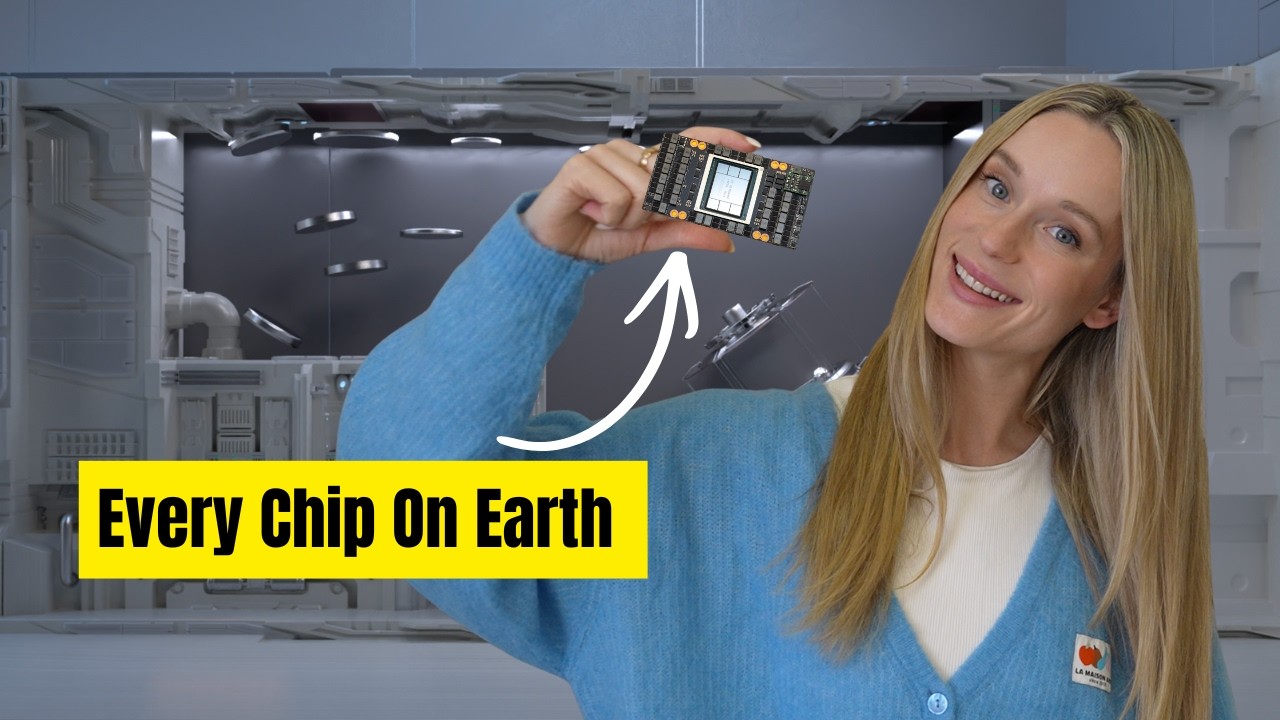
The video explores the critical role of a single company, ASML, in the global semiconductor industry, emphasizing how every modern technology device—from AI models and iPhones to data center chips—relies on their machines. ASML, based in the Netherlands, manufactures extreme ultraviolet (EUV) lithography machines, which are essential for printing the intricate circuit patterns on silicon wafers that form the basis of advanced chips. These machines use EUV light, a type of light that does not naturally exist on Earth in a usable form, generated through a highly complex process involving lasers and molten tin droplets.
ASML’s EUV machines are marvels of engineering, containing about 100,000 parts sourced from over 5,000 suppliers worldwide. The machines use a system of ultra-precise mirrors, polished to atomic-level smoothness, to focus the EUV light onto silicon wafers. The precision required is extraordinary, as even a nanometer-level drift in the mirrors can ruin a chip. Each machine costs around $350 million, weighs as much as a commercial airplane, and only a few dozen are produced annually, making them incredibly rare and valuable.
While ASML makes the machines that produce chips, the actual manufacturing of the world’s most advanced semiconductors is dominated by Taiwan Semiconductor Manufacturing Company (TSMC). Founded in 1987, TSMC pioneered the pure-play foundry model, focusing solely on chip fabrication for companies like Apple, Nvidia, and AMD. Today, TSMC produces about 90% of the world’s most advanced chips, with its main fabs located in Taiwan—a region fraught with geopolitical tensions, particularly with China.
This concentration of advanced chip manufacturing in Taiwan, combined with the limited number of ASML EUV machines, presents a significant risk to the global tech supply chain. Any disruption to TSMC’s operations could halt the production of critical chips, impacting everything from smartphones to AI hardware. Efforts are underway in the US and Europe to build new fabs and reduce reliance on Taiwan, but these initiatives are costly, time-consuming, and still dependent on ASML’s machines and skilled workforce, meaning diversification will take at least a decade.
The video concludes by reflecting on the incredible engineering, physics, and geopolitics that underpin the technology we use daily. It highlights the importance of understanding companies like ASML and TSMC to appreciate the fragility and complexity of the global semiconductor supply chain. The creator expresses enthusiasm for exploring more about hardware and technology, inviting viewers to engage and learn more about the foundational technologies powering the AI revolution and modern tech landscape.