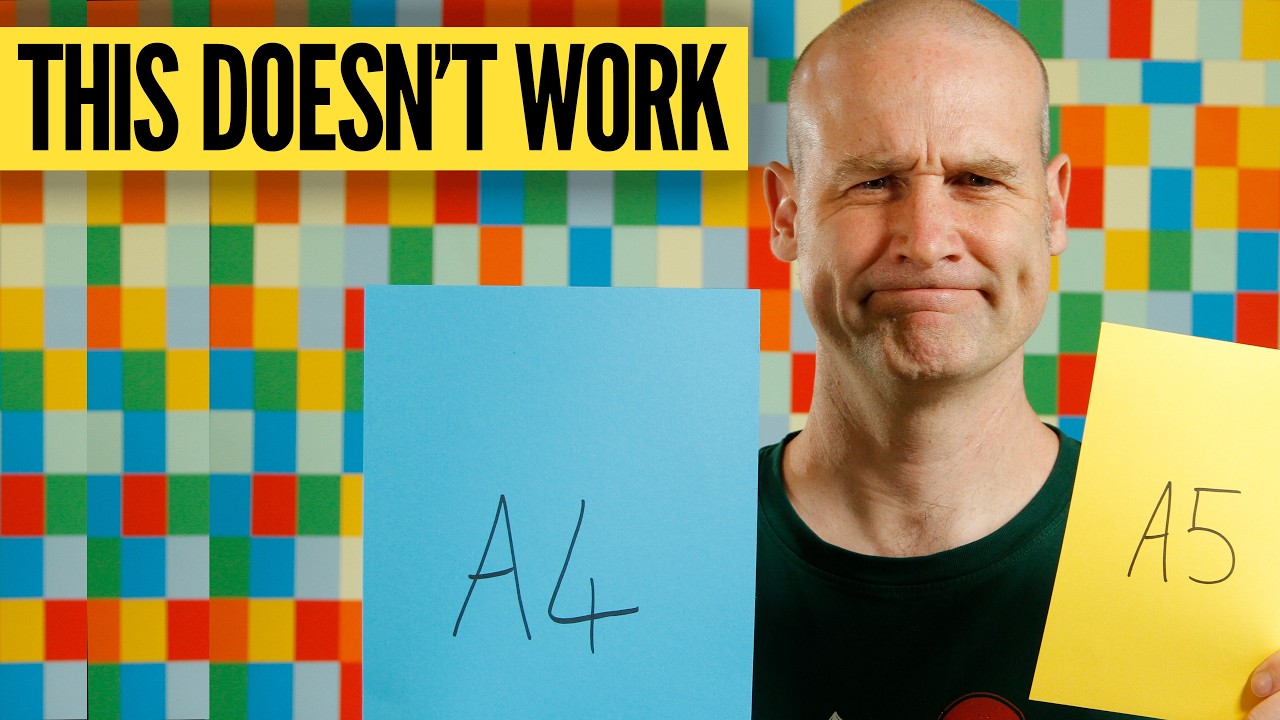
The video explores the fascinating properties and quirks of the A paper scale system, particularly focusing on the A4 size and its related sizes from A1 to A10. The A series is designed so that each size is half the area of the previous one, maintaining an aspect ratio of the square root of two (√2). This unique ratio allows for consistent scaling and folding, enabling, for example, two A5 sheets to perfectly fit into one A4 sheet. The presenter demonstrates this by arranging various A sizes into a spiral and discusses the theoretical ability to fit a power of two smaller sheets into a larger one, such as fitting 512 A9 sheets into an A0. However, due to rounding and manufacturing tolerances, these ideal mathematical properties are not perfectly realized in practice.
The video delves into the three key properties that define the paper scale system: the ability to split a sheet into smaller pieces, the equality of the split pieces, and the similarity (same aspect ratio) of these pieces. While the A series satisfies all three, other ratios like the golden ratio can satisfy some but not all properties. For example, splitting a golden ratio rectangle results in unequal but similar pieces, whereas splitting a square results in equal but not similar pieces. The presenter illustrates these concepts with diagrams and explains how only the √2 ratio uniquely satisfies all three properties simultaneously, which is why it is used in the ISO paper sizes.
Beyond the A series, the video touches on the B and C paper scales, which also use the √2 ratio but start from different base dimensions. The B series begins with a length of one meter, while the C series is the geometric mean between A and B sizes, commonly used for envelopes. The presenter also introduces the Post-it note scale (dubbed the P scale), which follows a halving pattern but does not maintain similarity in aspect ratios, alternating between two different ratios (approximately 1.5 and 1.34). This results in a descending scale that does not perfectly align with the principles of the A series.
A significant portion of the video is dedicated to exploring the practical limitations of the A series due to rounding to the nearest millimeter in official ISO sizes. This rounding causes cumulative discrepancies, especially noticeable in smaller sizes like A9 and A10, leading to extra unused space when trying to fit many smaller sheets into a larger one. The presenter demonstrates this by physically arranging 514 A9 sheets on an A0 sheet, exceeding the theoretical 512 due to these rounding effects. Collaborations with programmers led to computational packing solutions that optimize the number of smaller sheets fitting into larger ones, revealing that even more sheets can fit than previously thought, though perfect packing remains a complex challenge.
Finally, the video discusses extending the A series beyond the standard A10 size into much smaller sizes (A17, A18, and beyond), where rounding and aspect ratio deviations become even more pronounced. The presenter shows tiny paper samples under a macro lens, highlighting how the ratios diverge from √2 and how the system’s neat mathematical properties break down at these extremes. The video concludes by acknowledging the potential for future research in optimizing paper packing using manufacturing tolerances and invites viewers to explore related work by collaborators. The video is also sponsored by Jane Street’s Wise program, supporting women and gender-expansive individuals interested in STEM careers.