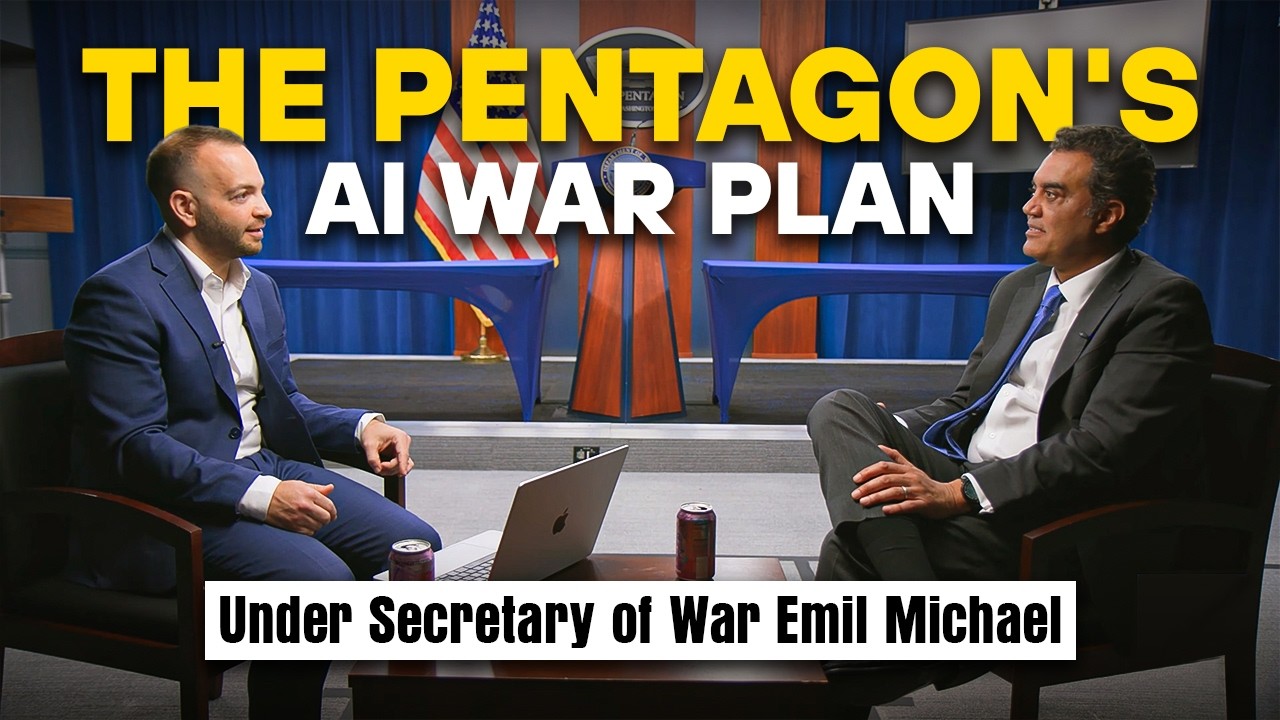
The interview with Emil Michael, Under Secretary of War for Research and Engineering, delves into the rapidly evolving role of AI in modern warfare and national security. Michael emphasizes that AI is primarily a tool to augment human decision-making rather than replace it, highlighting the importance of human oversight in military operations. He draws analogies to technologies like autonomous vehicles and Uber, explaining that while new technologies often face fear and resistance, they ultimately improve precision, reliability, and efficiency. AI systems, such as the Pentagon’s Maven Smart System, synthesize vast amounts of data to help military personnel make faster and more informed targeting decisions, though the final authority always rests with humans.
Michael discusses the practical applications of AI in intelligence analysis, anomaly detection, and battlefield operations, noting that AI helps synthesize complex data streams to improve decision-making speed and accuracy. He stresses that AI is not a magic solution to war but a powerful tool to achieve clearer objectives with less collateral damage and in less time. He also expresses concern about adversaries potentially using AI to remove humans from the decision-making loop, contrasting this with the U.S. approach that emphasizes augmentation rather than automation. The conversation touches on the use of drones in conflicts like Ukraine and Iran, highlighting the strategic importance of affordable, mass-producible drones and the ongoing efforts to develop both offensive and defensive drone technologies.
The discussion then shifts to the Pentagon’s relationship with AI vendors, focusing on the recent fallout with Anthropic. Michael explains that despite initial cooperation, the contract negotiations faltered due to Anthropic’s insistence on provisions against autonomous warfare and mass surveillance, which conflicted with the Pentagon’s operational needs and legal frameworks. This misalignment led to Anthropic being designated a supply chain risk, effectively barring them from government contracts. Michael defends this decision by underscoring the critical need for alignment on mission and values, especially given the immense power and potential risks associated with AI technologies. He also addresses misconceptions about the government’s stance, clarifying that the Pentagon already enforces strict human oversight policies.
Michael further elaborates on the challenges of integrating AI models hosted on third-party cloud platforms, noting the rapid update cycles and the importance of having reliable partners who align with national security objectives. He acknowledges the complexity of balancing innovation with security and the necessity of having multiple AI providers to avoid monopolistic dependencies. The conversation touches on cultural differences between Silicon Valley companies and government agencies, with Michael emphasizing the Pentagon’s nonpartisan, mission-driven culture focused on protecting warfighters and the nation. He also reflects on past controversies, such as Google’s involvement with the military, suggesting that understanding and collaboration between tech companies and the government are improving over time.
Finally, the interview covers broader topics including procurement reform, cyber warfare, and the humorous Pentagon pizza index myth. Michael highlights efforts to modernize defense contracting by encouraging risk-sharing and performance-based payments, aiming to foster innovation while ensuring accountability. He acknowledges the growing importance of AI in cyber operations and the need to stay ahead of adversaries in this domain. On a lighter note, he dismisses the Pentagon pizza index as unreliable, citing logistical complexities in ordering food within the Pentagon. Overall, the discussion provides a nuanced view of how AI is reshaping defense strategies, the challenges of vendor relationships, and the ongoing balance between technological advancement and ethical, legal oversight.