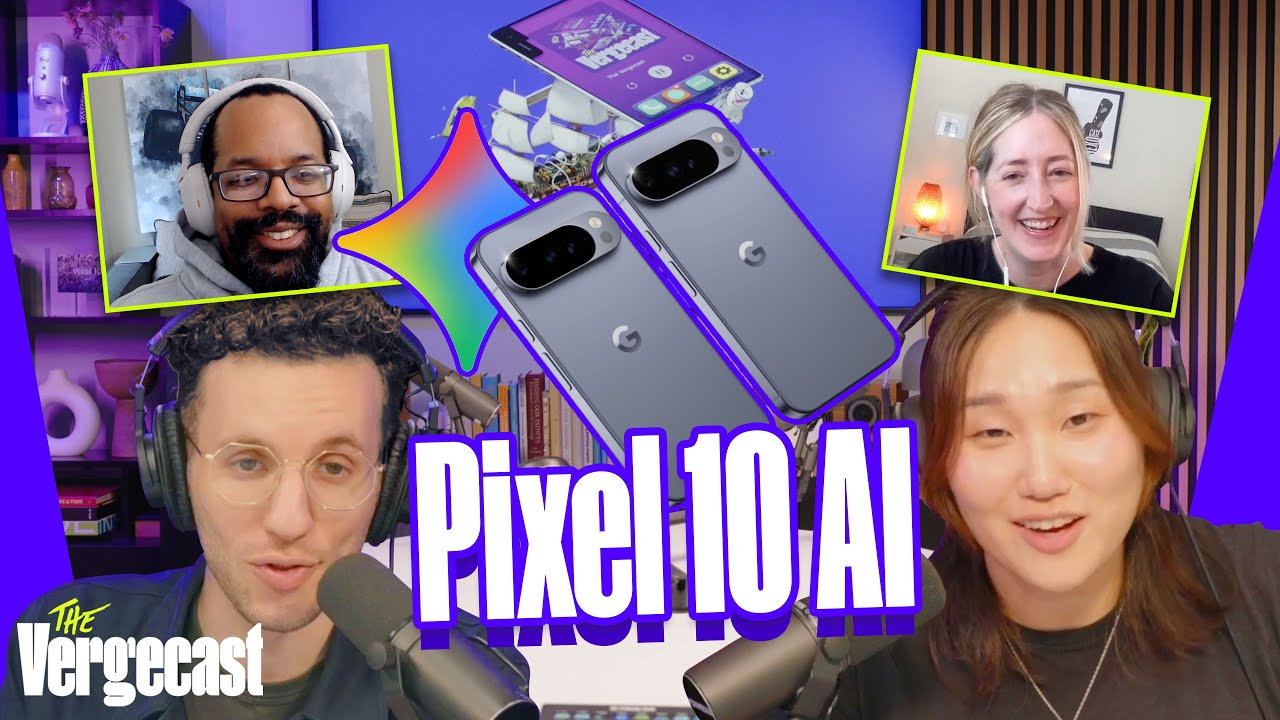
In this episode of The Vergecast, the hosts dive into the latest developments in smartphone technology, focusing primarily on the Google Pixel 10 and its AI capabilities. Reviewers Allison Johnson and V Song share their experiences with the Pixel 10 Pro, highlighting its improved AI features like Magic Q, which offers contextual suggestions within Google apps, and the ProRes Zoom that uses AI to enhance zoomed-in photos up to 100x. While the AI is becoming genuinely helpful, especially in small, precise ways such as calendar reminders and message suggestions, it still has limitations, particularly in handling natural, conversational language and integrating beyond Google’s ecosystem. The duo also experiments with the Pixel’s live voice translation feature, which mimics speakers’ voices but struggles with natural speech patterns and code-switching, leading to some humorous glitches.
The conversation then shifts to the broader smartphone industry, touching on Apple’s upcoming iPhone 17 event and the ongoing competition among major players like Google, Samsung, and Apple. The hosts speculate on Apple’s approach to AI integration, noting that while Apple has been cautious and somewhat secretive about AI features, the pressure is mounting for them to innovate in this space. They also discuss the convergence of smartphone designs and features, with Google pushing strong AI integration and Apple potentially responding with a significant design refresh and possibly more vivid color options for their devices.
A significant portion of the episode is dedicated to the ongoing troubles of Dish Network and its failed attempt to become a major 5G wireless carrier. The hosts outline the complex history involving Dish’s acquisition of Sprint’s prepaid assets, regulatory deadlines, and the FCC’s investigation under Chairman Brendan Carr. Despite promises to build a nationwide 5G network, Dish has failed to launch a viable service and recently sold much of its spectrum to AT&T, effectively reducing the number of major wireless carriers back to three. This situation raises concerns about competition in the US wireless market and the FCC’s role in enforcing carrier obligations.
The episode also covers Intel’s recent controversial deal with the US government, where the government acquired a 10% stake in the company in exchange for funding tied to the CHIPS Act. The hosts critique this move as a questionable form of crony capitalism, highlighting Intel’s struggles with technology leadership, missed opportunities in mobile and AI chip markets, and the political dynamics influencing the deal. They express skepticism about whether this intervention will help Intel regain its competitive edge, especially given the dominance of companies like TSMC and the complex geopolitical implications of semiconductor manufacturing.
Finally, the hosts discuss Elon Musk’s lawsuit against Apple and OpenAI, alleging anti-competitive practices related to AI app rankings and exclusivity deals. They view the lawsuit as somewhat frivolous, noting that Musk’s apps are already highly ranked but that he is unhappy with not receiving special treatment in the App Store. The conversation touches on the broader challenges of AI app development, content moderation, and platform control, with Musk’s behavior characterized as typical of his confrontational style. The episode concludes with a “thunder round” covering various tech news, including YouTube’s controversial AI upscaling of Shorts videos, Google’s tightening control over Android app distribution, Taco Bell’s AI drive-thru experiments facing backlash, and a novel but puzzling autonomous delivery locker vehicle introduced by Roart.