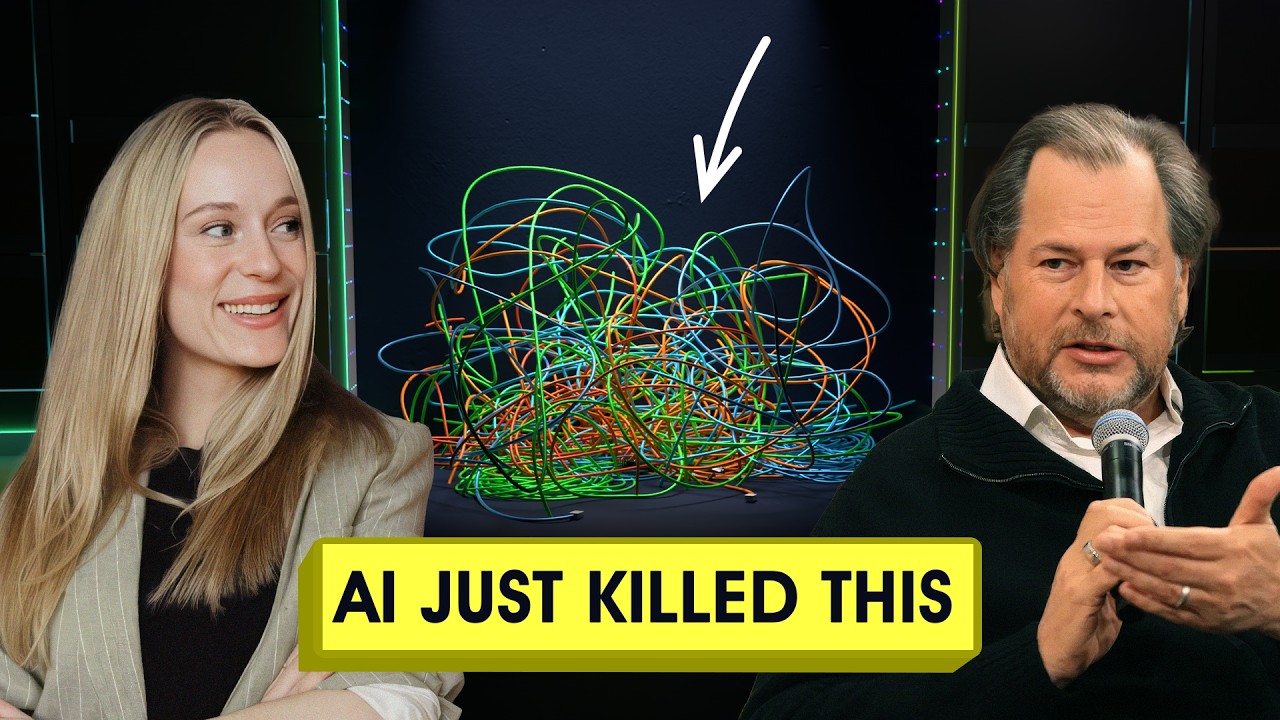
In a recent conversation with Salesforce CEO Marc Benioff, a significant shift in the AI ecosystem was highlighted, centered around Slack becoming the primary user interface not just for Salesforce but for the entire AI landscape. This transformation is underpinned by a crucial but little-known protocol called the Model Context Protocol (MCP), open-sourced by Anthropic in late 2024. MCP standardizes how AI models connect to external tools, eliminating the need for custom integrations for each model-tool pairing. This protocol acts like a universal connector—similar to USB-C in hardware—allowing any AI model that supports MCP to interact seamlessly with any MCP-enabled tool, fostering interoperability across the AI stack.
MCP’s rapid adoption is remarkable, with over 97 million monthly SDK downloads and support from major players like OpenAI, Google, and Microsoft. Salesforce has fully embraced MCP by launching its own MCP server within Slack, enabling external AI clients to pull data from Slack and perform actions, while Slackbot itself can reach out to other MCP-enabled services. This bidirectional communication creates a powerful ecosystem where Slack serves as a central hub for AI interactions, significantly enhancing productivity and user experience. Benioff emphasized that building such an ecosystem is essential for success in the tech industry, as collaboration among companies, developers, and users drives innovation.
At the core of Salesforce’s AI strategy is a sophisticated technology stack. Slack operates as the interface layer, supported by Salesforce’s agent orchestration layer called Agent Force, and applications like Sales Cloud and Service Cloud. Beneath these lies Data 360, a federated and harmonized data layer that integrates diverse enterprise data sources with varying schemas, enabling AI agents to understand and act on complex business contexts. This data harmonization is a challenging engineering feat but crucial for delivering meaningful AI-driven insights and actions. MCP facilitates the connection between AI agents and these disparate data sources, making the entire system cohesive and functional.
The impact of this integrated approach is already evident, with Anthropic reporting a 60% acceleration in deal closures using Slackbot. Other tech giants are pursuing similar architectural bets, aiming to own the interface between humans and AI agents—Microsoft with Teams and Copilot Studio, Google with Gemini in Workspace, and OpenAI with its Frontier platform. Slack’s advantage lies in being a communication tool where users already spend significant time, combined with MCP’s open standard that simplifies integration. The future points toward multi-sensory AI models that process data from various sources like sensors, video, and audio, pushing MCP’s extensibility to new limits.
Benioff also shared insights on the evolving role of engineers in this landscape, encouraging them to embrace the opportunities presented by protocols like MCP. Engineers who master these connective layers between AI models and real-world systems will be highly valuable as the industry moves beyond just language models to more complex, multi-modal AI. The race to dominate the AI interface will be won not by the best chatbot alone but by those who build the most effective protocol layers underneath. Salesforce’s vision is about leveraging the entire stack, with Slack as a critical surface layer, signaling a profound shift in how enterprise software and AI will integrate moving forward.