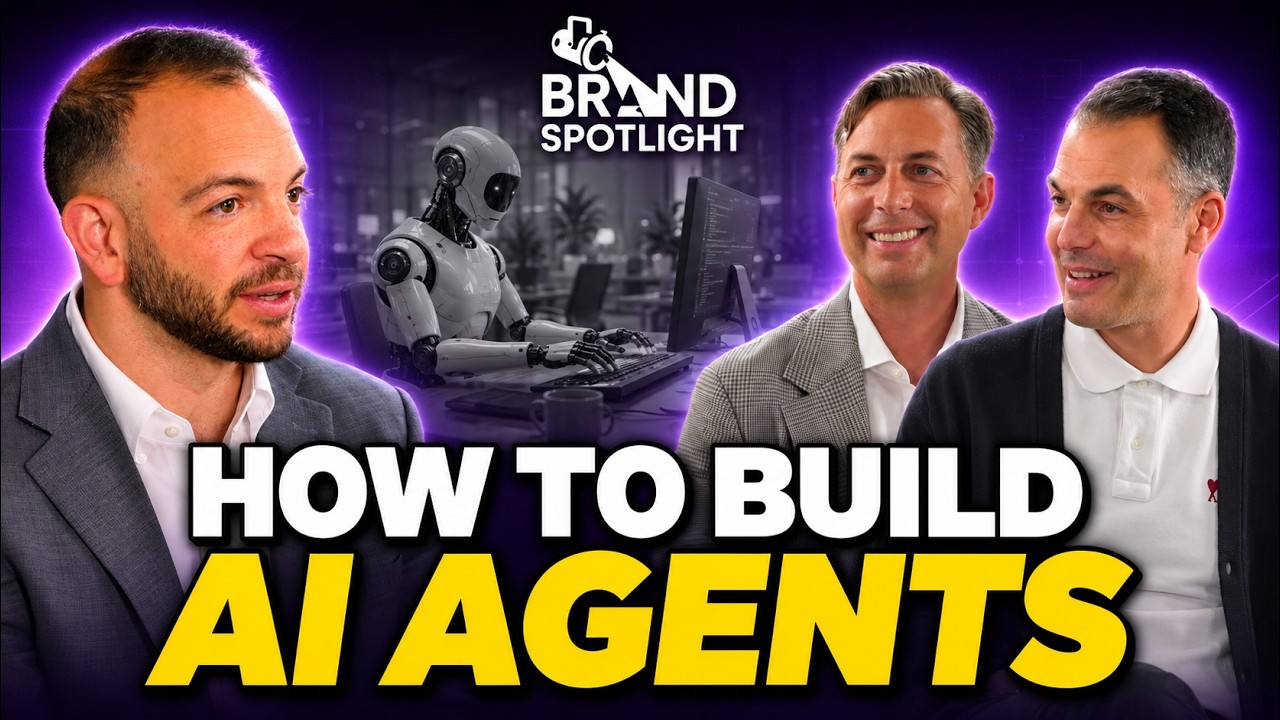
The video features a conversation between Joe Davis, EVP of AI engineering at ServiceNow, and Adel El Hallak, VP of product management at Nvidia’s Gentex AI, discussing the practical deployment of AI agents in enterprise settings. They explain that AI agents are not just single models but orchestrations of multiple specialized models, including proprietary and open-source ones, fine-tuned for specific tasks. ServiceNow and Nvidia collaborate closely on developing these agents, combining Nvidia’s open-source Neumotron models with ServiceNow’s AI blueprints to create sophisticated, multi-agent systems capable of deep research and task planning.
A significant focus of the discussion is on the challenges of deploying autonomous AI agents, like OpenClaw, in enterprise environments where trust, security, and governance are paramount. OpenClaw demonstrated the power of unbounded autonomy by autonomously completing complex tasks, but such freedom raises concerns about control and safety in corporate contexts. To address this, Nvidia and ServiceNow have developed Open Shell, a secure runtime environment that sandboxes AI agents, strictly controls their access to data and systems, and enforces policies at runtime. This approach ensures that AI agents operate within defined boundaries, preventing unauthorized actions and maintaining enterprise security.
The speakers emphasize the importance of governance layers, such as ServiceNow’s AI Control Tower, which provides centralized visibility and policy enforcement across all deployed AI agents. This governance framework integrates with Open Shell to manage permissions, monitor agent activities, and push company-wide policies, effectively creating a zero-trust environment where AI actions are deterministic and controlled despite the underlying probabilistic nature of large language models. They also discuss the concept of “harnesses,” which are the tooling and integrations that enable AI models to perform tasks, highlighting that improvements in harness engineering significantly enhance agent performance and reliability.
A practical example of AI agent deployment is ServiceNow’s L1 AIIT Specialist, an AI-powered first-level IT support agent that automates common service desk tasks such as granting application access or troubleshooting issues. This agent reduces resolution times by up to 99%, handling routine requests autonomously while escalating more complex cases to human engineers with detailed context. The success of this use case illustrates how AI agents can augment human workflows in IT, HR, CRM, and other enterprise functions, improving efficiency and user satisfaction by automating repetitive tasks and providing timely support.
Looking ahead, both leaders foresee rapid adoption and deeper integration of AI agents across complex business scenarios, with ongoing advancements in model reliability and governance. They anticipate that AI will increasingly govern not only digital agents but also human workflows and physical assets, including robotics. Additionally, they predict a shift toward more visual and video-based AI communication within enterprises, leveraging advances in AI-generated imagery and video to enhance understanding and collaboration. Overall, the conversation highlights the evolving landscape of AI agents from experimental pilots to trusted, governed tools driving enterprise productivity.