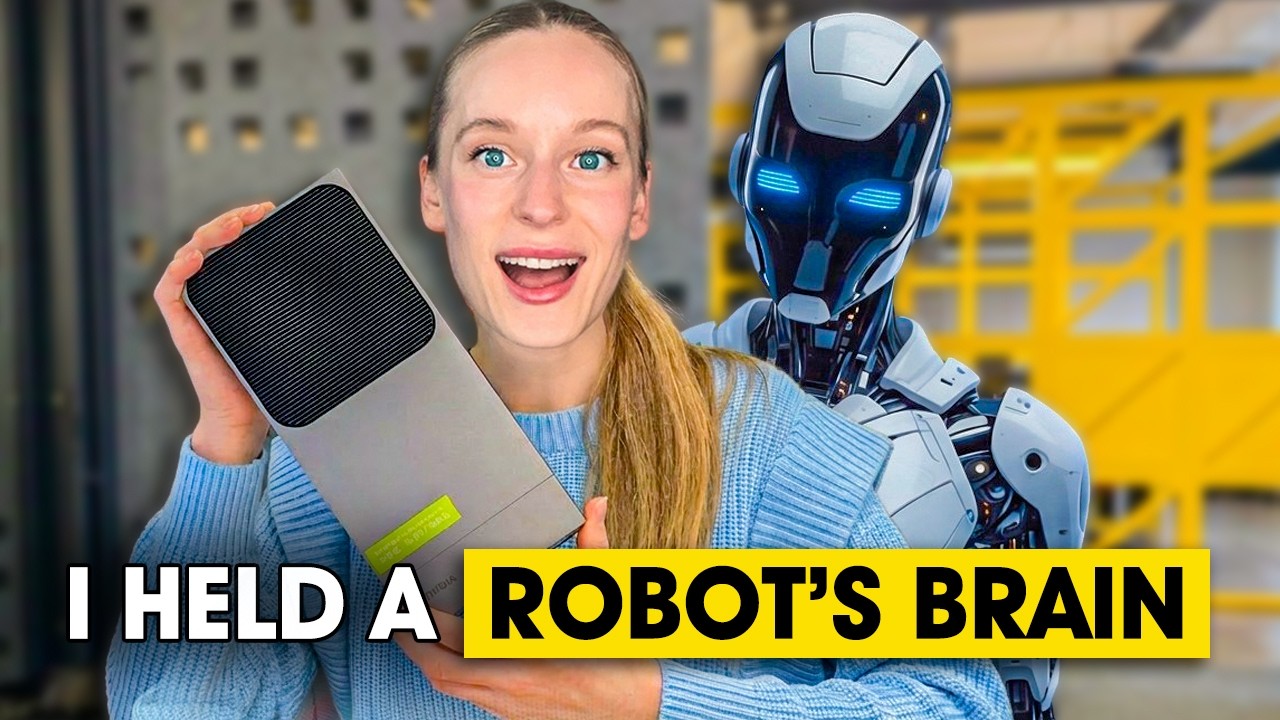
The video begins with the creator’s experience riding in a self-driving Mercedes equipped with NVIDIA’s technology through the challenging streets of San Francisco. While the ride itself was impressive, the real focus is on the robotics computing power behind such innovations, particularly the Jetson Thor, a powerful onboard computer that enables robots to perceive, reason, and act in real-time. Spencer Huang from NVIDIA explains how robots process visual data, plan actions, and execute movements all within the same device, and hints at future advancements where robots will continuously build and update mental models of their environment to predict and adapt to changes dynamically.
NVIDIA’s robotics ecosystem is built around three main computing platforms: DGX for training AI models in the cloud, Omniverse for simulation and virtual testing, and Jetson Thor for deploying AI on physical robots. However, the video highlights a significant challenge known as the “sim-to-real” gap, where robots trained in perfect simulated environments often struggle in the unpredictable real world. This gap is especially pronounced with complex tasks like manipulating soft objects, underscoring the need for real-world data and domain expertise. Fortunately, open-source tools like Isaac, Groot, and Cosmos are making robotics development more accessible to a broader range of experts beyond traditional robotics engineers.
The video also introduces Jan Liphardt and his company Open Mind, which is developing an open-source operating system for robots called OM1. This OS aims to unify robot software much like Android did for smartphones, allowing different manufacturers to run the same software and enabling users to download new skills via a robot app store. Jan’s work focuses on practical applications, such as robots in elder care that can monitor and assist people with conditions like Parkinson’s disease, demonstrating how robotics can have a profound social impact by addressing real human needs.
Drawing parallels between autonomous vehicles and robotics, the video showcases NVIDIA’s self-driving car technology, which uses a combination of AI models and classical safety systems to navigate complex urban environments. The car’s AI learns from thousands of model iterations to drive smoothly and safely, with a safety stack ready to intervene if needed. The technology is advancing rapidly, with plans for beta testing and nationwide rollout of robotaxi services in multiple cities within the next few years. This progress promises to make roads safer and provide mobility solutions for people who may be anxious or unable to drive themselves.
In conclusion, the video emphasizes that the future of robotics and autonomous systems is being shaped by powerful computing platforms like Jetson Thor and open-source software ecosystems. The real breakthroughs will come from domain experts who understand the problems that matter most, not just robotics specialists. The shared motivation of innovators like Spencer and Jan—both inspired by their mothers’ needs—illustrates the human-centered potential of these technologies. With ongoing advancements in simulation, AI, and software openness, robotics is becoming more accessible and poised to transform many aspects of daily life.