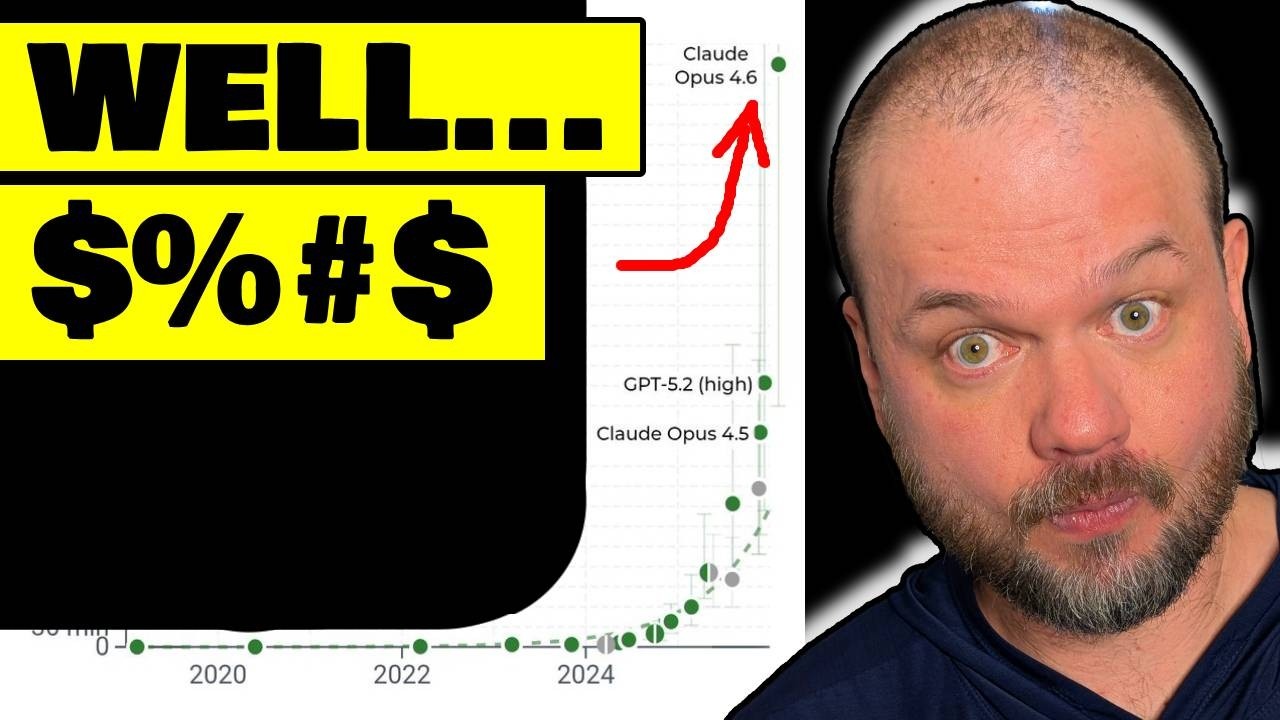
The video discusses a chart that is considered by many to be the “scariest” in the history of AI development, as it visually represents the rapid acceleration of AI agents’ capabilities. The chart, produced by the nonprofit Meter Research, measures how much human expert labor (in hours) can be replaced by AI agents across hundreds of tasks in fields like engineering, coding, machine learning, and cybersecurity. Importantly, the y-axis of the chart reflects the number of hours a human expert would take to complete a task, not how long the AI takes. Recent models, particularly Claude Opus 4.5 and 4.6, have shown dramatic jumps in capability, with Opus 4.6 able to complete tasks that would take a human expert nearly two full workdays.
The presenter emphasizes that the pace of AI progress is not just continuing but accelerating. While earlier projections suggested AI capabilities were doubling every seven months, recent data shows this is now happening roughly every four months. This rapid acceleration has surprised even industry leaders like Sam Altman, who recently stated that the world is not prepared for how quickly extremely capable AI models are arriving. The video also highlights that coding, once considered a highly skilled and protected profession, is now largely automated within leading AI labs, with models like Opus 4.6 authoring most of their own code.
The presenter shares personal anecdotes about using Opus 4.6 to automate complex tasks, such as building a news aggregator website and handling tedious accounting work. These examples illustrate not only the speed and efficiency of modern AI agents but also their ability to automate ongoing processes, not just one-off tasks. The presenter likens this transformation to the impact of the printing press on literacy: just as everyone eventually became literate, the ability to code may soon be universally accessible, fundamentally changing the nature of software development.
Despite the impressive progress, the video acknowledges criticisms and caveats. Some experts argue that measuring task difficulty by human hours is flawed, as tasks that are time-consuming for humans may not be inherently difficult for AI, and vice versa. Others point out that while AI is excelling at coding, it may not “magically” master all other domains. However, research suggests that improvements in one area, like coding, often transfer to related fields, such as math and accounting. The presenter also notes that while AI models can make mistakes, their top-end abilities are improving so rapidly that solutions to these issues are likely to emerge.
In conclusion, the chart has become a key indicator of AI’s progress, with each new model release closely watched for its position on the curve. Both AI optimists and skeptics agree that the trajectory of progress is undeniable, even if the exact implications are debated. The presenter urges viewers to pay attention to these developments, as the pace of change is only increasing and the eventual impact on society and the workforce will be profound. The video ends with a call to subscribe to the presenter’s newsletter for ongoing updates and analysis.