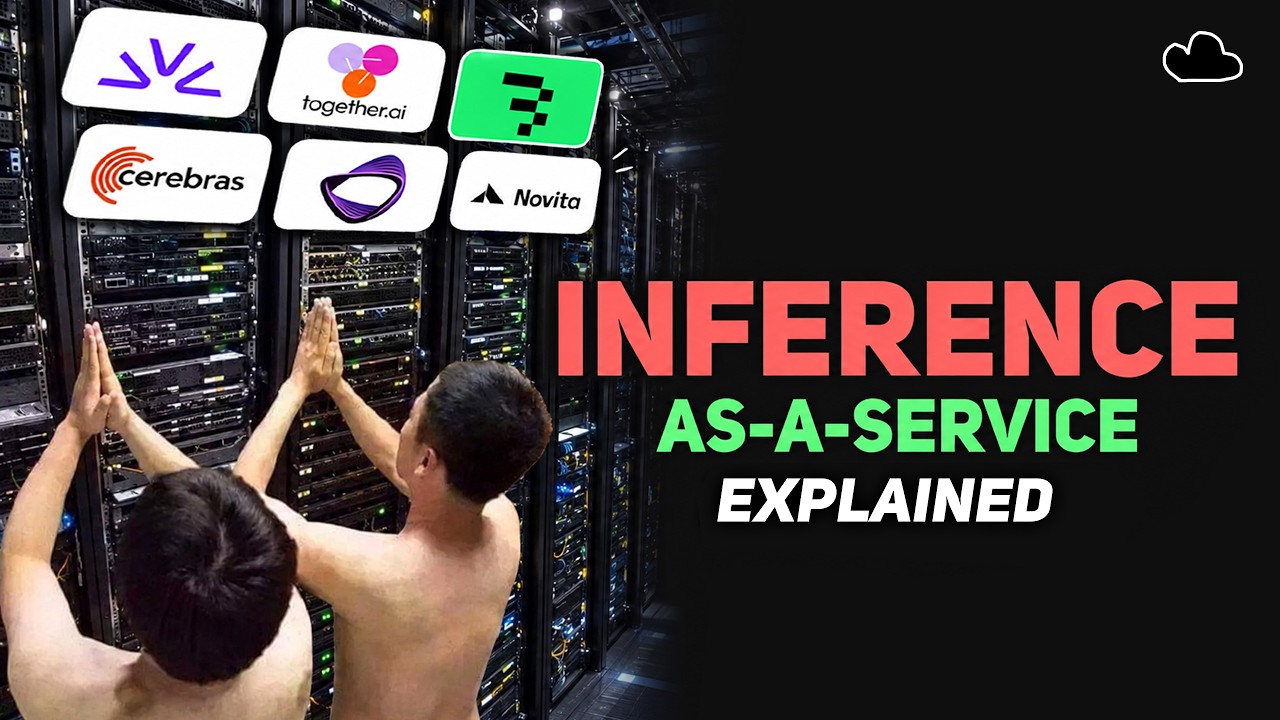
The video explores the surprising economics behind AI startups that offer Large Language Model (LLM) inference-as-a-service, highlighting that many of the top revenue-generating companies do not develop their own models but instead serve open-source models. Despite this, they generate substantial revenue by providing optimized, scalable access to these models. The video categorizes these companies into four groups: hyperscalers (like Amazon and Google), neo clouds (focused on GPU rental), full-stack inference platforms, and custom silicon inference platforms. The latter two focus primarily on inference services, which involve running the models after training, a process that is computationally intensive and complex to optimize.
Inference-as-a-service companies make money by charging users for API access to run models, but the margins can be very tight due to high GPU costs and competition from official APIs. For example, running a large model like DeepSeek V4 Pro requires expensive GPU clusters, and the revenue generated per token processed often barely covers these costs unless demand is very high. To improve profitability, these companies focus heavily on optimizing inference speed and efficiency through techniques like caching, batching, and specialized hardware usage, which reduce the computational load and latency.
Caching allows servers to reuse previously computed intermediate results (KV cache) when processing repeated prompt prefixes, drastically reducing the cost of inference for repeated inputs. Batching combines multiple user requests to maximize GPU utilization, improving throughput but requiring a balance between latency and efficiency. Additionally, some providers separate the inference process into prefill (processing input prompts) and decode (generating output tokens) stages, optimizing each independently to better handle the different computational demands.
A critical factor in achieving high efficiency is the use of custom GPU kernels—specialized programs tailored to the exact model architecture and hardware. These kernels reduce unnecessary data movement and fuse multiple operations into single steps, significantly speeding up inference. However, writing these kernels is complex and model-specific, giving first-party model developers a significant advantage over third-party providers who must reverse-engineer and optimize models after release. Custom silicon platforms like Groq and Cerebras take this further by designing processors specifically for AI inference, achieving much higher token generation speeds but facing challenges supporting complex models immediately.
The video concludes by noting that the separation between model development and inference service providers is likely to grow, especially as open-source models improve and demand for scalable, low-latency inference increases. Many AI labs lack the resources to build and maintain large inference infrastructures, creating opportunities for specialized companies to fill this gap. As models become more capable and widespread, inference-as-a-service will become increasingly vital, driving innovation in optimization and hardware to meet global demand efficiently.
Useful Links