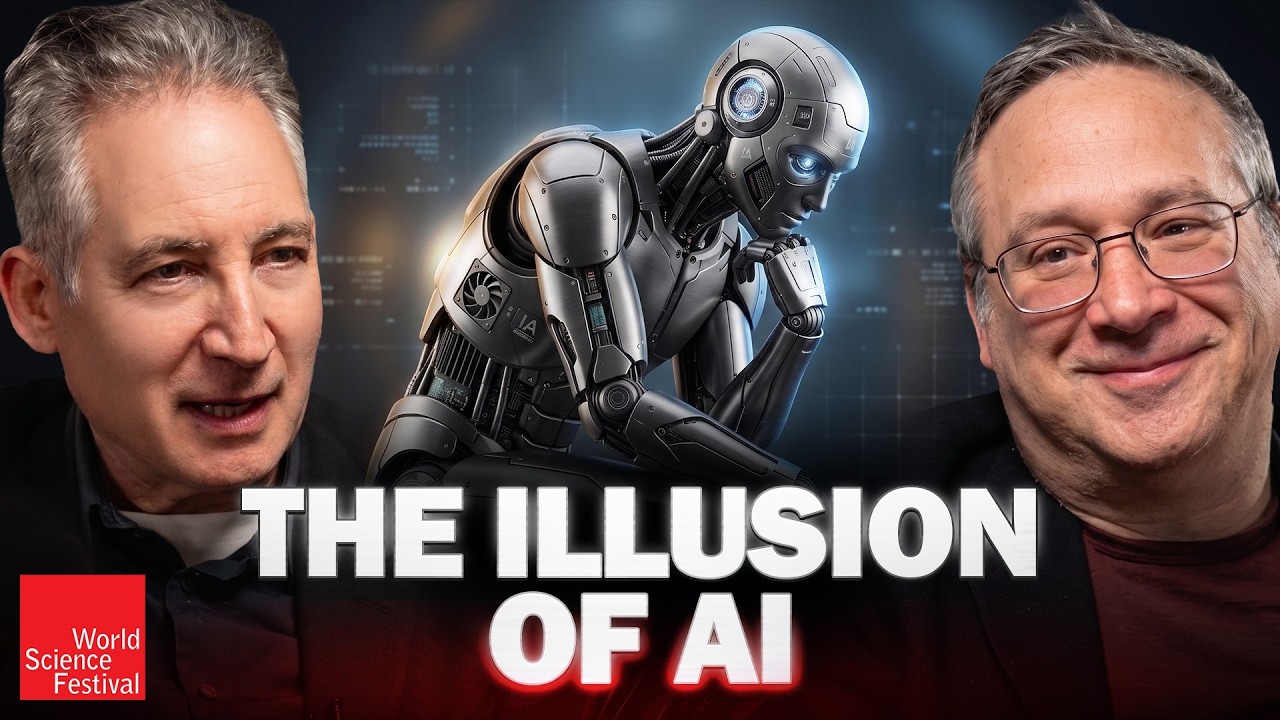
In this insightful conversation with AI expert Gary Marcus, the limitations and future prospects of artificial intelligence, particularly large language models (LLMs), are explored in depth. Marcus expresses skepticism about the prevailing belief that simply scaling up data and computational power will lead to artificial general intelligence (AGI). He emphasizes that while LLMs excel at approximating human language patterns, they lack true understanding, abstraction, and reliable reasoning capabilities. He highlights that current AI systems often rely on symbolic “harnesses” or classical AI techniques to compensate for these shortcomings, indicating that scaling alone is insufficient for achieving genuine intelligence.
Marcus traces his academic journey from cognitive science and neuroscience to AI, underscoring his long-standing interest in how humans learn and reason differently from neural networks. He explains that unlike humans, who can generalize abstract rules beyond specific examples, neural networks primarily operate through pattern recognition and similarity, limiting their ability to extrapolate or reason about new situations. This fundamental difference underpins many of the challenges faced by AI today, including hallucinations and errors in reasoning, which remain persistent despite advances in data and compute power.
The discussion also delves into why people often anthropomorphize AI systems, attributing human-like intelligence or consciousness to them. Marcus attributes this to evolutionary psychology, where humans tend to over-attribute agency, combined with the design choices by AI developers that enhance the illusion of thinking, such as word-by-word text generation. He firmly rejects claims that current LLMs possess self-awareness or consciousness, describing such notions as ludicrous. Instead, he advocates viewing AI as powerful but fundamentally limited tools that require human guidance and critical oversight.
Looking ahead, Marcus envisions a future where AI systems integrate neural networks with symbolic reasoning—an approach known as neurosymbolic AI—to overcome current limitations. He believes that while AI will eventually replicate many human cognitive functions, it may not need to mimic the human brain exactly, nor necessarily become conscious. He also discusses the societal implications of AI, cautioning about risks such as misinformation and accidental conflict, while expressing hope for a utopian future of abundance enabled by AI-driven advances in medicine, energy, and production, provided political and ethical challenges are managed wisely.
Finally, on a more personal note, Marcus encourages lifelong learning and creativity, sharing his own experience of learning guitar as an adult and emphasizing that AI tools can support human creativity without replacing it. He stresses that while AI can assist in many tasks, human meaning and fulfillment will increasingly come from artistic and personal pursuits. Overall, the conversation offers a balanced, nuanced perspective on AI’s capabilities, challenges, and potential impact on humanity’s future.