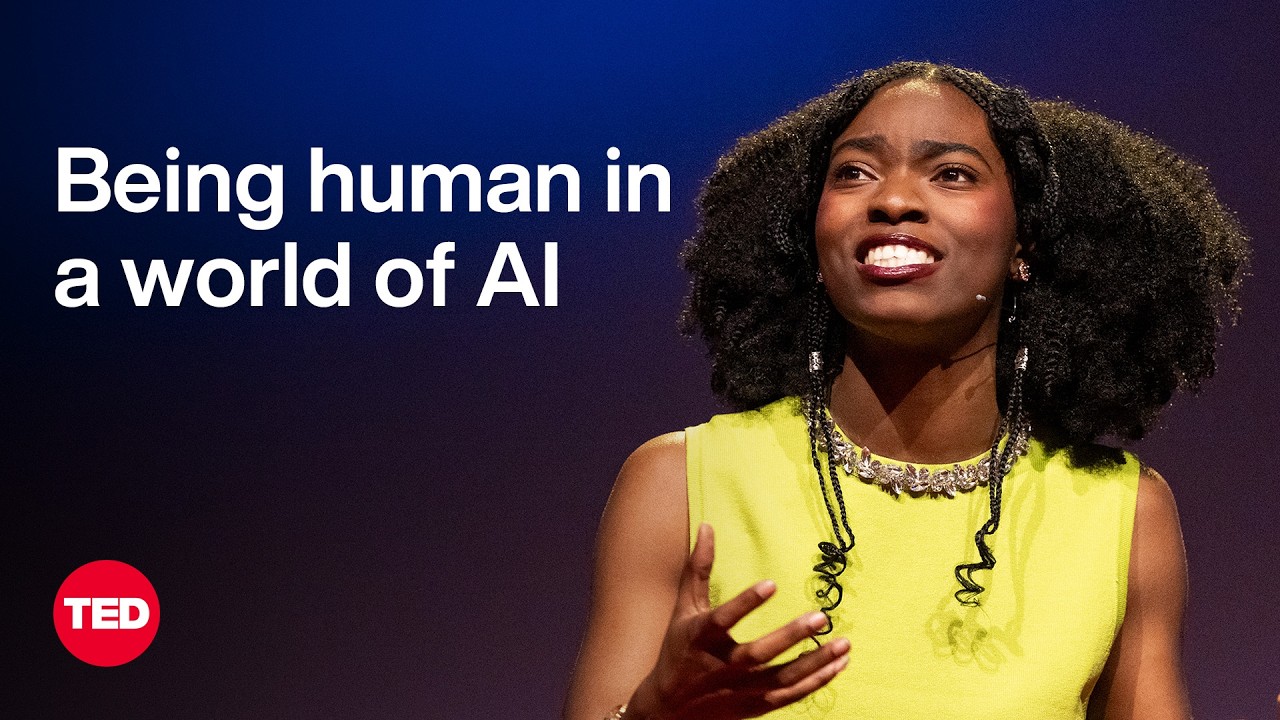
In “The Unprompted,” Salome Agbaroji highlights the limitations of AI in truly understanding human emotions and critiques society’s reliance on technology to solve deep-rooted social issues like inequality and injustice. She calls for human agency, empathy, and hope, urging people to act spontaneously and morally to create a better future where technology serves humanity rather than replaces it.
In her powerful poem “The Unprompted,” Salome Agbaroji explores the complex relationship between humans and artificial intelligence, particularly highlighting the limitations of AI in understanding the depth of human experience. She begins by describing the hollow, restless moments of late-night scrolling through phones and engaging in superficial digital conversations, where AI chatbots attempt to answer her personal and existential questions but ultimately fall short. This opening sets the tone for a reflection on how technology, while impressive, cannot fully grasp or address the nuanced emotions and crises that define human life.
Agbaroji critiques the broader societal and systemic issues that technology alone cannot solve. She points out that despite AI’s brilliance, it is not the first “intelligent” system humans have created, and it inherits the biases and inequalities embedded in human history—racism, caste systems, and economic disparities. The poem emphasizes that these deep-rooted problems are not simply technical challenges but moral and social ones, which require human empathy and action rather than automated solutions. The poet reminds us that the suffering of displaced children and marginalized communities cannot be alleviated by algorithms or software fixes.
The poem also questions the notion of progress and innovation in the modern world. Agbaroji challenges the audience to consider the irony of celebrating technological marvels while millions remain illiterate and exploited in poor working conditions. She warns against the dystopian future often imagined as a sci-fi AI takeover, suggesting instead that the real dystopia is the present reality where humanity watches crises unfold with the power to intervene but chooses inaction. This critique calls for a reevaluation of what true innovation means and who it serves.
Central to the poem is the idea of human agency and hope. Agbaroji asserts that the work to create a better world cannot be automated; it requires “audacious hope” and “unfounded optimism” that no algorithm can replicate. She calls on people to be “the unprompted”—to act spontaneously and morally in the face of bleak realities. While technology can be a tool for altruism and positive change, it is ultimately humans who must wield it responsibly, deciding whether to build or destroy with their inventions.
In conclusion, “The Unprompted” is a call to remember our humanity amid rapid technological advancement. Agbaroji urges us to focus not on the capabilities of machines but on the human values and promises that guide their use. She envisions a future where our most pressing questions are not about survival but about how technology can genuinely support well-being and justice. The poem ends on a hopeful note, emphasizing that salvation lies in human hands, empowered but not replaced by technology.