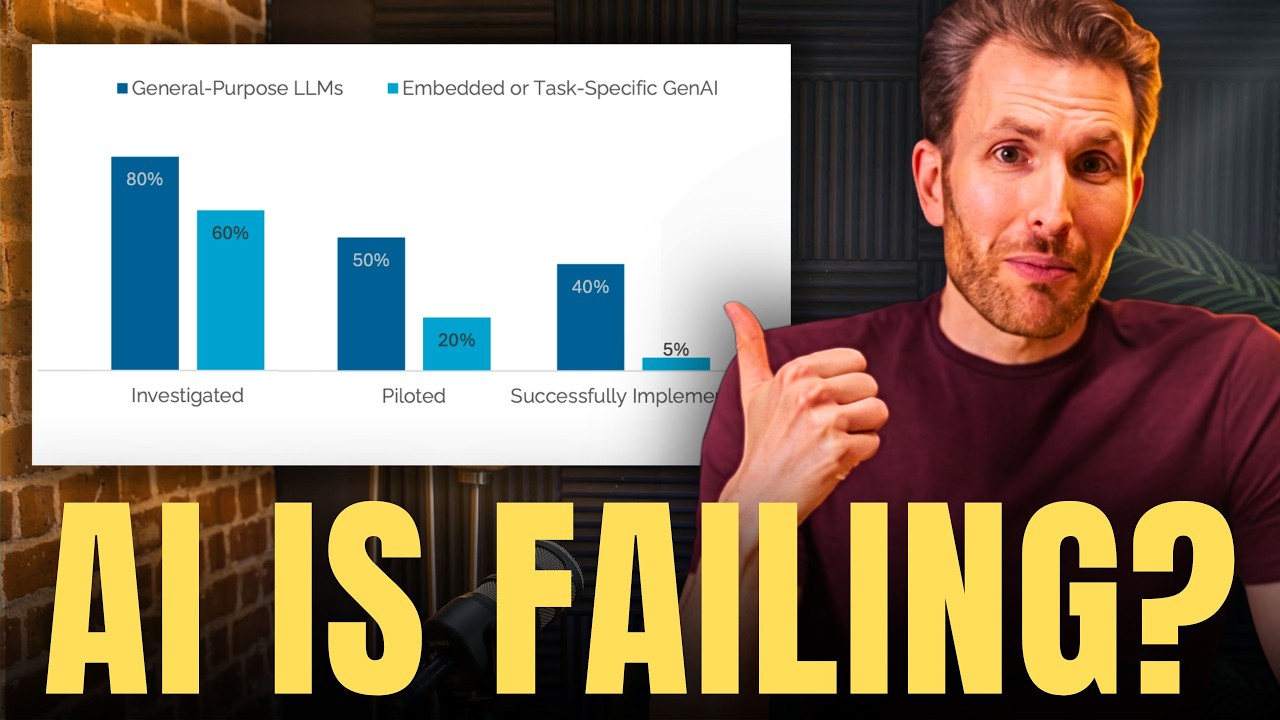
The widely publicized MIT study claiming a 95% failure rate for generative AI pilots is misleading due to flawed methodology, a small sample size, and undisclosed conflicts of interest, with only about 5% of surveyed companies achieving successful AI deployments under an exceptionally high success bar. This case underscores the dangers of sensationalized media reporting on preliminary research and highlights the need for transparency, rigorous peer review, and critical evaluation in AI studies and journalism.
The widely circulated MIT study claiming that 95% of generative AI pilots at companies were failing is fundamentally flawed and misrepresented. Contrary to media headlines, the study did not find a 95% failure rate among AI pilots. Instead, it revealed that only 20% of surveyed organizations had actually piloted custom AI tools, and among those, about 25% were successful—meaning roughly 5% of all companies surveyed had successful deployments. The majority of companies never even piloted AI projects, making the “95% failure” claim misleading and akin to judging Tinder users by marriage success without considering how many actually dated.
The study set an exceptionally high bar for success, requiring AI projects to demonstrate a “marked and sustained” impact on productivity or profitability within six months—a challenging benchmark given that enterprise tech often takes years to show results. Projects that merely broke even or showed potential future benefits were classified as failures. Despite this, a 25% success rate under such stringent criteria is impressive, especially considering the AI models used were relatively primitive compared to today’s standards. Additionally, over 90% of employees in these companies regularly used generative AI tools like ChatGPT for their work, though the report downplayed these individual productivity gains as not directly impacting profit and loss.
The study’s methodology and reporting raise serious concerns. The sample size was small—only 52 interviews and 153 survey responses—far less than the inflated numbers cited by media outlets like Fortune. This small sample means the results have wide uncertainty margins, and slight changes in data could drastically alter conclusions. Moreover, the full report was not publicly accessible when the story went viral, limiting journalists’ ability to scrutinize or accurately report on the findings. This lack of transparency contributed to the rapid spread of misleading headlines that influenced markets and public opinion.
Another critical issue is the conflict of interest among the study’s authors, who are involved in developing and commercializing AI agent frameworks. The report concludes that current AI tools fail due to lacking learning and contextual adaptation, promoting agentic AI—precisely the technology the authors are working on—as the solution. This self-serving conclusion was presented under the prestigious MIT brand without disclosing these conflicts, misleading readers into believing it was an impartial academic study. The authors’ interpretations often seemed to steer the data toward justifying their own products rather than providing an objective analysis.
Ultimately, this case highlights broader problems in how research is reported and consumed, especially in fast-moving fields like AI. A weak, non-peer-reviewed study with questionable data and undisclosed conflicts of interest was amplified by major media, shaping public discourse and investor behavior before anyone could critically evaluate it. The episode serves as a cautionary tale about the dangers of accepting sensational headlines at face value and underscores the need for transparency, rigorous peer review, and critical scrutiny in both research and journalism.