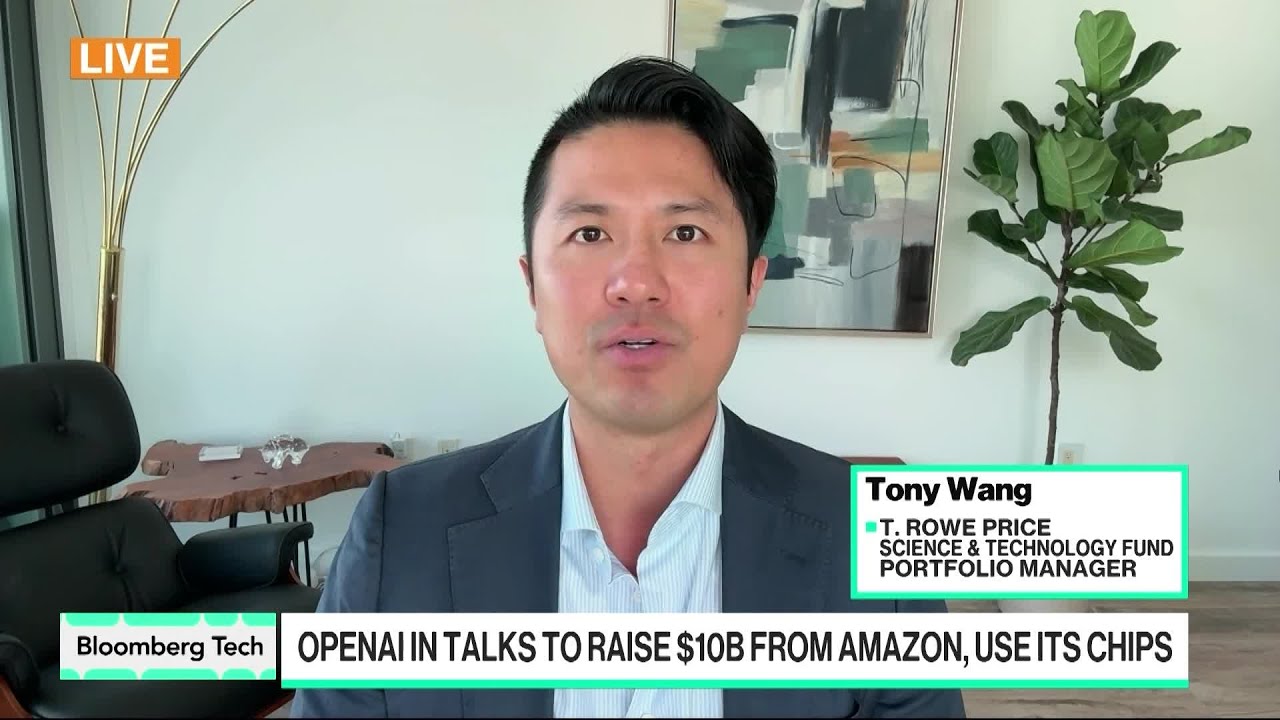
Tony Wang from T. Rowe Price highlights the dynamic and expanding AI landscape as a “space race” where multiple tech companies like Amazon, Google, Nvidia, and Oracle strategically invest and innovate without a winner-takes-all outcome, emphasizing the importance of managing risk and focusing on firms with strong competitive advantages. He also points to the growing opportunities beyond AI infrastructure, particularly in application layers and memory markets, underscoring T. Rowe Price’s diversified investment approach across public and private sectors to capitalize on AI’s transformative potential.
In the discussion, Tony Wang from T. Rowe Price addresses concerns about the circularity of deals between Amazon and OpenAI, emphasizing that while creative financing often invites scrutiny, the partnership is synergistic and logical given OpenAI’s rapid growth and need for diverse resources. He highlights the importance of continued progress in scaling AI technologies and the transformational impact these tools have on rethinking work, suggesting that demand remains strong and the ecosystem is evolving positively.
When asked about the competition between major tech players like Alphabet and Nvidia, Wang notes that the AI market is expanding exponentially, allowing multiple companies to succeed without a winner-takes-all scenario. He describes the current landscape as a “space race” with different companies focusing on their areas of expertise, such as Google’s optimization for its ecosystem and Nvidia’s broader platform capabilities. This diversity, he argues, benefits the industry as a whole, with several companies like AMD and Broadcom also performing well.
Regarding Oracle’s ambitious investments in AI infrastructure and the concerns about their financing strategies, Wang believes the company is responding to strong demand signals and is making strategic moves to meet both short-term and long-term needs. While acknowledging some market anxiety, he views the situation as potentially overblown and considers Oracle’s approach as a sensible bet on a once-in-a-generation opportunity. He stresses the importance of managing risk and rotating portfolios to focus on companies with strong competitive advantages and promising risk-adjusted returns.
Wang also discusses the future of AI beyond infrastructure, pointing to the application layer as the next phase of growth. He mentions large language models and the potential for both new startups and established software companies to capture value by leveraging AI to reduce costs and enhance domain-specific capabilities. This evolution could open opportunities in various sectors, including enterprise software, healthcare, and finance, highlighting the broad impact AI is expected to have across industries.
Finally, Wang touches on the memory market, noting an upward trajectory in prices due to increased demand and capacity constraints, which benefits companies like Micron and SanDisk. He also explains T. Rowe Price’s unique position in both public and private markets, citing their partnership with Lambda Inc., a private company with innovative cloud infrastructure. Wang expresses confidence in Lambda’s execution and future public market prospects, underscoring the firm’s strategy of investing across different stages of company development to capitalize on emerging AI technologies.