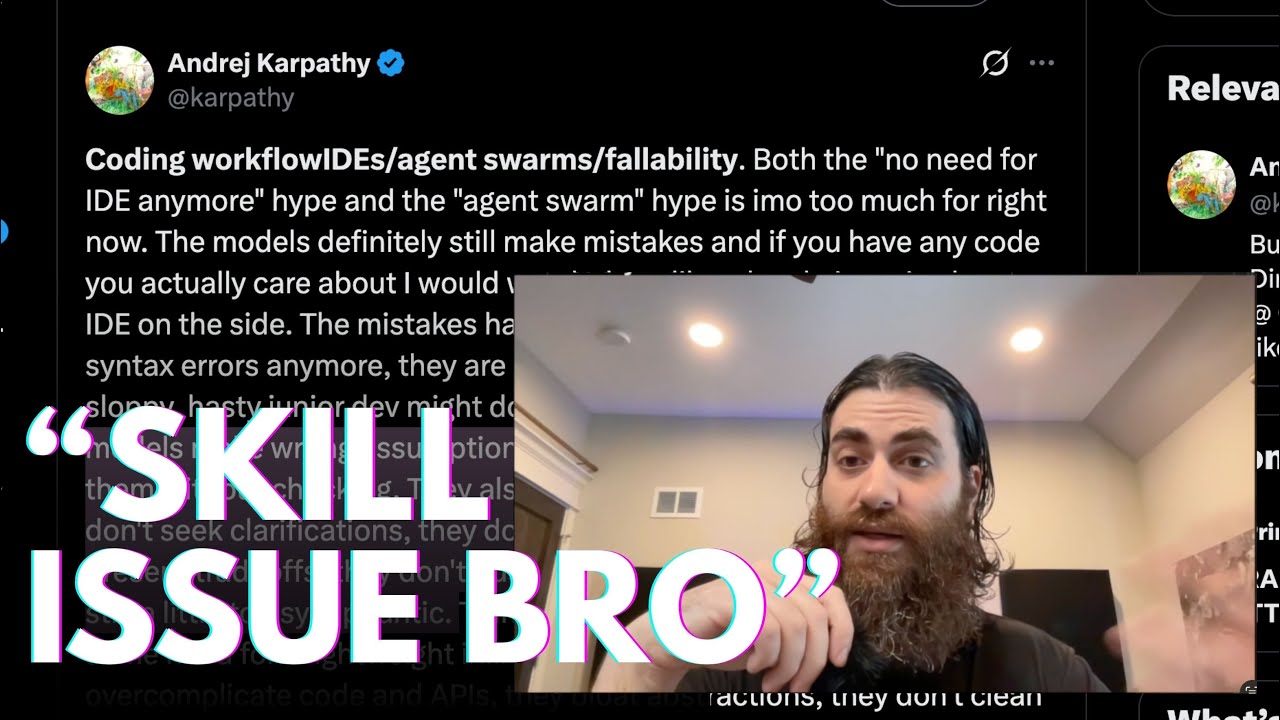
The video argues that there is little to no real “skill” involved in AI coding, or what some call “vibe coding,” “agentic engineering,” or “context engineering.” The speaker suggests that the goal of AI companies is to make their models so capable that anyone can use them, removing the need for specialized skill. Despite experimenting with various advanced prompting and workflow techniques, the speaker finds that the output from AI models remains consistently at a “junior developer” level, regardless of user expertise.
To support this point, the speaker references a post by Andrej Karpathy, a prominent AI researcher and former director of AI at Tesla, who coined the term “vibe coding.” Karpathy observes that while AI models no longer make simple syntax errors, they now make more subtle conceptual mistakes, such as making incorrect assumptions, failing to clarify ambiguities, and not surfacing inconsistencies or trade-offs. The models also tend to overcomplicate code, bloat abstractions, and leave behind dead code, often requiring human intervention to simplify or correct their output.
The speaker humorously compares the AI model, Claude, to a hypothetical coworker named Simon. If Simon exhibited the same behaviors as the AI—making wrong assumptions, failing to clarify, overcomplicating code, and deleting comments he doesn’t understand—he would likely be called into HR for a performance review. Yet, Simon is kept around because he works quickly and takes tasks off others’ plates, even if the quality of his work is questionable. This analogy highlights the tension between speed and quality in AI-generated code.
Despite these shortcomings, the speaker acknowledges that AI coding tools still represent a significant improvement in productivity, making it hard to imagine returning to manual coding. However, the speaker warns that relying too heavily on AI-generated code without proper oversight can lead to long-term problems, much like building a skyscraper on a shaky foundation. Bad code, even if it “works” in the short term, can be disastrous and costly to fix later.
In conclusion, the speaker advises that while AI tools like Claude (or “Simon”) can be useful for handling menial or repetitive coding tasks, they should not be trusted with foundational or critical software components. The art of good software engineering remains essential, as bad code can undermine entire projects. AI coding tools are best used as helpful interns rather than as replacements for skilled, experienced developers.