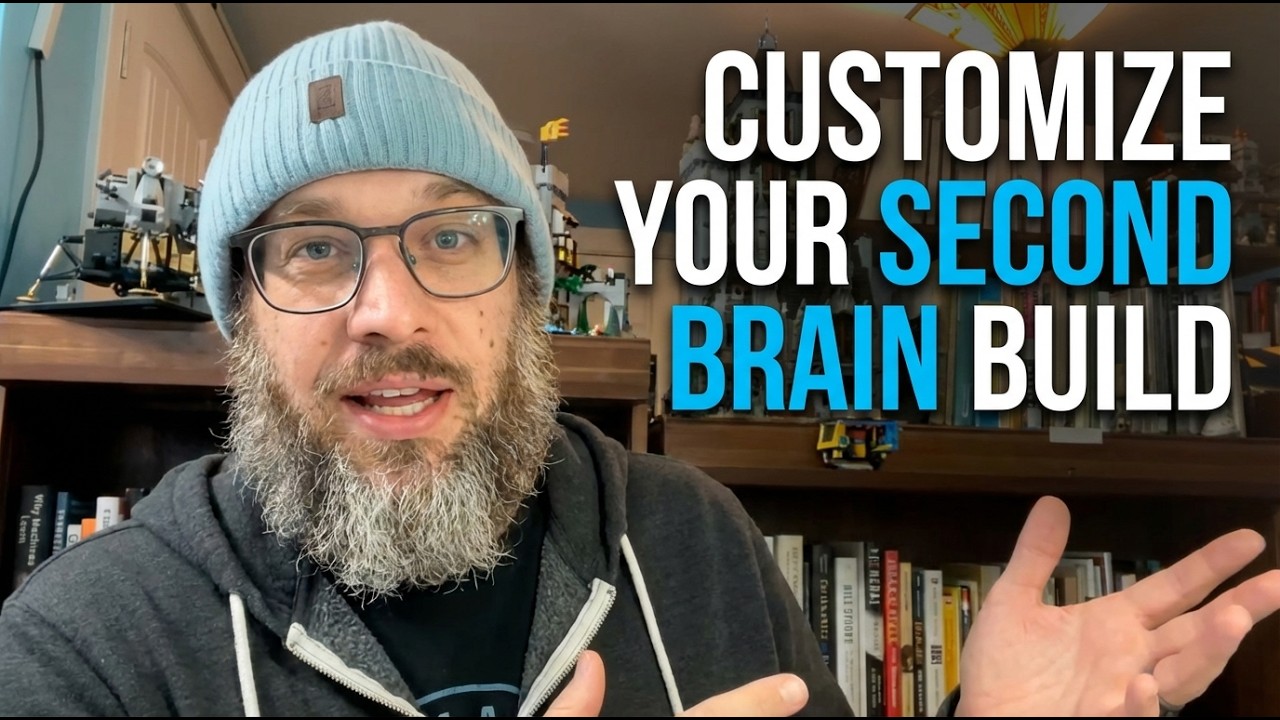
The video explores four key principles that distinguish successful AI system builders from those who get stuck or give up, based on the creator’s observations of a community project to build a “second brain” (a personal knowledge management system). The main insight is that while specific tools may vary, the underlying architectural patterns are what truly matter. Community members implemented the second brain using a wide range of tools—some not even mentioned in the original tutorial—demonstrating that a solid architecture is portable across different platforms. The emphasis is on learning and applying patterns, not memorizing tool-specific workflows.
The first principle is that architecture is portable, but tools are not. Builders who understood the core structure—such as having a capture point, a sorting mechanism, and an intelligence layer—were able to recreate the system using tools like Discord, Obsidian, MacWhisper, and others. This flexibility allowed for creative solutions and adaptations, showing that focusing on the architecture enables builders to swap out tools as needed without losing functionality.
The second principle is that principles-based guidance scales better than rules-based guidance, especially when working with AI. Instead of hard-coding rigid rules, successful builders provided their AI agents with general software development principles (like “don’t swallow errors” or “use test-driven development”). This allowed the AI to apply judgment in new contexts, making the systems more robust and adaptable. The video highlights that writing prompts and guidelines for AI should lean toward principles, enabling the AI to handle unforeseen situations more effectively.
The third principle is that if the agent builds the system, the agent can also maintain it. By involving AI agents in the construction process, builders ensure that the agent retains the necessary context to debug, extend, or repair the system later. This reduces the “switching cost” for human builders and allows for easier long-term maintenance, as the agent can be re-instantiated with its build memory intact. The video suggests that in 2026, involving AI in both setup and ongoing maintenance should be the default approach.
The fourth principle is that your system can be infrastructure, not just a tool. Some community members extended their second brain builds into reusable infrastructure, such as APIs and SDKs, enabling other applications to leverage their knowledge base. The video also notes the importance of community in accelerating builds: the fastest progress came from those who combined community-shared patterns with AI collaboration. Ultimately, the video concludes that the combination of community knowledge and AI implementation muscle is transforming how complex systems are built, making it easier and faster for anyone—not just engineers—to create powerful, personalized solutions.