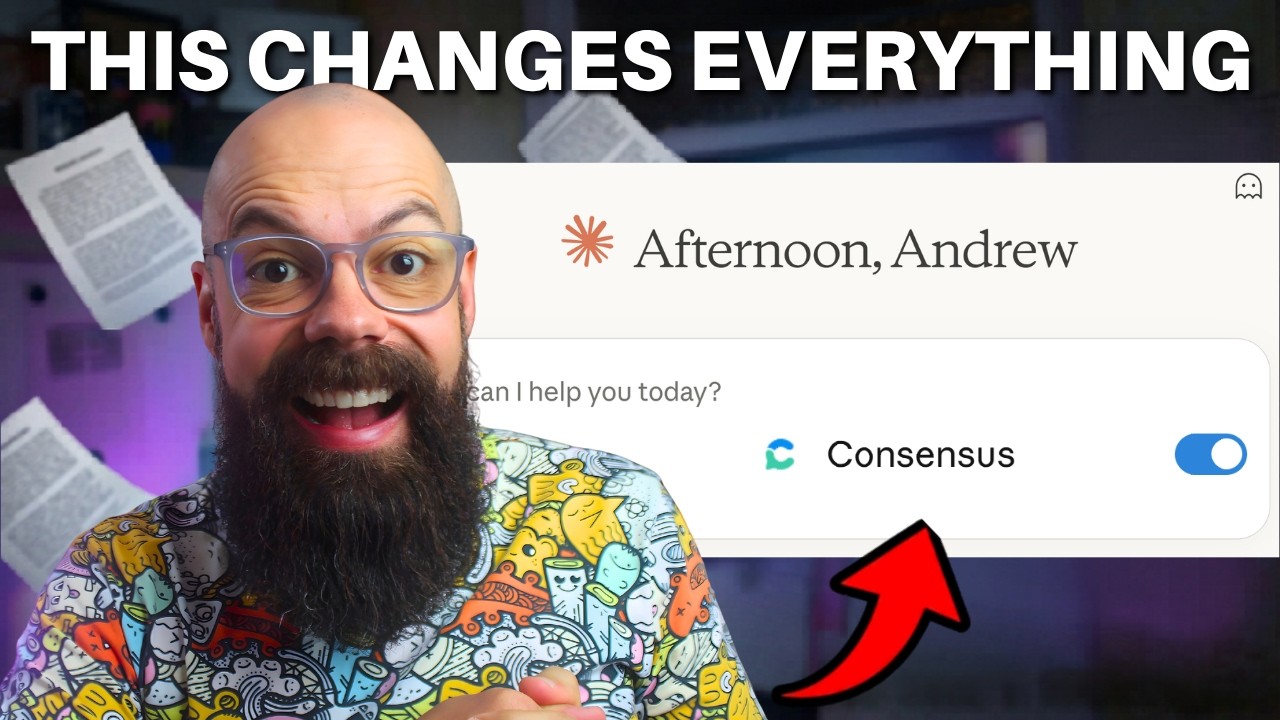
The video discusses a significant advancement in the use of large language models (LLMs) for academic research through the integration of Consensus AI with platforms like Claude and ChatGPT. Traditionally, LLMs have lacked deep understanding and specialized capabilities tailored to academic fields, limiting their usefulness for researchers. However, with the new Consensus AI MCP (Modular Connector Protocol) connection, users can now build custom research workflows that directly access peer-reviewed papers and data generated by Consensus, enhancing the research process significantly.
Connecting Consensus AI to Claude is straightforward. Users simply go to the customization settings in Claude, browse connectors, and select Consensus to establish the connection. Once connected, users gain access to Consensus’s powerful academic features within Claude, including the ability to run pre-built “skills.” These skills are specialized workflows designed to assist with various academic tasks such as curriculum development, literature reviews, and grant research. Consensus provides several ready-made skills, and users can also create their own tailored workflows using Claude’s skill creator tool.
The video highlights how these skills operate through detailed workflows that mirror academic research processes. For example, the literature review helper skill guides users through stages like initial reconnaissance, framework selection, and sub-area exploration, complete with error handling and structured outputs. Users can upload these skills into Claude and use them to automate complex research tasks. The skill creation process is user-friendly, allowing researchers to customize workflows that reflect their specific research needs and methodologies.
One of the most impressive demonstrations shown is the use of Claude’s co-work feature combined with Consensus. By inputting a research query, such as identifying research gaps in a PhD project on OPV devices, the system performs comprehensive literature searches, synthesizes findings, and generates detailed reports. These reports include topic overviews, key papers, historical context, and identified research gaps across various dimensions. This capability exemplifies how integrating Consensus with LLMs can transform academic research by providing thorough, structured, and actionable insights with minimal manual effort.
Finally, the video notes that this integration is not limited to Claude; ChatGPT users can also connect to Consensus via its app interface, enabling similar research-enhancing functionalities. Moreover, Consensus supports connections with various MCP clients beyond Claude and ChatGPT, such as Claude Code, CodeX, and others, broadening its applicability. This development represents a powerful fusion of academic AI tools and large language models, making advanced research workflows more accessible and efficient for scholars across disciplines. The presenter encourages viewers to explore this integration to enhance their academic work.