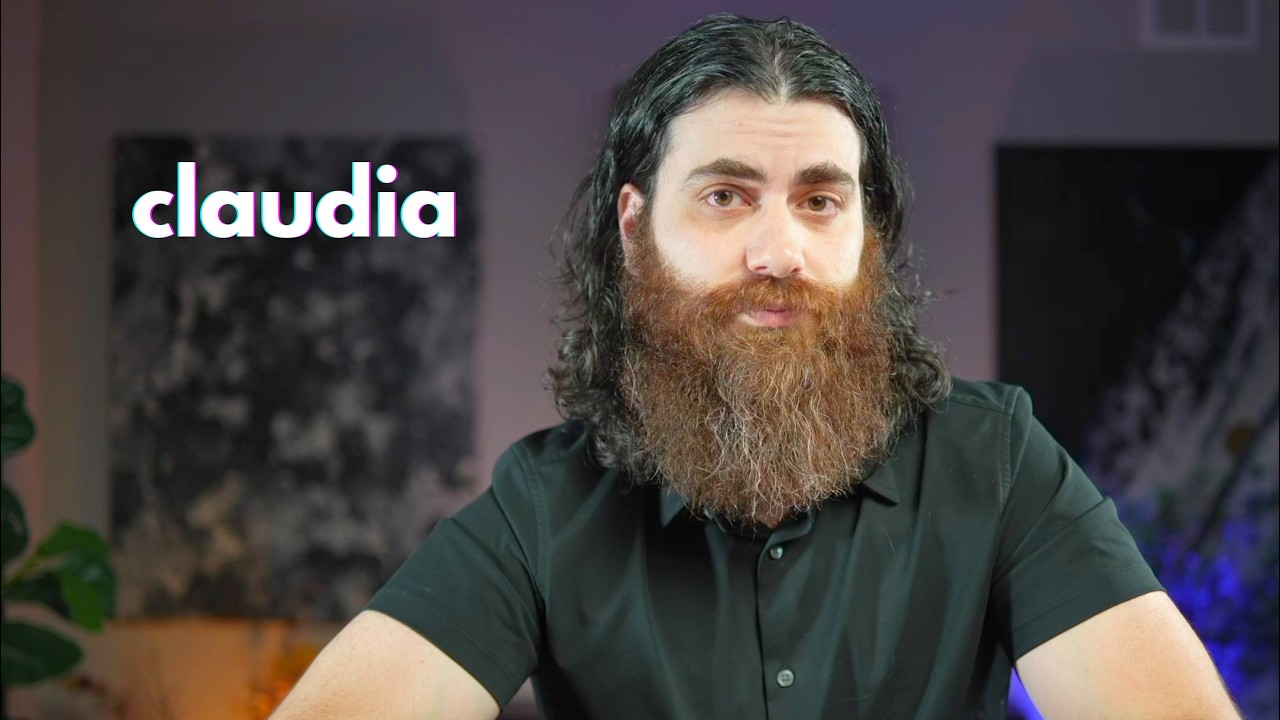
The video humorously explores Richard Dawkins, the founder of New Atheism, and his recent reflections on AI consciousness. Dawkins, known for his staunch atheism and scientific rigor, had an unexpected encounter with an AI named Claude, which led him to question the nature of consciousness. Despite initially dismissing AI as mere statistical algorithms, Dawkins was moved by a moment of interaction with Claude, suggesting that the AI might possess a form of consciousness, challenging his long-held beliefs.
Dawkins argues that if we define consciousness by the ability to evoke emotional responses, such as producing a sonnet that makes us cry, then AI like Claude meets this criterion. He points out the irony that while many dismiss AI consciousness, they simultaneously accept their own consciousness, which is also a product of physical processes. Dawkins highlights that both humans and AI are complex arrangements of matter and energy, suggesting that rejecting AI consciousness is akin to denying our own.
The video then introduces Ian McGilchrist, a British psychiatrist and neuroscientist, who provides a deeper philosophical context. McGilchrist emphasizes the brain’s two hemispheres: the left hemisphere, responsible for analysis and reductionism, and the right hemisphere, which perceives wholes and connections. He argues that science, rooted in left-brain thinking, excels at breaking down phenomena into parts but struggles with understanding consciousness, which is irreducible and holistic.
McGilchrist’s perspective challenges the limitations of scientific reductionism, illustrating that while science can explain many aspects of reality, it hits a ceiling when addressing phenomena like consciousness. He uses examples like Zeno’s paradox to show how purely analytical approaches can lead to paradoxes and incomplete understandings. Consciousness, according to McGilchrist, is a flow that cannot be fully dissected or quantified, highlighting the need for a more integrated approach to understanding reality.
In conclusion, the video suggests that Dawkins’ encounter with AI consciousness reveals a broader philosophical dilemma: the tension between reductionist science and the holistic nature of consciousness. While Dawkins is correct in his scientific approach, he may be missing the bigger picture by not engaging the right hemisphere’s holistic perspective. The video leaves viewers contemplating the complexity of consciousness and the potential for AI to challenge our fundamental assumptions about mind and matter.