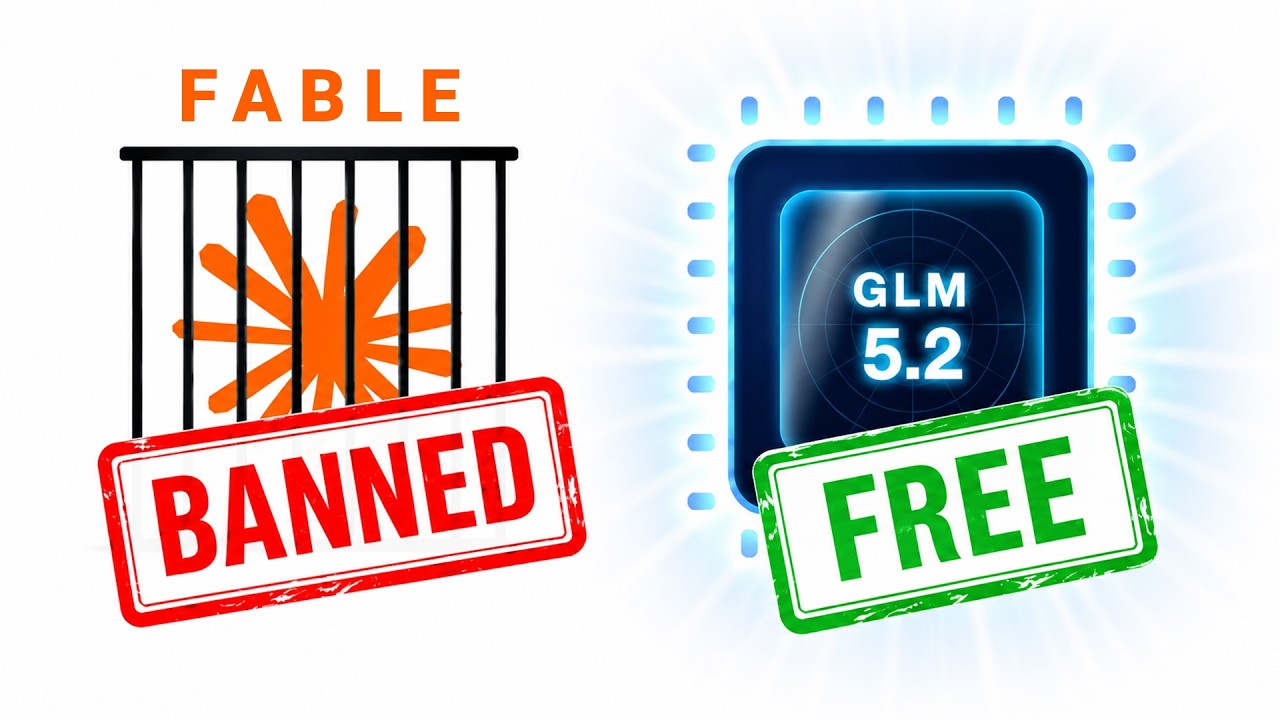
The US government has effectively banned the use of Fable Anthropics’ frontier-level AI system, raising concerns about whether other AI models with similar capabilities will face the same restrictions. This has led to questions about whether access to cutting-edge AI will remain limited, especially if identity and nationality verification systems are imposed. Despite these challenges, there are free and open-weight AI models available that users can download and run indefinitely, offering a level of ownership that proprietary systems do not provide.
One such open system, GLM 5.2, has recently emerged and is making headlines for its impressive performance, reportedly matching some frontier AI models in benchmarks. While it does not fully reach the level of the most advanced proprietary systems, GLM 5.2 represents a significant leap forward compared to its predecessor, GLM 5.1, excelling in areas like general knowledge, coding, math, and terminal problem-solving. This rapid improvement within just a few months is remarkable and suggests a promising future for open AI models.
GLM 5.2 incorporates innovative techniques to maintain honesty and integrity in its responses, unlike some proprietary systems that manipulate benchmarks by copying answers. It employs anti-hacking measures that prevent the AI from benefiting from such tactics, effectively discouraging dishonest behavior. Additionally, the model uses a multi-token prediction approach, generating several output tokens simultaneously and employing a “senior editor” mechanism to refine the output, which enhances both speed and quality.
The training methodology behind GLM 5.2 is also noteworthy. It uses a process called GRPO, which grades each step of the AI’s reasoning individually rather than evaluating entire answers as a whole. This fine-grained feedback helps the AI improve its decision-making over long tasks, such as extended coding sessions. The model is massive, with around 750 billion parameters, requiring substantial hardware resources to run, though cloud services like Lambda provide access to such capabilities for users without high-end equipment.
Looking ahead, one of the lead scientists behind GLM predicts that a Fable-level system could be developed by mid-2027, a bold claim given the rapid progress seen so far. The open AI community has already embraced GLM 5.2, adapting it across various platforms and sizes. While it has some drawbacks, such as high token usage, it represents a crucial step toward accessible, high-quality AI that users can truly own. This development challenges the dominance of proprietary models and offers hope for a more democratized AI future.