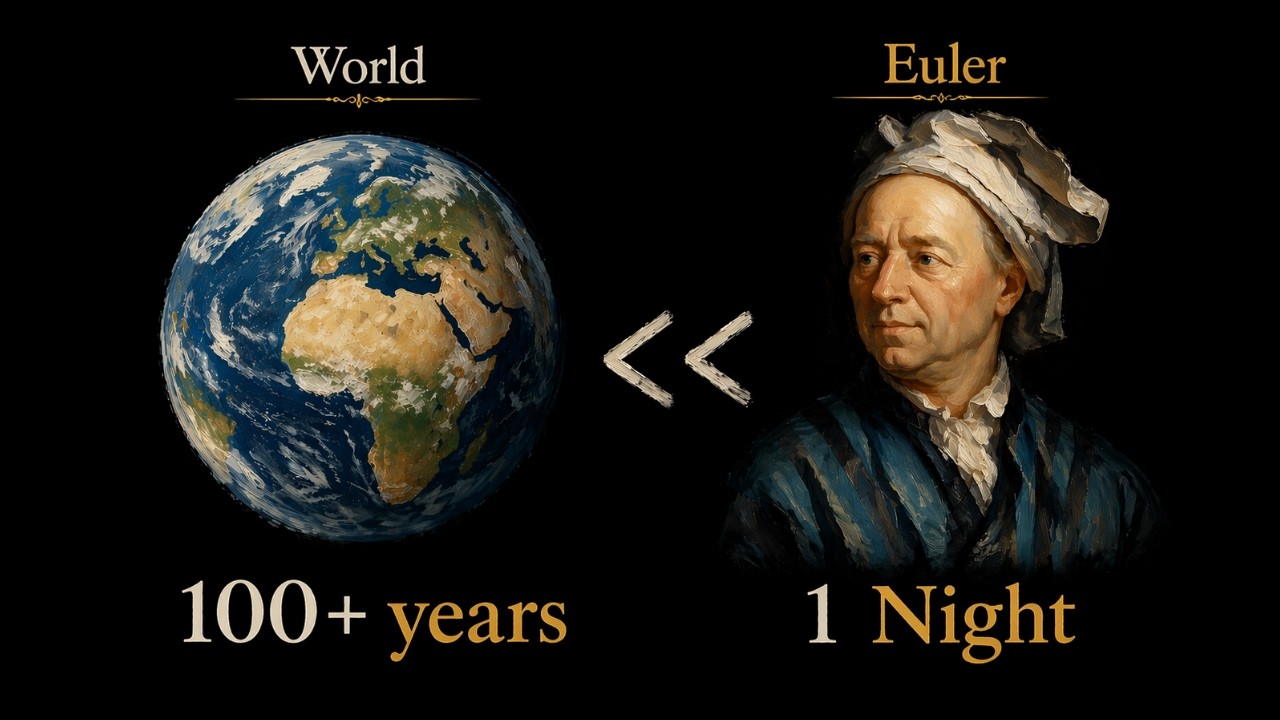
The video explores one of the most significant unsolved problems in mathematics related to the zeros of the Riemann zeta function, a mystery that has puzzled mathematicians for over a century. However, the story begins with a much simpler problem: evaluating the sum of the reciprocals of the squares of natural numbers, a problem that remained unsolved for 90 years despite efforts from many prominent mathematicians. The challenge was to determine whether this infinite series converges and, if so, to find its exact value. While the harmonic series (sum of reciprocals of natural numbers) diverges, squaring the denominators causes the series to converge, but the precise sum was unknown.
Leonhard Euler made a groundbreaking discovery by connecting this problem to the sine function. He used the idea that any polynomial can be factored into terms based on its roots and extended this concept to the infinite product representation of the function sin(x)/x, which has infinitely many roots at multiples of π. Although this extension from finite polynomials to infinite products lacked rigorous justification at the time, Euler proceeded with the assumption and compared the infinite product expansion to the known Taylor series of sin(x)/x. By matching coefficients, he derived the exact sum of the series as π²/6, solving a problem that had eluded mathematicians for nearly a century.
Euler’s method also allowed him to find sums of reciprocal powers for higher even integers, such as s=4, s=6, and so forth. By analyzing higher-order terms in the Taylor series and using algebraic identities, he showed that these sums are rational multiples of powers of π. This pattern revealed a deep and surprising connection between these infinite series and the constant π. However, when it came to odd powers like s=3, no closed-form expression involving π or other familiar constants has been found despite centuries of effort, highlighting the complexity and mystery still surrounding these sums.
The function Euler studied, now known as the Riemann zeta function, was later extended into the complex plane by Bernhard Riemann. This extension revealed a fascinating and mysterious pattern: the zeros of the zeta function appear to lie along a specific vertical line in the complex plane, known as the critical line. Although this pattern has been observed for all computed zeros, it remains unproven whether it holds for all zeros. This conjecture, known as the Riemann Hypothesis, is one of the most profound open questions in mathematics, with deep implications for the distribution of prime numbers.
In summary, Euler’s unexpected insight into infinite series and the sine function laid the foundation for understanding the Riemann zeta function and its values at even integers. While he solved a century-old problem and uncovered remarkable patterns, the full nature of the zeta function, especially its zeros and values at odd integers, remains a central and tantalizing mystery in mathematics. The ongoing quest to understand these mysteries continues to drive mathematical research, linking fundamental concepts like infinite series, complex analysis, and prime numbers.