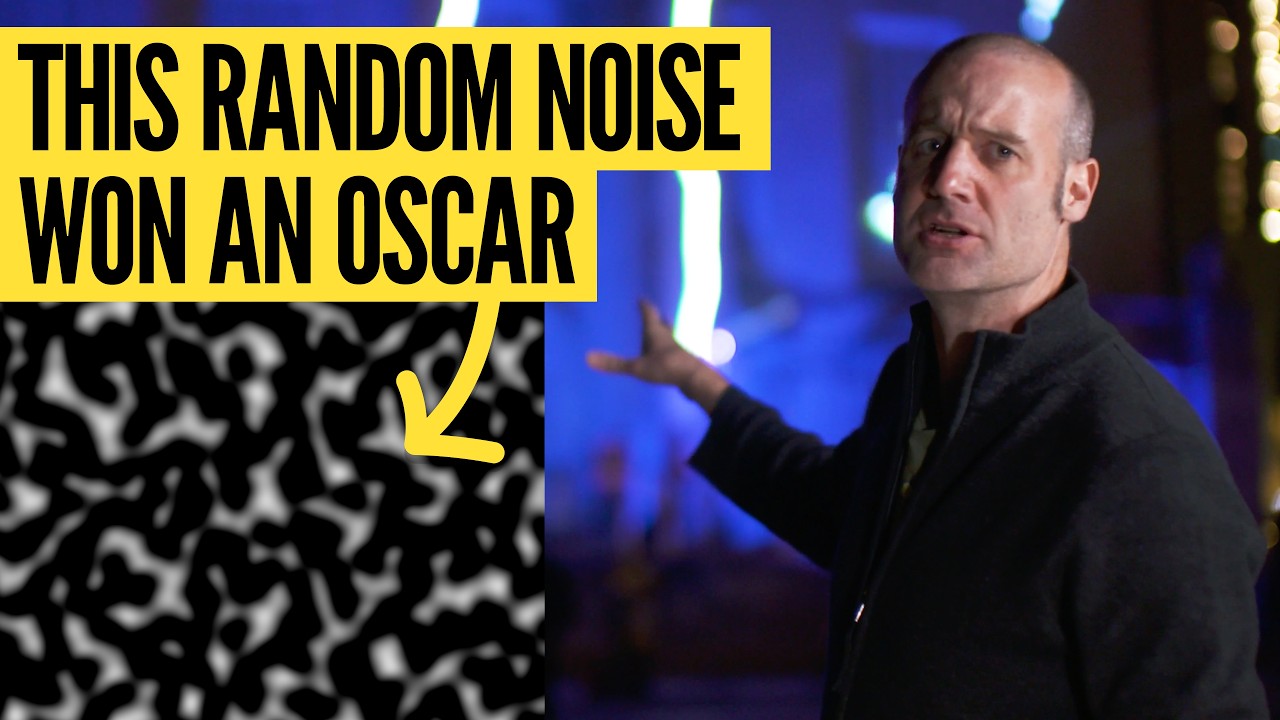
The video takes place at the Leeds Late Night Festival, where the presenter explores the mathematics behind creating realistic lightning bolt effects using lasers. The key challenge is generating randomness that appears natural and continuous, unlike simple random noise which is jerky and unnatural. The presenter introduces Perlin noise, a type of pseudo-random noise that produces smooth, continuous patterns resembling natural phenomena. Unlike true random noise, Perlin noise has memory and flows smoothly from one point to the next, making it ideal for visual effects like lightning.
Perlin noise works by assigning a random unit vector to each integer coordinate on a grid and then calculating dot products between these vectors and the vectors from the grid points to the point of interest. These dot products are then averaged with smoothing functions to produce continuous noise values. The original Perlin noise used completely random vectors, but later versions use a fixed set of vectors with clever permutations to improve computational efficiency. A special smoothing polynomial is applied to ensure the noise transitions smoothly, which is both mathematically elegant and computationally efficient.
To address the computational complexity of Perlin noise in higher dimensions, a variant called simplex noise was developed. Simplex noise replaces the hypercube grid structure with simplexes (triangles in 2D, tetrahedrons in 3D, and their higher-dimensional analogs), reducing the number of calculations needed. This makes it feasible to generate noise in 3D, 4D, and beyond with linear computational complexity rather than exponential, enabling more complex and realistic effects in computer graphics and visual effects.
The presenter also discusses how Perlin noise can be layered at different scales, called octaves, to create fractal noise that mimics the complexity of natural textures. By combining multiple octaves with decreasing amplitude and increasing frequency, the noise gains detail and realism. This technique is used by the laser artist Seb to create dynamic lightning effects, where the noise controls the shape and movement of the lightning bolt over time. The video includes a demonstration of how these noise layers combine to produce the final effect, with additional techniques like sine wave envelopes to fix the endpoints of the lightning.
Finally, the video highlights the significance of Perlin noise in the visual effects industry, noting that its creator, Ken Perlin, won an Academy Award in 1997 for this invention. The presenter expresses admiration for Perlin noise as his favorite type of random noise and shares personal projects involving unique noise-based images for Patreon supporters. The video concludes with thanks to the laser artist Seb and an invitation to explore more about the technology on Seb’s YouTube channel, along with information about upcoming shows and Patreon rewards.