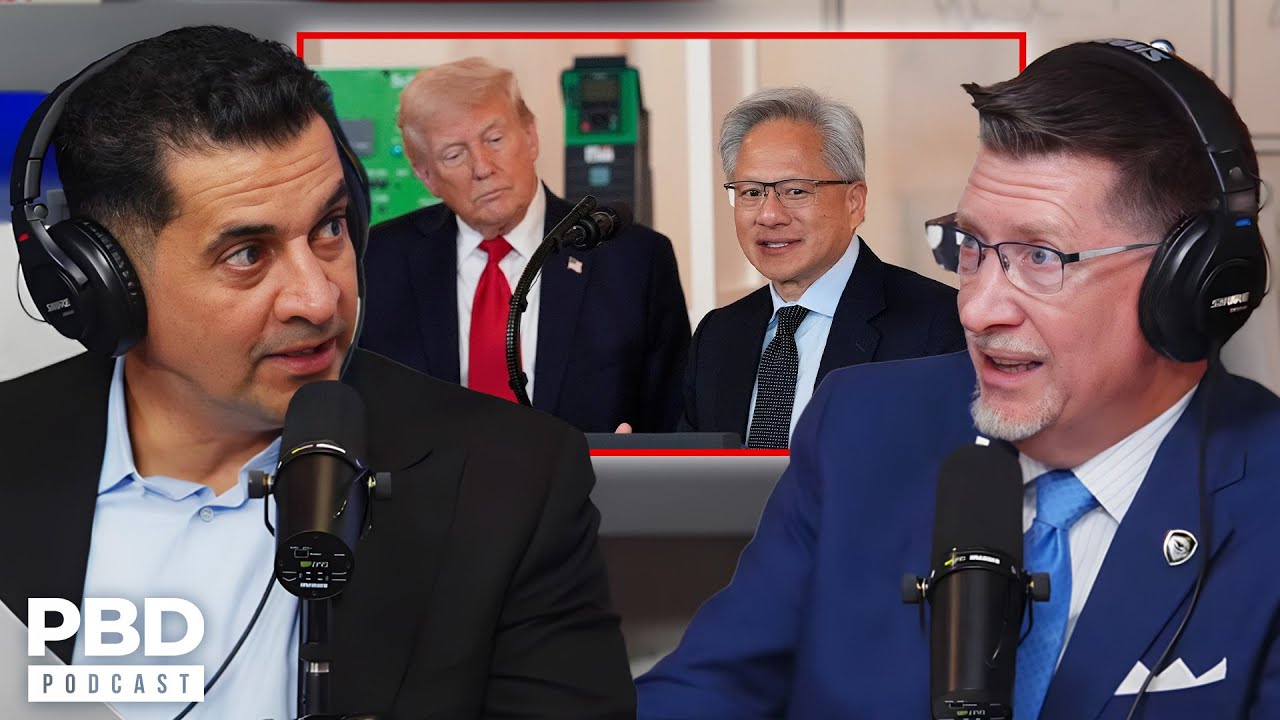
The video discusses the Trump administration’s decision to block Nvidia from exporting its most advanced AI chips to China, framing the chips as critical “tomahawk missiles” in the AI arms race with significant national security implications. It highlights the tension between economic interests and strategic security, emphasizing the need to maintain U.S. technological superiority while navigating complex geopolitical dynamics with China.
The video discusses the Trump administration’s decision to block Nvidia’s attempt to export its most advanced AI chips, specifically the Blackwell chips, to China. This move came shortly before President Trump’s meeting with Chinese President Xi Jinping in South Korea. Nvidia’s CEO, Jensen Huang, had been lobbying to maintain access to the Chinese market, but officials viewed allowing the export of these cutting-edge chips as a significant geopolitical risk that could accelerate China’s technological capabilities. Trump made it clear in a CBS 60 Minutes interview that while he would allow some deals between Nvidia and China, the most advanced semiconductors would not be sold to China.
The discussion highlights the strategic importance of these AI chips, comparing them to “tomahawk missiles” in the AI arms race. The chips are critical for building data centers and advancing AI technology, which has implications not only for economic competitiveness but also for national security and defense. The panelists express concern that even with export controls, China might still gain access to advanced technology through proxy locations or other indirect means, emphasizing the complexity of controlling technology flow in a globalized world.
There is also a debate about the balance between economic interests and national security. Nvidia stands to gain tens of billions of dollars from exports to China, which could create a dependency of Chinese companies on Nvidia’s technology. However, the panelists argue that long-term strategic thinking must prevail over short-term financial gains to maintain America’s technological edge. They stress the importance of keeping the technological gap between the U.S. and China wide, likening the situation to a nuclear arms race where maintaining superiority is crucial.
The video further explores the geopolitical dynamics, suggesting that China might use delays in trade negotiations as leverage to obtain these advanced chips. The panelists speculate on whether the U.S. should concede to China’s demands to finalize a broader trade deal or hold firm to protect national security interests. They emphasize that the U.S. has other leverage points, such as tariffs and resource deals, which could be used to negotiate from a position of strength without compromising on critical technology exports.
Finally, the video transitions into a promotion for a business planning workshop scheduled for December 12th, aimed at entrepreneurs and business leaders looking to prepare for the complex economic and geopolitical environment ahead. The speaker encourages viewers to register for the event to gain insights into managing risks and opportunities in the coming years, highlighting the importance of strategic planning in an uncertain global landscape. The video closes with invitations to watch more related content and the full podcast.