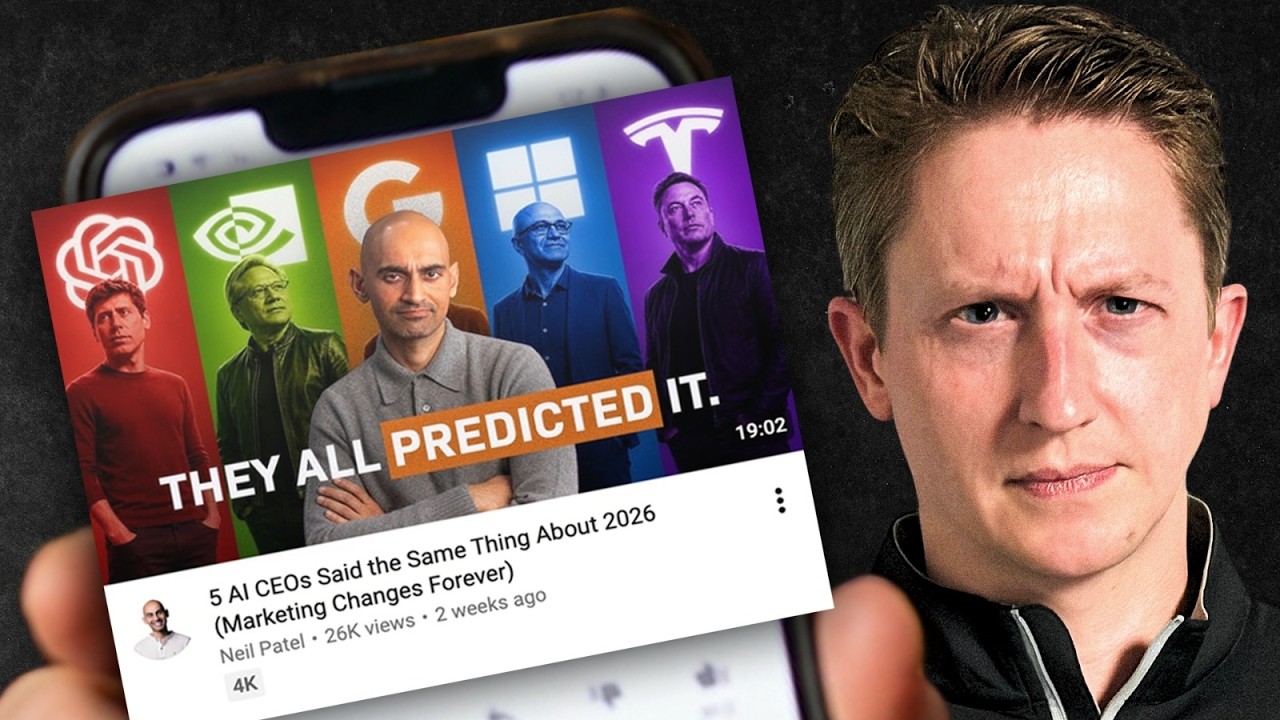
The video critiques Neil Patel’s recent discussion about a major shift in marketing driven by AI, particularly focusing on the transition from AI models to AI systems and agents. While Neil correctly identifies that AI is changing marketing dynamics, especially with AI agents pulling and citing content rather than traditional keyword-based SEO, the critique points out that the current tools for tracking AI citations are unreliable and overly simplistic. The presenter demonstrates that AI responses vary significantly even with similar prompts, making AI citation tracking dashboards misleading and not reflective of real user behavior.
Neil highlights insights from five influential AI CEOs, including Sam Altman, Sundar Pichai, Satya Nadella, Jensen Huang, and Elon Musk, who collectively signal a shift from AI models to autonomous AI systems capable of continuous, context-aware work. This shift means marketers must optimize content not just for human readers but for AI agents that extract and cite information to answer user queries. The presenter agrees with the overall direction but emphasizes that this new AI-driven marketing still largely relies on traditional SEO fundamentals like entity work, structured data, and content architecture, with only minor new elements such as review language and branded search gaining importance.
A key takeaway is that the era of keyword-focused SEO is ending, replaced by entity-based optimization where businesses must prove their identity, trustworthiness, and relevance to AI agents. This involves comprehensive content strategies that integrate schema markup, detailed reviews, and off-site mentions to build a strong entity profile. The presenter stresses that many agencies are still selling outdated SEO tactics or simple AI content generation as AI strategy, which falls short of the systemic approach needed to succeed in this new landscape.
The video also discusses how AI-driven traffic, while currently a small fraction of total site visits, generates disproportionately high revenue and conversion rates, especially for high-trust purchases. However, much of the AI influence happens upstream, where AI agents create shortlists that users then verify through branded searches on Google. This means marketers should focus on being included in these AI-generated shortlists rather than chasing direct AI referral traffic, which remains limited but valuable.
Finally, the critique underscores that building a true AI-driven marketing system requires integrating content production, entity architecture, schema, internal linking, review generation, and off-site signals into a cohesive, automated workflow. This systemic approach contrasts sharply with the common practice of producing isolated AI-generated content pieces. While Neil’s video is praised for pointing in the right direction, the presenter highlights the need for practical strategies tailored to businesses without massive content teams and invites viewers to explore more detailed, hands-on approaches to building AI-optimized marketing systems.