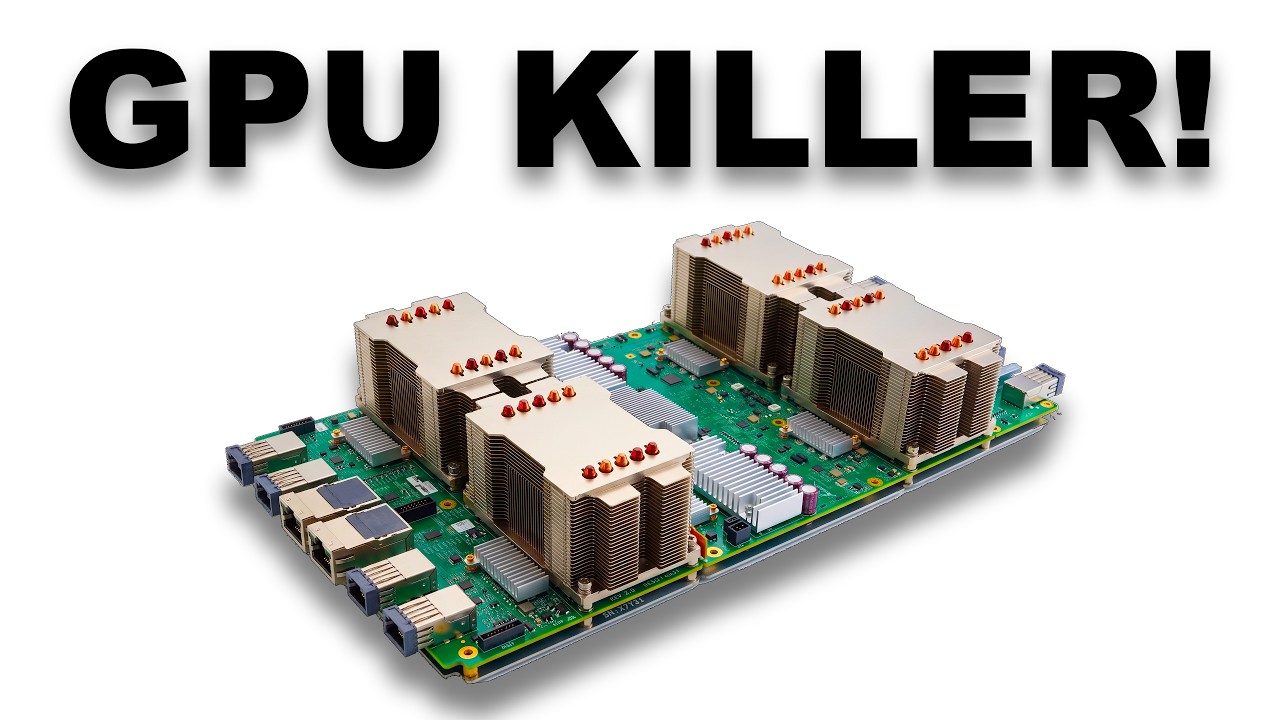
The video explores the paradox in the AI hardware industry where Nvidia GPUs dominate the market despite Google’s TPU chip being technically superior. Google’s TPU, designed with a systolic array architecture, overcomes the Von Neumann bottleneck inherent in GPUs by efficiently reusing data within the chip, resulting in significantly faster and more energy-efficient AI computations. Google demonstrated the TPU’s power by training advanced AI models like Gemini entirely on TPUs, and the chip operates at nearly half the cost of comparable Nvidia systems.
However, despite these advantages, TPUs remained largely confined to Google’s data centers for nearly a decade. The primary reason is that TPUs are ASICs—application-specific integrated circuits—designed for a specific type of computation (matrix multiplication). This rigidity made companies wary of investing heavily in TPUs, fearing that future AI architectures might render the chips obsolete. In contrast, Nvidia GPUs, though less efficient, are general-purpose processors that can adapt to new algorithms simply by updating software, making them a safer investment.
Another significant barrier was Google’s control over TPU access. For years, TPUs were only available through Google Cloud, meaning companies had to rely on Google as a supplier and competitor, limiting adoption. Additionally, Nvidia’s early investment in CUDA, a free and widely adopted software platform, created a vast ecosystem of developers and tools around GPUs. This software advantage made GPUs more accessible and easier to integrate into AI workflows, further entrenching Nvidia’s dominance.
Recently, the landscape has shifted dramatically. The Transformer architecture, perfectly suited to TPU’s design, has become the industry standard, validating Google’s original bet. Major AI players like Anthropic, Meta, and Apple have started adopting TPUs, with Google beginning to sell the chips directly for use in external data centers. This marks a significant change, breaking down previous barriers of access and software ecosystem, and positioning TPUs as a viable competitor to Nvidia’s GPUs.
In conclusion, the video highlights that while TPUs have always been the superior hardware for AI, their limited accessibility and lack of a broad software ecosystem prevented widespread adoption. Nvidia’s GPUs won not because they were better, but because they were more usable and supported. Now that Google is addressing these issues by opening TPU access and the AI industry has standardized on Transformer models, the question shifts to how Nvidia will respond to this new competition and what the future holds for AI hardware.