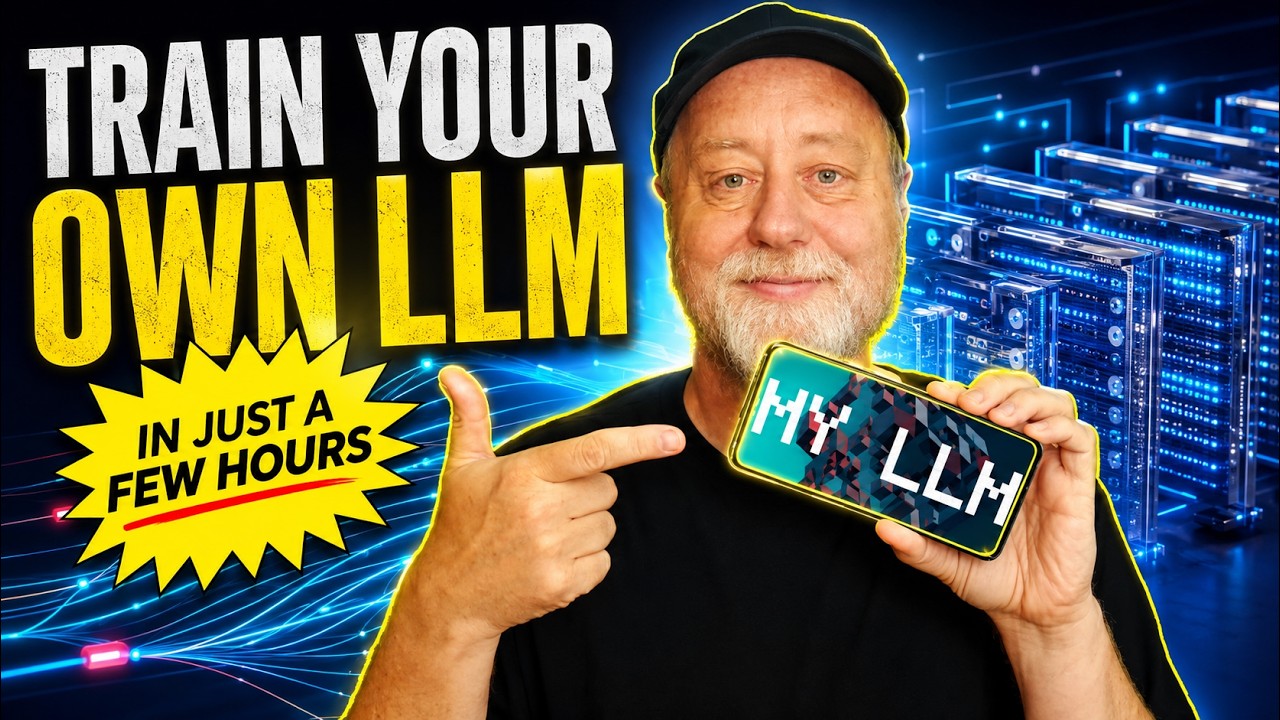
The video explains how to train your own tiny large language models (LLMs) on a personal computer, even without a powerful GPU, making it accessible for enthusiasts and learners. The presenter demonstrates training two different LLMs: a 10 million parameter model on the complete works of Shakespeare (about 1MB of text), which can be trained in under an hour with a GPU or overnight on a CPU, and a larger 24 million parameter model trained on a 2.1GB Tiny Stories dataset, requiring a GPU and taking a few hours. This hands-on approach helps deepen understanding of how LLMs work by building and experimenting with them directly.
The foundation for this project is a GitHub repository called “Train an LLM from Scratch,” inspired by Andrej Karpathy’s nanoGPT project but scaled down for easier learning. The repository provides step-by-step instructions to build the training pipeline from scratch, though the presenter offers a shortcut by sharing completed code, data, and instructions for those who prefer not to follow the entire process manually. The package includes scripts for training and generating text, model files, and datasets like Shakespeare’s works and Sherlock Holmes stories, allowing users to experiment with different training materials.
The video also highlights the importance of Python and PyTorch for running the training scripts, noting that users must choose the appropriate PyTorch version depending on their hardware (CPU, Nvidia GPU, Intel GPU, or AMD GPU) to optimize performance. After training, users can generate text completions using prompts, with adjustable parameters like temperature and top-k to influence the output. The Shakespeare-trained model produces text that mimics Shakespearean style, demonstrating the potential of even small datasets and models to generate coherent, stylistically relevant text.
The second dataset, Tiny Stories, consists of simple, child-friendly short stories with limited vocabulary and sentence complexity, enabling faster and more efficient training of small models. This dataset is ideal for beginners because the simplicity allows the model to learn word relationships quickly and generate fluent, consistent stories. The training process supports interruption and resumption, making it practical for users training on personal hardware over multiple sessions. The presenter encourages experimentation with different model sizes and training steps to optimize results.
Finally, the presenter shares personal experiences of scaling up to a 50 million parameter model trained on a large public domain book dataset using cloud GPUs, noting that while results are less impressive than with Tiny Stories, the process offers valuable insights into LLM training dynamics. The video concludes by encouraging viewers to explore various datasets and model sizes to deepen their understanding of LLMs and enjoy the learning journey. The overall message is that training tiny LLMs at home is feasible, educational, and fun, providing a practical way to grasp the fundamentals of large language models.