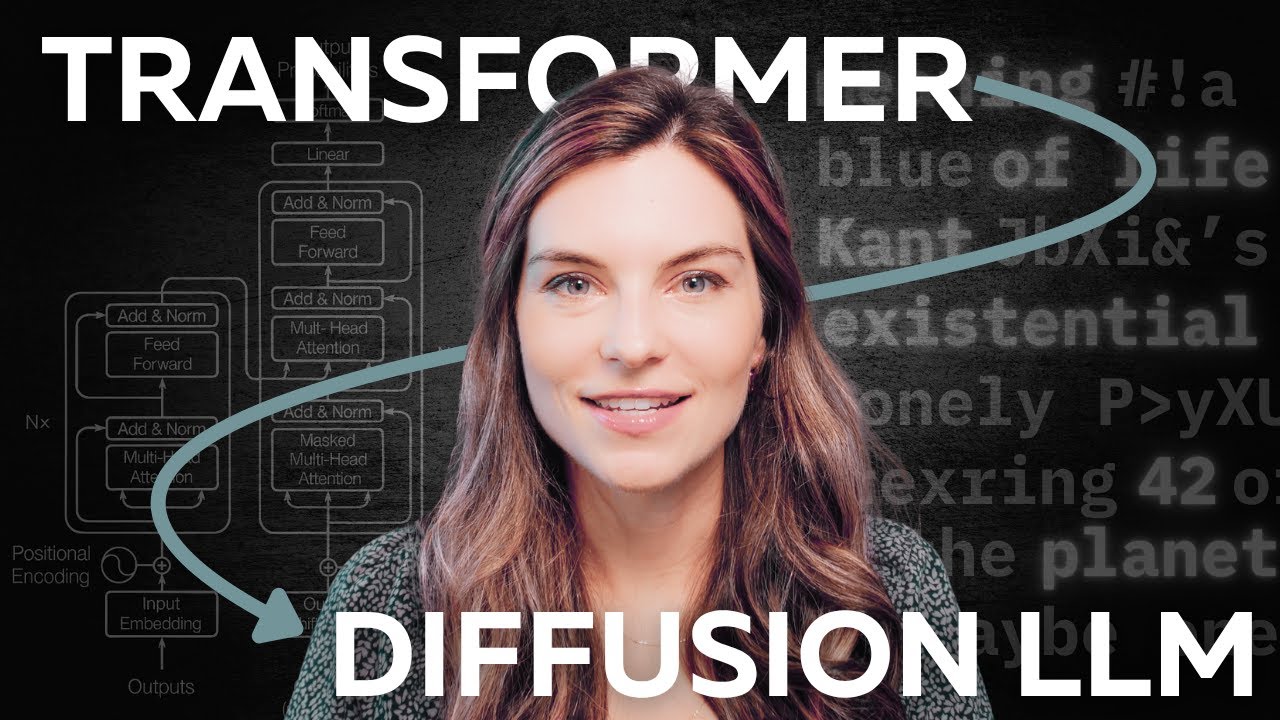
The video explores the connection between transformers and diffusion-based large language models (LLMs), clarifying that transformers are the foundational architecture powering both traditional autoregressive models like GPT and newer diffusion LLMs. Unlike autoregressive models that generate text one token at a time without revision, diffusion LLMs start from noise and iteratively refine their output, promising faster inference, higher quality, and more flexible prompting. The video begins by tracing the origin of transformers, introduced by Google researchers in 2017 primarily for machine translation, and explains how this architecture revolutionized natural language processing by replacing recurrent neural networks.
Transformers consist of two main components: an encoder and a decoder. The encoder processes the input sequence with full self-attention, where every token attends to every other token, creating contextual embeddings. The decoder generates output tokens one at a time using causal attention, which only allows tokens to attend to previous tokens, ensuring proper sequence generation. This architecture was initially designed for machine translation, a sequence-to-sequence task, but later adaptations used either the encoder or decoder separately for different language tasks. For example, autoregressive LLMs like GPT use only the decoder with causal attention to predict the next token based on previous tokens, enabling them to learn from vast amounts of free-form text through next-token prediction.
The video then discusses BERT, a transformer encoder model designed for text classification tasks such as sentiment analysis. BERT introduced masked language modeling, where 15% of tokens are randomly masked and the model learns to predict them all at once, enabling it to understand context bidirectionally. This pre-training approach differs from autoregressive models and is well-suited for tasks where the entire input is available upfront. BERT’s architecture and training method laid the groundwork for diffusion LLMs, which extend the masked language modeling concept by iteratively refining masked tokens through multiple diffusion steps, gradually reducing noise to generate coherent text.
Diffusion LLMs, exemplified by models like Lada, start inference with a prompt followed by a sequence of masked tokens representing noise. Over several diffusion steps, the model progressively uncovers and predicts tokens, refining the output until a coherent response emerges. Training diffusion LLMs involves randomly masking different proportions of tokens at each step, teaching the model to handle varying noise levels. While this approach is less efficient than autoregressive training—since only some tokens are predicted per step—it offers advantages such as avoiding sampling drift, where errors in early predictions can cascade in autoregressive models.
In summary, the video highlights that transformers are a versatile architecture that underpins both autoregressive and diffusion-based LLMs. Autoregressive models rely on the decoder with causal attention for sequential token generation, while diffusion models build on the encoder with masked language modeling to iteratively refine noisy inputs. This evolution reflects a broader trend in machine learning to balance efficiency, quality, and flexibility in natural language generation. The video concludes by noting that transformers have also expanded beyond language to dominate vision tasks, setting the stage for future discussions on their applications in image and video processing.