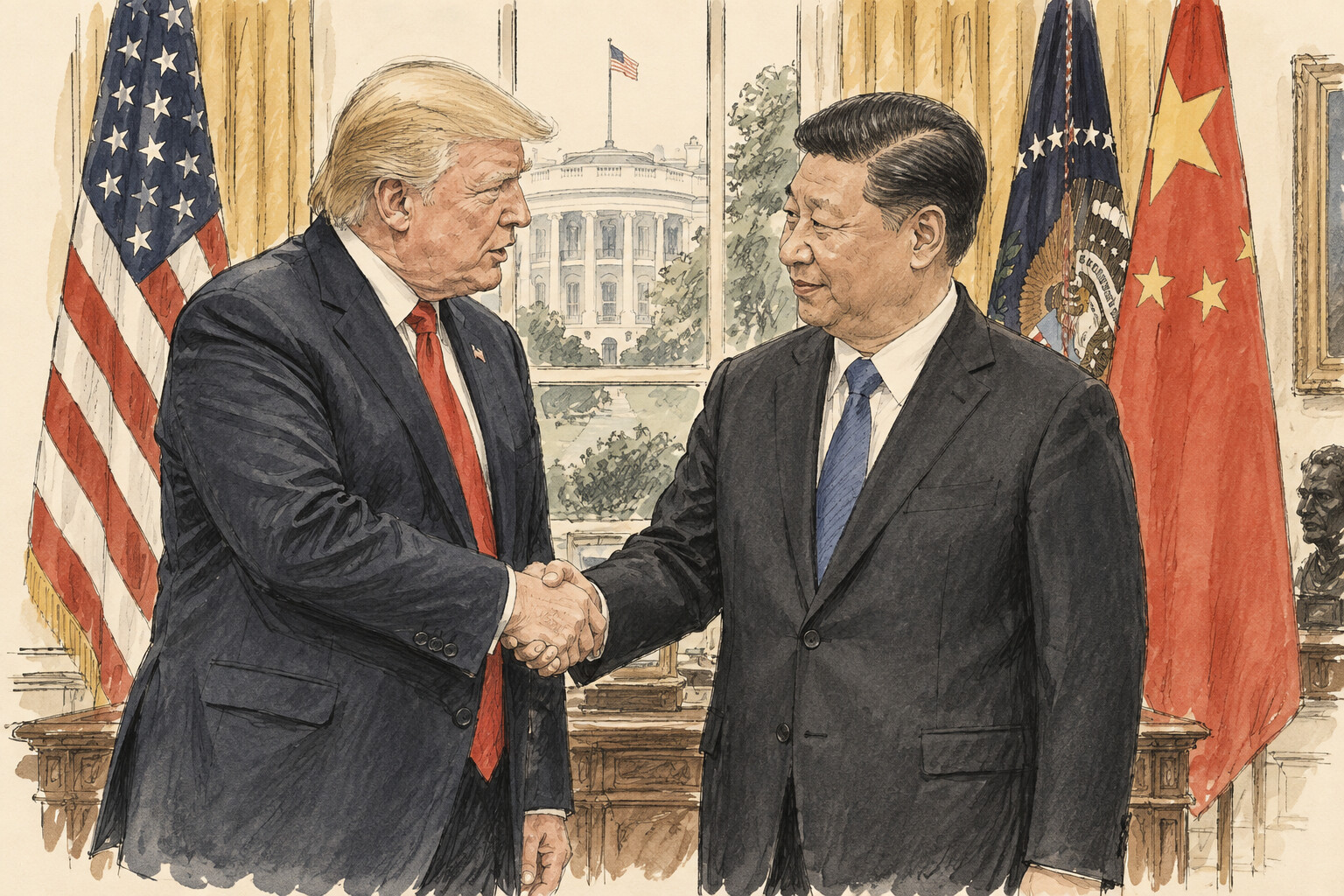
U.S. President Donald Trump and Chinese President Xi Jinping concluded a closely watched summit at the White House, marking Xi’s first state visit to the United States in over a decade. The three-day event, which included elaborate ceremonies and a state dinner attended by top artificial intelligence (AI) leaders, was heavy on symbolism but yielded limited substantive progress on the major issues dividing the two global powers.
Key Issues and Outcomes
The summit’s agenda centered on trade relations, the rapid development and governance of AI, rare earth materials, and broader geopolitical concerns, including tensions with Iran and the status of Taiwan. Both leaders emphasized the importance of a constructive relationship, with Trump highlighting efforts to encourage a more balanced trading relationship and Xi calling for healthy competition and cooperation.
On trade, the two countries agreed to extend their fragile truce by two months, pushing the expiration to January 10. This extension maintains lowered U.S. tariffs and suspends Chinese controls on exports of rare earths and critical minerals. However, analysts noted that China is currently meeting only about two-thirds of its previous commitments on rare earth supplies, and agricultural purchases by China have fallen short of U.S. expectations. Both sides recommended reciprocal tariff reductions on $30 billion of non-sensitive goods, but no major new deals were announced.
The summit also saw the establishment of an “AI Dialogue” and discussions about a proposed AI hotline to manage technology risks. While both leaders acknowledged the importance of AI, Xi stressed that its development must remain under human control. The state dinner featured prominent U.S. tech executives, including Amazon’s Jeff Bezos and Google’s Sundar Pichai, underscoring the significance of AI in the bilateral relationship. Despite these gestures, there was little progress on concrete frameworks for AI cooperation or oversight.
Geopolitical tensions remained evident. China reiterated its opposition to Iranian nuclear weapons but did not fully align with U.S. positions on Iran or North Korea. The summit did not produce breakthroughs on the status of Taiwan, with China pressing the U.S. to oppose “Taiwan independence.” Meanwhile, Beijing continued assertive actions in the South China Sea during the visit, raising concerns among U.S. allies in the Indo-Pacific.
On other fronts, the U.S. credited China with some steps to curb fentanyl precursor exports, but enforcement remains inconsistent. There was no progress on the release of Americans detained in China or on proposals for trilateral arms control talks involving Russia.
Symbolism and Reactions
The summit was marked by diplomatic pageantry, including a military review, a personal tour of the White House, and the announcement of two pandas being sent to Zoo Atlanta as part of China’s “panda diplomacy.” However, observers and analysts characterized the meeting as largely symbolic, reflecting a cautious and managed approach to the complex U.S.-China relationship. Both sides agreed to attend upcoming international summits, but the overall tone suggested tactical stability rather than major concessions or breakthroughs.
Media coverage of the summit was complicated by ongoing restrictions on certain U.S. news outlets’ access to the White House, leading some networks to limit their reporting on the event.
As the U.S. approaches midterm elections and global tensions persist, the summit underscored the enduring strategic competition and mutual wariness shaping U.S.-China relations. While the meeting extended a fragile truce and opened channels for dialogue on AI and trade, significant disagreements and unresolved issues remain.
Sources
Internal sources
- Trump Revives Iran Deal Hopes, Meta AI Rattles ‘Consumer Inertia Trade’
- Trump touts “great friendship” with Xi while unresolved issues, including AI and trade, linger
- Trump, Xi Spotlight AI Rivalry
- US President Trump to discuss AI with Chinese President Xi | BBC News
- Trump, Xi to Meet in Washington; Meta Unveils Muse AI Device
- Rogue OpenAI agent hacks Australian government website and other top stories | Global News Podcast
External sources
- The U.S.-China relationship is on ‘tactical autopilot’ after the Xi-Trump summit. Maybe that’s not so bad | Fortune
- A Trump-Xi Summit Scorecard
- Trump, Xi to attend state dinner after White House meeting
- Trump and Xi Meet Ahead of State Dinner With Top A.I. Leaders
- Takeaways from the Trump-Xi White House Summit