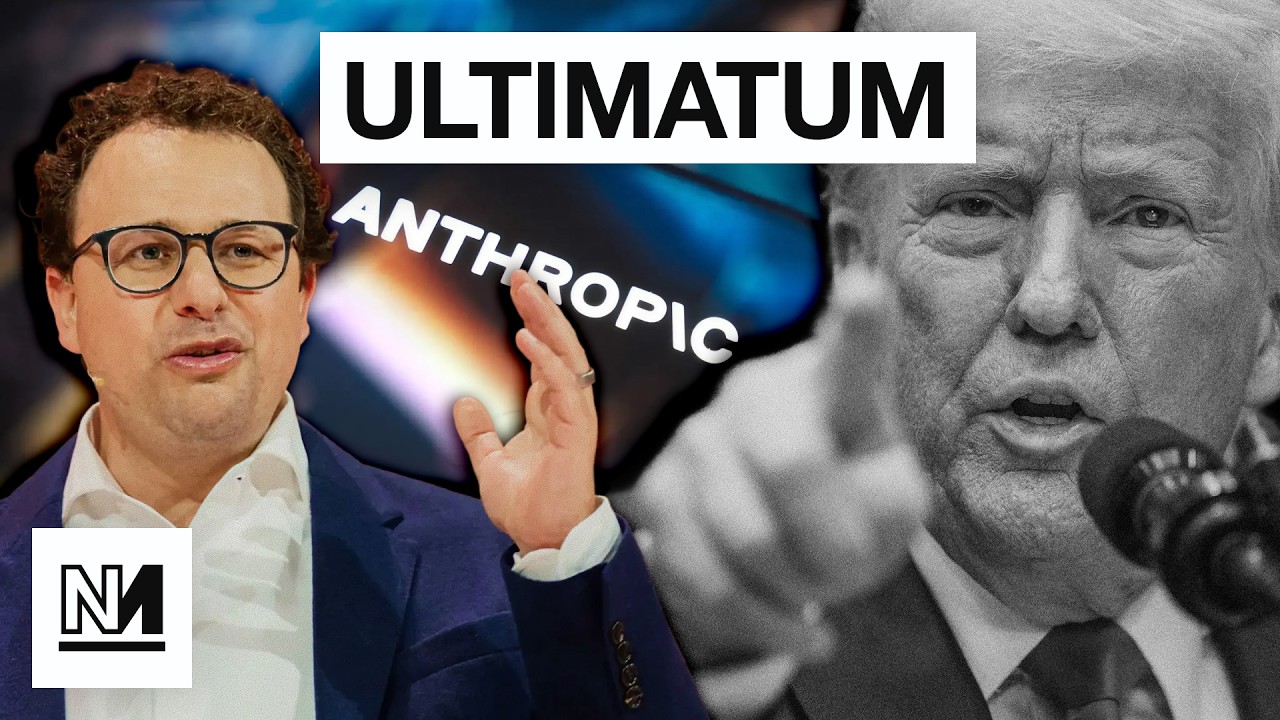
The video discusses a major conflict between Anthropic, the AI company behind Claude, and the Trump administration, specifically the Pentagon. The Department of Defense has a $200 million contract with Anthropic but wants unrestricted access to Claude’s AI capabilities, including for surveillance and autonomous weapons. Anthropic, led by CEO Dario Amodei, is resisting, insisting on safeguards to prevent the use of its AI for mass surveillance of Americans or fully autonomous weapon systems. The standoff has escalated, with Defense Secretary Pete Hexf reportedly threatening to cut ties, label Anthropic a supply chain risk, or invoke the Defense Production Act to force compliance.
The Defense Production Act would allow the government to compel Anthropic to prioritize Pentagon contracts and adapt its AI to military needs, bypassing the company’s ethical restrictions. This move is seen as highly adversarial and could have significant consequences for Anthropic, as being labeled a supply chain risk would force many other companies to avoid using Claude in their workflows. Despite the pressure, Amodei is holding firm on his red lines, willing to adapt some policies but refusing to enable mass surveillance or fully autonomous weapons.
The standoff has drawn strong reactions. Some commentators, like historian Rutger Bregman and journalist Mehdi Hasan, praise Amodei for standing up to government overreach and defending ethical principles, contrasting him with other tech leaders who are more compliant. Amodei himself has explained his concerns about AI undermining constitutional rights, particularly the Fourth Amendment, and the dangers of removing human oversight from lethal decision-making. He warns that AI could be used to circumvent legal protections and enable mass surveillance in ways previously impossible.
The discussion broadens to the global impact of AI in warfare, citing examples from the conflict in Gaza where AI systems like Gospel and Lavender have been used for rapid target selection, resulting in high civilian casualties. Even with human oversight, AI has already transformed warfare, raising alarms about what could happen if the Pentagon gains unrestricted access to advanced models like Claude. The hosts express skepticism about relying on tech CEOs to safeguard humanity, noting that politicians often lack the understanding or will to regulate AI effectively.
Finally, the video addresses recent reporting that Anthropic has weakened its own internal safety policies. Previously, the company pledged not to release AI models unless it could guarantee adequate safety measures, but it has now shifted to a more flexible approach, citing competitive pressures. This change has sparked criticism that market forces are pushing even the most principled companies to compromise on safety. The hosts conclude by reflecting on the broader risks of AI, not just existential threats but also the gradual erosion of human skills and sociality as society becomes increasingly dependent on AI-driven convenience.