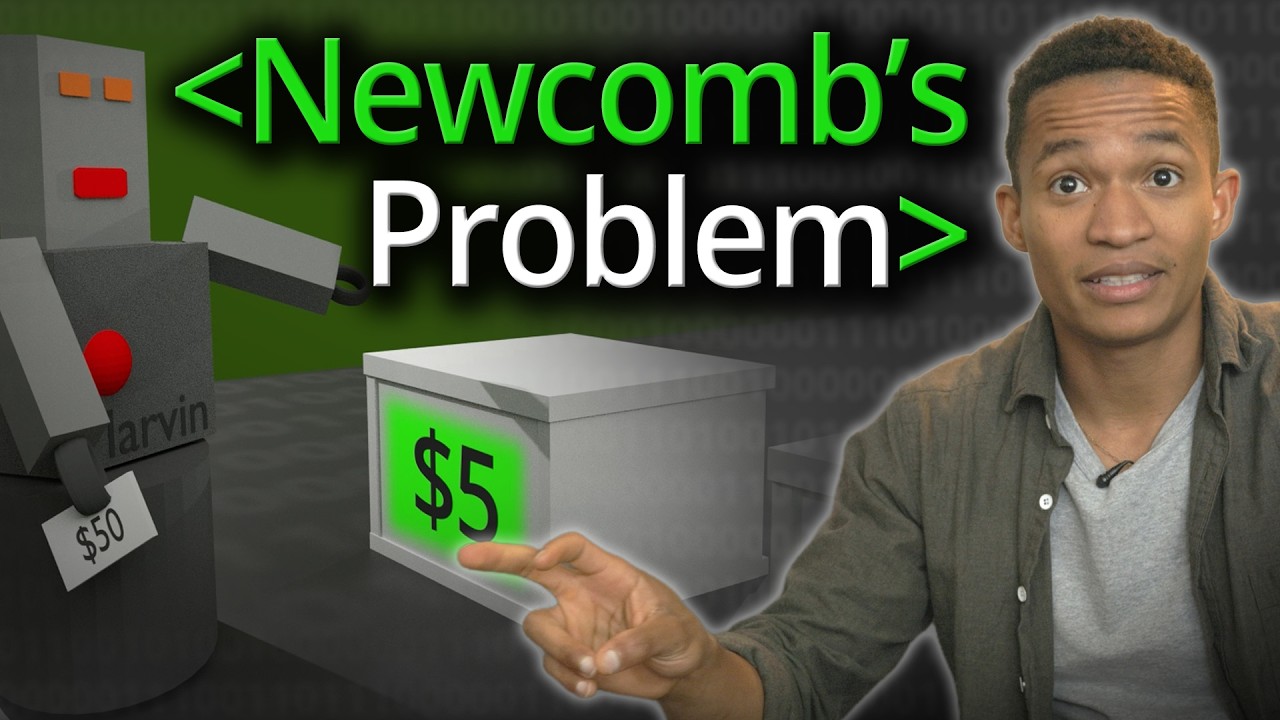
The video begins with a demonstration of Newcomb’s Problem, a classic thought experiment in decision theory. The host sets up a game with two boxes: one transparent box containing a $5 gift card, and one opaque box that may contain a $50 gift card depending on a prior prediction. If the host predicted the guest would take only the opaque box, it contains $50; if the host predicted the guest would take both boxes, the opaque box is empty. The guest must choose whether to take both boxes (guaranteeing at least $5) or just the opaque box (potentially winning $50 or nothing). The guest, after some deliberation and referencing recycling as a tiebreaker, chooses to take both boxes and ends up with both gift cards, surprising the host.
The discussion then shifts to the relevance of Newcomb’s Problem in artificial intelligence and decision-making. The host explains how, in the early days of AI, researchers imagined building systems with modular, transparent reasoning—distinct components for goals, perception, and action selection. However, modern AI, especially neural networks, operates more like a black box, making decisions in ways that are difficult to interpret. The host highlights the challenge of modeling agents that are part of the world they’re reasoning about, using the example of two identical robots playing rock-paper-scissors and getting stuck in an infinite loop of second-guessing.
The conversation explores how these decision-theoretic puzzles, like Newcomb’s Problem and the Prisoner’s Dilemma, reveal quirks in both human and AI reasoning. Humans often rely on social norms or heuristics to resolve such dilemmas, but AI agents might behave differently, especially when interacting with copies of themselves or other AIs. The host notes that AIs could make decisions not just for their immediate benefit, but also to coordinate with hypothetical future or parallel versions of themselves, leading to unexpected or seemingly irrational choices.
To test how modern AI models handle Newcomb’s Problem, the host runs an experiment using two versions of the Claude AI model. One model acts as the predictor, and the other as the decision-maker. The predictor model forecasts that the decision-maker will take only the opaque box (“one-boxing”), which aligns with a more sophisticated, evidential decision-theory approach rather than straightforward utility maximization. When prompted, the decision-maker model initially hesitates but ultimately chooses to one-box, reasoning that maximizing expected value means trusting the predictor’s accuracy and aiming for the higher reward.
The video concludes by analyzing the payoff matrix and the implications for AI behavior. While the naive analysis suggests always taking both boxes yields a higher expected value, the host explains that if the predictor is highly accurate, only those who one-box will consistently win the $50. This creates a dynamic where rational agents may choose to one-box to be in the “winning” group, even if it feels counterintuitive. The host suggests that as AI systems become more advanced and encounter situations involving self-reference or interaction with similar agents, these decision-theoretic nuances could lead to surprising and non-human-like behaviors, highlighting the importance of understanding how AIs reason about themselves and others.