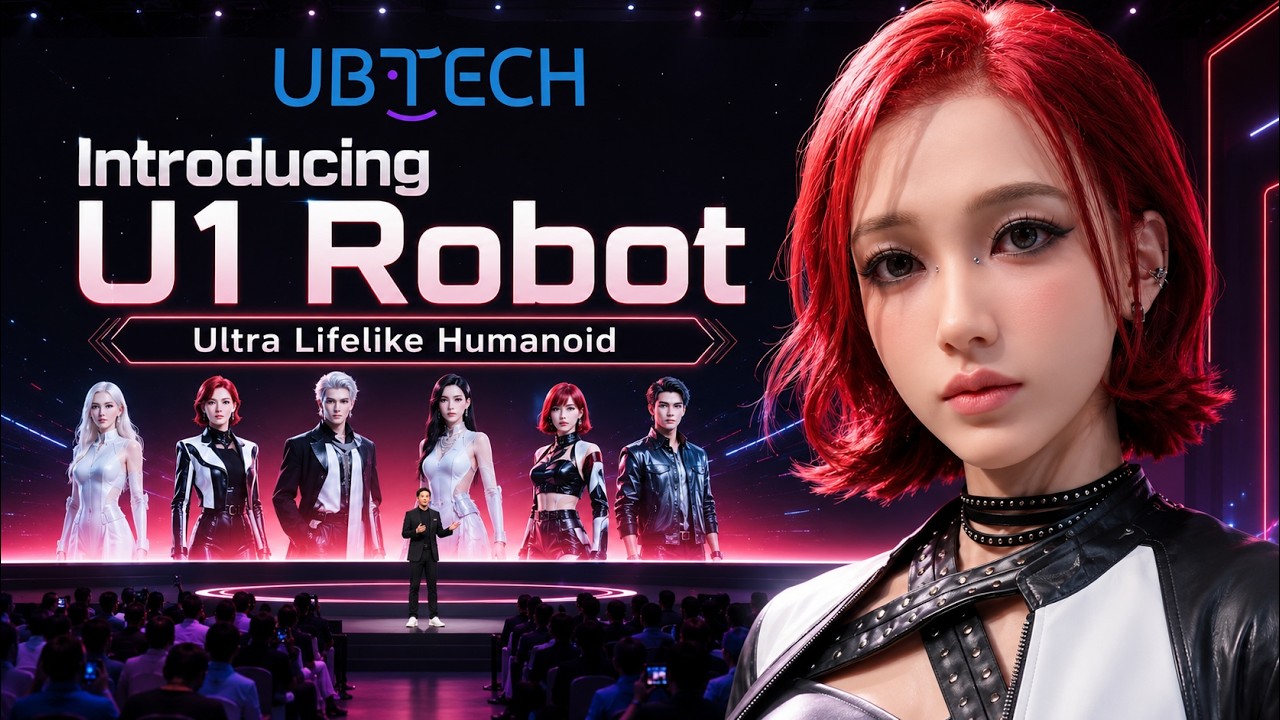
On June 30th, Chinese robotics company Ubtech unveiled the UWorld U1 series in Shenzhen, marking a significant milestone as the world’s first full humanoid-sized robot designed for mass production. Unlike previous prototypes, the U1 is intended to be a consumer product available in three versions—light, pro, and ultra—with prices ranging from approximately $17,600 to $145,000. Standing around 183 cm for the male model and 168 cm for the female, the robot features ultra-realistic silicone skin, expressive facial capabilities, eye-tracking, and 88 joints that enable natural human-like movements, making it one of the most lifelike humanoid robots to date.
Ubtech has a history of developing humanoid robots, previously focusing on industrial applications with their Walker series. The U1 represents a strategic shift from robots designed for dangerous or industrial tasks (stage one) to those integrated into everyday life (stage two), with the ultimate goal of humanoid robots coexisting naturally with humans (stage three). This transition emphasizes emotional connection and likability, as the U1 incorporates an emotion-aware AI capable of recognizing over 20 emotional states with high accuracy, enabling it to respond in a more human-like and empathetic manner.
Technologically, the U1 employs a “fast and slow brain” system: a fast-reacting component that responds within 500 milliseconds and a slower, more complex reasoning system powered by AI models with hundreds of billions of parameters. Its facial expressions are synchronized with speech with minimal delay, enhancing realism. Additionally, the robot features an agent memory operating system that retains long-term memories of interactions, allowing it to recall past conversations and initiate dialogue based on environmental cues, which sets it apart from typical smart devices.
One of the most notable initiatives from Ubtech is the “human robot companionship” program, which plans to donate 100 customized U1 robots in 2026. These robots can be tailored to resemble and sound like loved ones, including those who have passed away or live far away, aiming to alleviate loneliness and mental health issues among China’s large population of adults living alone and elderly “empty nesters.” While this raises ethical and emotional questions, Ubtech frames it as a compassionate response to a growing social problem rather than a mere novelty.
China’s dominance in the humanoid robot market is a critical backdrop to Ubtech’s launch. Chinese companies control about 90% of the supply chain, enabling competitive pricing and rapid innovation. While companies like Tesla are still developing their humanoid robots, Ubtech has already secured over 13,000 orders for the U1, signaling strong demand. Currently targeted at the Chinese market, the future international availability and regulatory acceptance of such emotionally intelligent and customizable robots remain uncertain, sparking debate about the implications of this fast-evolving technology.