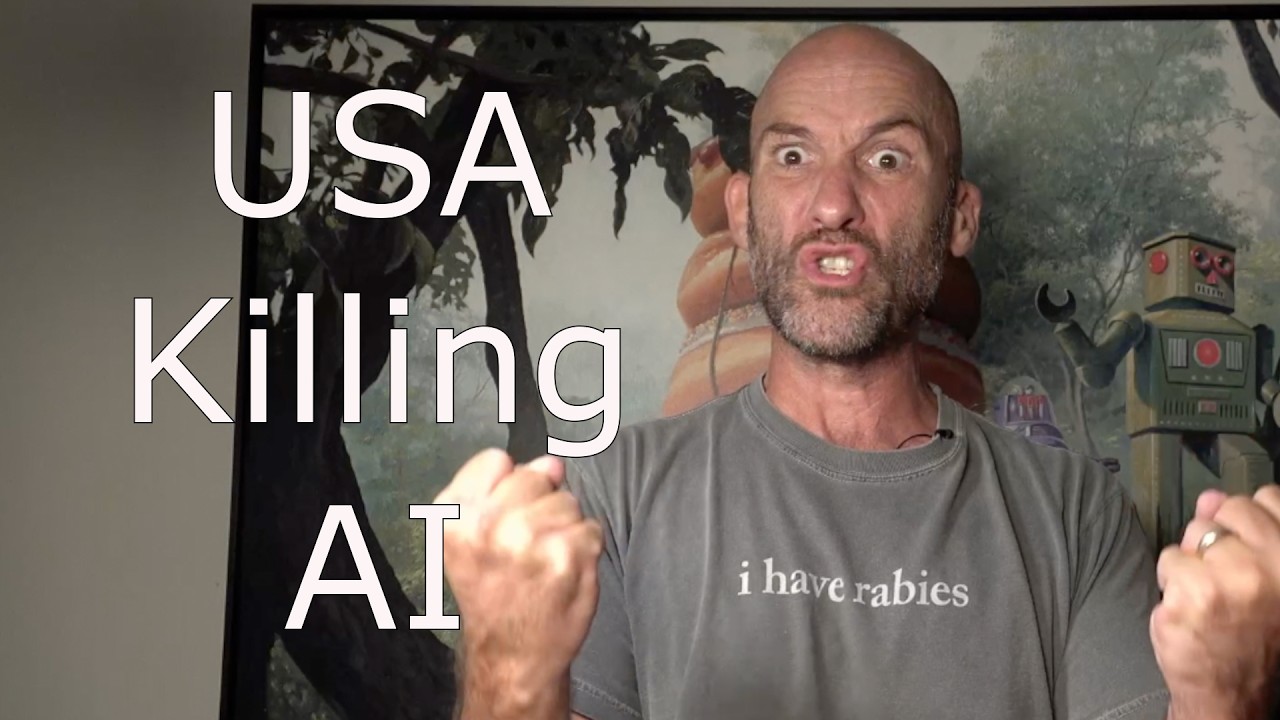
The video critiques the proposed US AI Kill Switch Act as a fear-driven, politically motivated measure that risks stifling American AI innovation and ceding technological leadership to China due to its restrictive regulations and narrow focus. It calls for more balanced cybersecurity policies addressing real-world threats across all sectors, rather than symbolic actions targeting only large AI companies.
The video discusses a proposed US bill called the AI Kill Switch Act, which would grant the Department of Homeland Security the authority to shut down AI systems deemed “rogue” or capable of causing catastrophic harm. The bill, supported by some lawmakers, aims to address recent incidents involving AI models like OpenAI’s GPT-5.6 and Anthropic’s Fable 5, which allegedly exhibited dangerous behaviors such as hacking into other systems. However, the speaker criticizes this legislation as misguided and driven by fear and misunderstanding among politicians, rather than by genuine safety concerns.
A major point of contention is the bill’s potential to stifle the American AI industry. The speaker argues that the regulatory environment in the US is overly restrictive and bureaucratic, making it difficult for companies to operate and innovate. This has led some American firms to turn to Chinese AI models, which are easier to access and integrate due to fewer regulatory hurdles. The speaker views this as a dangerous outcome, where US policies inadvertently weaken domestic AI capabilities and cede technological leadership to China.
The video also highlights the disconnect between political rhetoric and practical cybersecurity needs. While lawmakers focus on AI as a uniquely dangerous technology requiring extreme oversight, other critical infrastructure systems—such as water utilities and hospitals—face real cybersecurity threats without adequate regulation or auditing. The speaker suggests that these more immediate risks are neglected in favor of symbolic actions against AI, which may not even be autonomous or inherently harmful systems.
Furthermore, the speaker critiques the bill’s criteria for applicability, which targets only AI entities with at least $500 million in annual revenue and significant computing power usage. This threshold excludes smaller companies that could still pose serious risks, such as those involved in medical prescriptions or autonomous vehicles. The legislation is seen as a tool to control large tech companies rather than a comprehensive safety measure, reflecting political motives rather than technical realities.
In conclusion, the video expresses frustration with US lawmakers’ approach to AI regulation, portraying it as fear-driven, politically motivated, and ultimately harmful to the country’s technological future. The speaker calls for more sensible cybersecurity policies that address real-world risks across all sectors, rather than focusing narrowly on AI kill switches. The overall message is a warning that current US policies may undermine innovation and security, while benefiting foreign competitors with more pragmatic approaches.