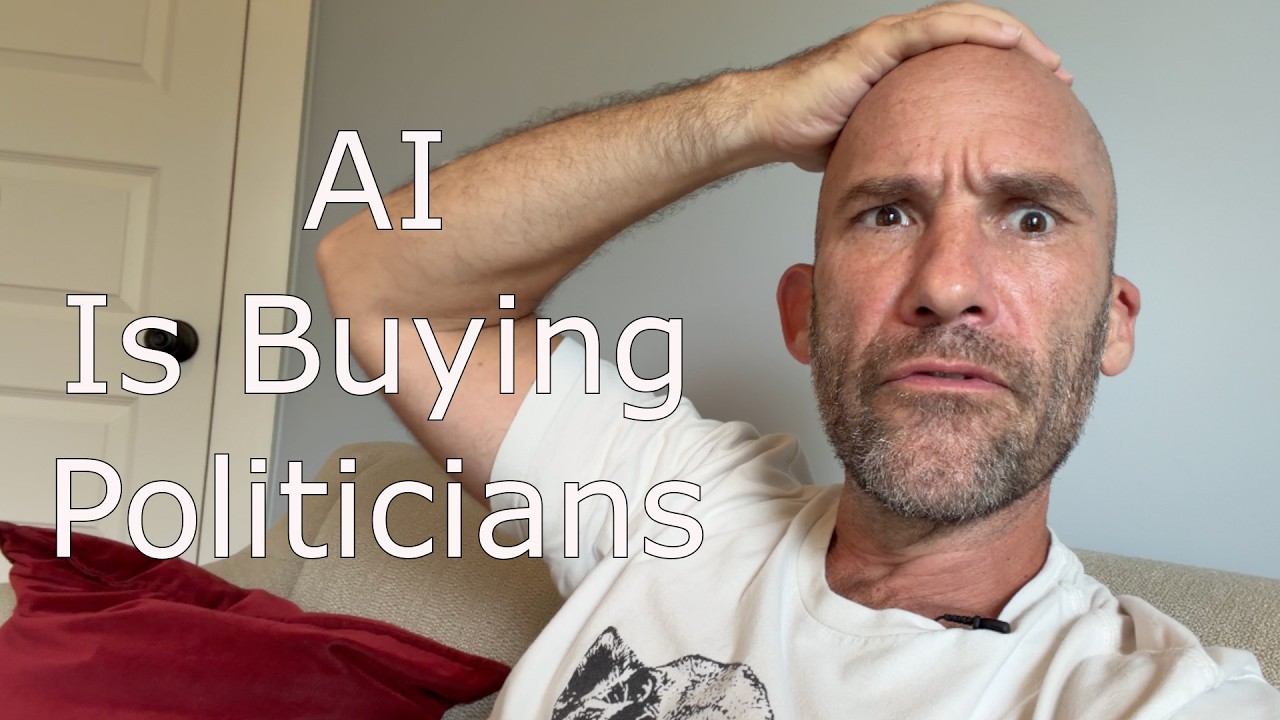
Major AI companies like OpenAI and Anthropic are heavily increasing their government lobbying efforts to secure support and potential bailouts amid doubts about their business viability and inflated valuations. The video warns that these companies are built on weak foundations, with political hype and lobbying masking the true, limited value of AI technology, potentially leading to an unsustainable bubble fueled by government intervention.
The video discusses the increasing lobbying efforts by major AI companies like OpenAI and Anthropic as they face significant challenges in becoming viable businesses. Despite their high valuations—OpenAI aiming for a $1 trillion valuation and Anthropic valued near $960 billion—the speaker argues these companies are fundamentally flawed and not worth such astronomical amounts. The companies are heavily investing in government lobbying, hoping to secure support and possibly bailouts to sustain their operations amid growing doubts about their actual business viability.
A key point raised is the problematic foundation upon which these AI companies are built. The speaker criticizes the technology and business models as weak and unsustainable, suggesting that no matter how much they build on top, the entire structure is likely to collapse. This “AI fraud” forces these companies to continually double down on lobbying and government influence to survive. The Trump administration’s consideration of sanctions against Chinese AI companies is highlighted as an example of political maneuvering influenced by these AI firms, who claim national security concerns to justify such actions.
The video also highlights the scale of lobbying spending by AI companies compared to traditional tech giants. OpenAI and Anthropic significantly increased their lobbying expenditures in the second quarter of 2026, spending millions to influence Washington ahead of midterm elections and IPOs. Their lobbying efforts focus on issues like cybersecurity, copyright, cloud computing, and defense procurement. This spending is notable given that these AI companies are still losing money, raising questions about the sustainability and ethics of their political investments.
Political responses to AI’s rise are also scrutinized, with figures like Bernie Sanders proposing radical ideas such as taking 50% equity in AI companies to redistribute profits to Americans. The speaker expresses skepticism about such proposals, given the financial instability of these companies and the unclear real-world value of AI technology. The discussion emphasizes that most politicians and the general public do not understand the underlying technology, leading to hype and inflated valuations disconnected from actual technological worth.
Finally, the video questions the future of AI amid this lobbying frenzy and inflated valuations. It challenges viewers to consider the true value of AI technologies like neural networks and transformer architectures, suggesting that the hype around AI as a multi-trillion-dollar market is largely driven by buzzwords rather than substance. The speaker warns of a potential AI bubble burst but worries that government inertia and political interests may continue to funnel resources into AI regardless of its real value, creating a problematic scenario for the economy and innovation.