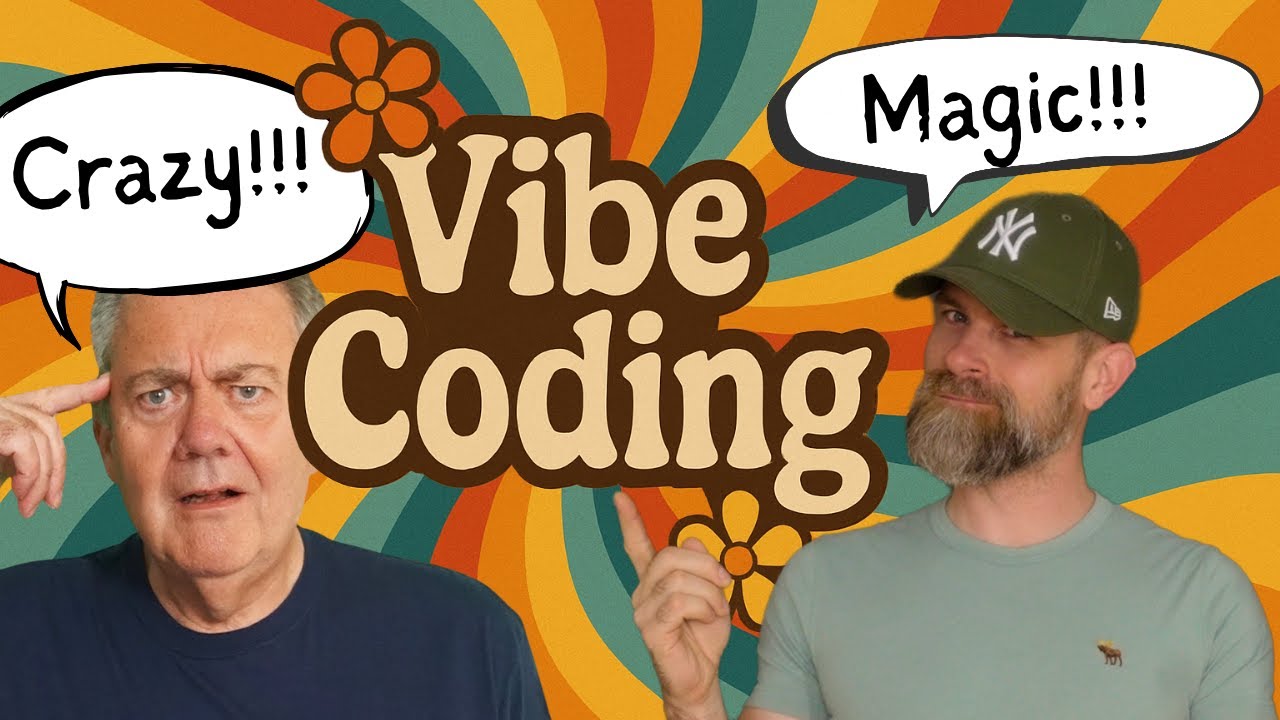
In this video, the speaker reacts to Dave Farley’s recent post about “vibe coding,” a term coined by Andrej Karpathy to describe creating software with AI without ever looking at the generated code, focusing solely on the end result. While acknowledging Farley’s valid concerns about vibe coding being potentially problematic for software engineers—especially regarding control, security, and maintainability—the speaker argues that Farley misses the broader opportunity vibe coding presents. The speaker emphasizes that vibe coding is not about replacing experienced engineers but about exploring new ways to accelerate and improve parts of the software development process.
The speaker explains that vibe coding is particularly well-suited for requirements engineering and prototyping. It allows product managers, UI/UX experts, and non-technical stakeholders to “code” features themselves, not just describing but demonstrating behavior and user experience. This approach can significantly shorten the feedback loop between idea and customer validation, enabling faster iterations and clearer communication. The mantra “Show, don’t tell” replaces ambiguous specifications with tangible, interactive prototypes, reducing misunderstandings and aligning expectations among developers, testers, and product owners.
Despite the enthusiasm for vibe coding’s potential, the speaker cautions against overestimating AI’s current capabilities. Complex, evolving software projects require careful balancing of modularity, performance, and maintainability—areas where AI-generated code still falls short. The speaker agrees with Farley that AI cannot yet replace senior engineers and that vibe coding is not suitable for production-level software, especially where privacy and security are critical. However, the speaker highlights that vibe coding can simplify mundane or time-consuming tasks, freeing engineers to focus on higher-value work.
The video also addresses the risks of vibe coding being marketed as a shortcut for non-experts to create software, warning that this could lead to poor-quality outcomes and misunderstandings about software development complexity. The speaker references the Dunning-Kruger effect to explain why some might be misled into thinking vibe coding is an easy fix. Responsible use of AI tools and clear understanding of their limitations are essential to avoid these pitfalls and harness vibe coding’s benefits effectively.
In conclusion, the speaker sees vibe coding as a game-changer that complements traditional software engineering rather than replacing it. It offers a new paradigm for rapid prototyping, clearer communication, and productivity gains, especially in early-stage development and feature validation. While acknowledging the challenges and current limitations, the speaker encourages product managers and stakeholders to familiarize themselves with vibe coding to leverage its potential responsibly. The video ends with a call for civil discussion and an invitation to subscribe for more content.